Astronomy
01
Webb’s First Deep Field: The Infrared Image That Opened a New Window on the Early Universe
Revisiting NASA’s landmark July 2022 image of galaxy cluster SMACS 0723, which revealed thousands of galaxies and demonstrated the James Webb Space Telescope’s infrared capabilities.
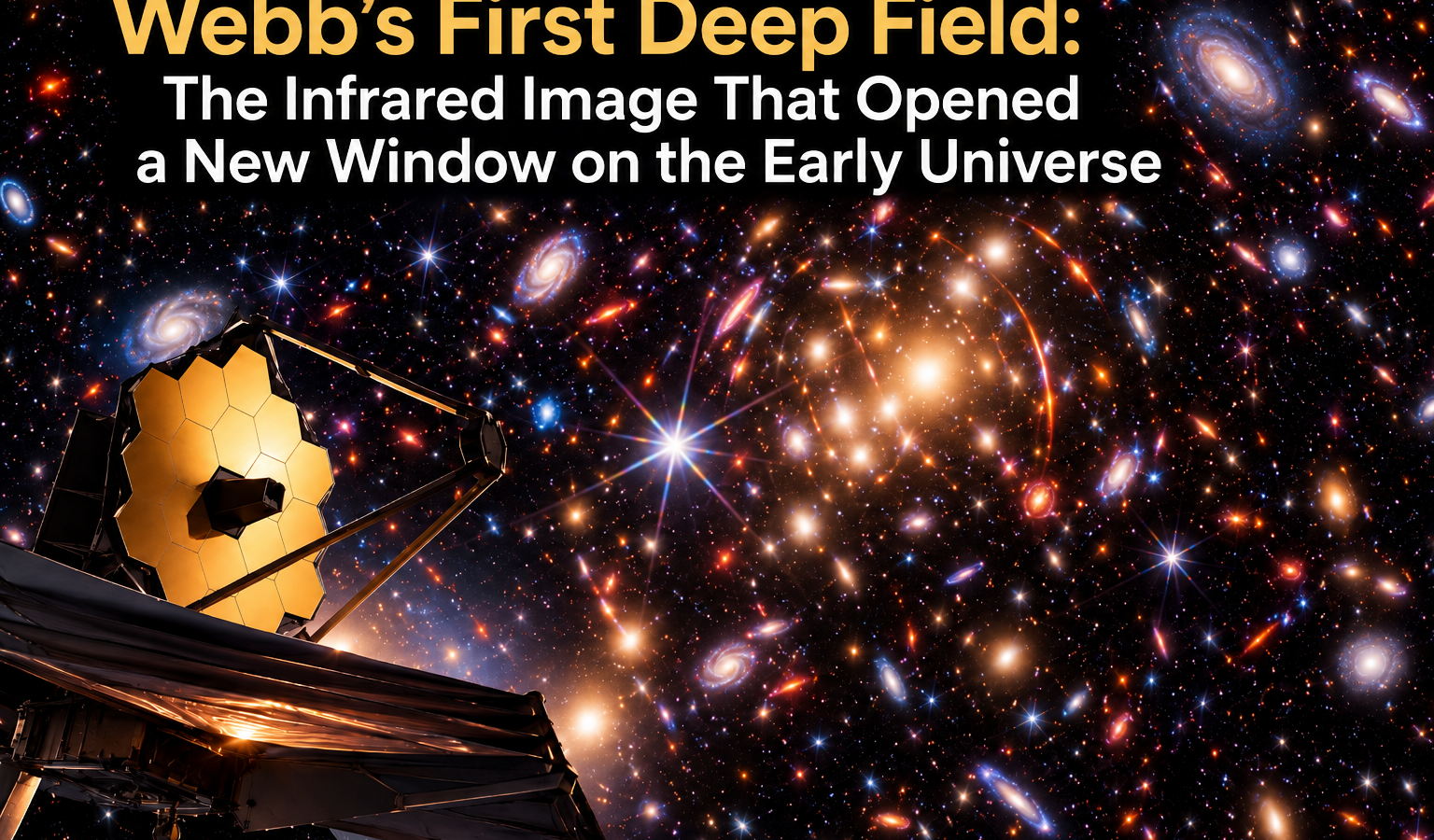
Released in July 2022, Webb’s First Deep Field targeted the galaxy cluster SMACS 0723. The cluster is seen as it was about 4.6 billion years ago, while the image also contains much more distant galaxies whose light traveled for billions of years before reaching the telescope.
Webb’s Near-Infrared Camera combined observations at different wavelengths totaling 12.5 hours. The resulting view contains thousands of galaxies in a patch of sky comparable to a grain of sand held at arm’s length.
The cluster’s gravity bends and magnifies light from galaxies behind it, creating stretched arcs through gravitational lensing. This natural magnification allows astronomers to investigate otherwise faint objects from the early universe.
Webb’s spectroscopy complemented the image. Its NIRSpec instrument observed 48 galaxies simultaneously, and one measured signal came from a galaxy whose light had traveled 13.1 billion years.
Analysis
The scientific advance was not simply a spectacular photograph. Combining sensitive infrared imaging, gravitational lensing and spectroscopy gave researchers new ways to measure the physical properties and evolution of distant galaxies. This is a retrospective on a 2022 milestone, not a new discovery in October 2026.
Key Takeaway
Webb’s first deep field demonstrated how infrared observations and gravitational lensing can reveal galaxies from the universe’s earliest epochs.