

RKE / RISOLNET KNOWLEDGE ENGINE
DAILY SCIENCE & TECHNOLOGY BRIEF
Today’s science and technology briefing explores five different frontiers united by a common principle: understanding complex systems well enough to control them. The James Webb Space Telescope reveals the turbulent environment of stellar birth, the 2026 Chemistry Nobel celebrates molecular handedness, Microsoft introduces stronger execution boundaries for AI agents, artificial intelligence helps stabilize mRNA vaccines, and Samsung reports extraordinary preliminary earnings driven by demand for AI memory.
Astronomy & Space
01
James Webb Reveals a Spectacular Stellar Nursery in NGC 7129
A new infrared image exposes young stars, powerful protostellar jets and intricate gas structures within a star-forming region approximately 3,300 light-years from Earth.

The NASA/ESA/CSA James Webb Space Telescope has revealed a remarkably detailed view of NGC 7129, a stellar nursery located in the constellation Cepheus. Its infrared sensitivity allows astronomers to examine stars and protostars that were previously obscured by dense clouds of dust.
The region contains stars at different stages of development. One of its most prominent objects, LkHα 234, is a young pre-main-sequence star estimated to have between five and eight times the mass of the Sun.
Golden regions in the image trace hot atomic hydrogen, while reddish structures reveal molecular gas affected by shocks from protostellar outflows. Webb’s improved resolution also exposes intricate filaments, cavities and background galaxies that were difficult to distinguish in earlier Spitzer observations.
Analysis
Established observations: Webb resolves young stars, protostellar jets and complex gas structures in considerably greater detail than previous infrared observations.
Scientific interpretation: Newly formed stars actively reshape their surroundings through radiation and energetic outflows. These processes can compress, heat or disperse nearby gas, influencing subsequent episodes of star formation.
Limitations: The image is a scientifically processed representation of infrared observations. Its colours correspond to assigned wavelength bands rather than direct human vision. Additional spectroscopic and dynamical studies are required to quantify the physical processes involved.
Biotechnology
02
2026 Chemistry Nobel Recognizes the Power of Molecular Handedness
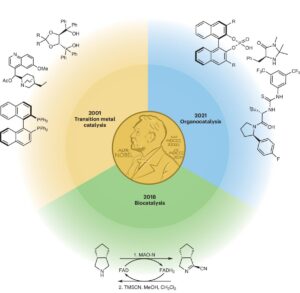
Henri B. Kagan and Kenso Soai receive the Nobel Prize for discoveries involving nonlinear effects and autocatalysis in asymmetric organic synthesis.
The 2026 Nobel Prize in Chemistry has been awarded to Henri B. Kagan and Kenso Soai for foundational discoveries concerning molecular chirality and asymmetric chemical reactions.
Many organic molecules can exist in two mirror-image configurations known as enantiomers. Although their chemical composition is identical, their three-dimensional structures differ in the same way that left and right hands differ.
This distinction is especially important in biology and pharmaceutical chemistry because different enantiomers may interact differently with enzymes, receptors and other molecular targets.
Kagan demonstrated that small differences in the chirality of catalysts can generate disproportionately large effects on reaction selectivity. Soai developed an autocatalytic reaction in which a chiral product promotes the formation of additional molecules with the same handedness.
Analysis
Established findings: Nonlinear asymmetric catalysis and autocatalytic amplification provide experimentally demonstrated mechanisms through which small molecular imbalances can become much larger.
Scientific interpretation: These discoveries are important for selective chemical synthesis and offer valuable models for investigating how biological systems may have developed strong preferences for particular molecular configurations.
Limitations: The discoveries do not establish a definitive explanation for the origin of biological homochirality. They demonstrate plausible amplification mechanisms rather than reconstructing the complete chemical history of early life.
Artificial Intelligence
03
Microsoft Execution Containers Introduce Stronger Security Boundaries for AI Agents

A new policy-driven execution layer aims to prevent autonomous AI agents from accessing file
s, networks and system resources beyond their assigned permissions.
Microsoft announced the general availability of Microsoft Execution Containers, or MXC, on October 7, 2026.
As AI agents become capable of writing code, modifying files and executing complex workflows, traditional application permissions are increasingly insufficient to manage the associated risks.
MXC allows developers and administrators to define which resources an agent can access. These permissions are enforced by the execution environment rather than by the agent’s own instructions.
An AI coding assistant, for example, may be permitted to modify a software repository and execute development tools while being prevented from changing production configuration files or accessing unrelated personal documents.
Microsoft identifies several agentic tools as compatible with MXC, including GitHub Copilot, OpenAI Codex and OpenClaw.
Analysis
Established capabilities: MXC provides policy-based restrictions on file access, network destinations and execution resources, with enforcement outside the agent’s direct control.
Technological significance: Agentic AI requires security mechanisms that remain effective even when a model generates unexpected instructions or executes untrusted code. Separating agent behaviour from authorization policy is therefore an important step toward enterprise adoption.
Limitations: Containment does not eliminate every security risk. Incorrectly configured permissions, harmful operations within an authorized scope and software vulnerabilities remain possible.
Life Sciences
04
AI-Guided Formulation Could Help Eliminate Cold-Chain Requirements for mRNA Vaccines
An experimental framework combines artificial intelligence and high-throughput testing to identify more temperature-resistant lipid nanoparticle formulations.
Researchers have developed AGENT, an AI-guided experimental framework designed to improve the thermal stability of mRNA vaccines carried by lipid nanoparticles.
The approach combines high-throughput experimentation with Bayesian optimization to identify promising formulations while minimizing the number of experiments required.
The researchers completed six optimization cycles in approximately one month and developed solid-state formulations that retained full measured bioactivity after storage at 37 degrees Celsius for more than two months.
Preclinical experiments also investigated immune responses and delivery through microneedle patches, suggesting potential alternatives to conventional refrigerated vaccine distribution.
Analysis
Established findings: AI-guided optimization accelerated formulation screening and identified lipid nanoparticle systems with substantially improved thermal stability under experimental conditions.
Scientific interpretation: Artificial intelligence may contribute to pharmaceutical development beyond molecular discovery, particularly in formulation engineering, manufacturing optimization and drug delivery.
Limitations: The results remain experimental and preclinical. They do not demonstrate that currently marketed mRNA vaccines can immediately be stored at room temperature, nor do they replace the need for regulatory validation and clinical studies.
Technology
05
Samsung Forecasts Approximately $80 Billion in Quarterly Operating Profit as AI Memory Demand Surges
The semiconductor manufacturer expects record third-quarter earnings as demand for advanced memory technologies continues to reshape the global electronics industry.
 Samsung Electronics announced preliminary earnings guidance for the third quarter of 2026, forecasting consolidated revenue of approximately 195 trillion Korean won and operating profit of approximately 107.4 trillion won.
The operating profit estimate is equivalent to roughly 80 billion US dollars and represents an increase of approximately 782.5% compared with the same quarter of 2025.
The extraordinary growth is being driven primarily by semiconductor demand associated with AI infrastructure expansion, particularly advanced memory technologies.
High Bandwidth Memory, or HBM, has become a strategically important component of modern AI accelerators because increasingly powerful processors require enormous quantities of data to be transferred at very high speeds.
Strong demand is also affecting conventional memory markets, contributing to higher component prices and creating additional cost pressure for manufacturers of computers, smartphones and other electronic devices.
Analysis
Established information: Samsung has officially released preliminary estimates for consolidated revenue and operating profit. These figures are guidance rather than finalized financial results.
Market interpretation: AI infrastructure spending is transforming memory manufacturing into a strategically critical industry. Competitive advantage increasingly depends on production capacity, advanced packaging and the ability to supply high-performance memory at scale.
Limitations: Exceptional current profitability does not guarantee indefinite growth. Additional manufacturing capacity, competition, currency movements and changes in AI investment could significantly affect future earnings.
The RKE Signal
The defining theme of today’s science and technology news is control. Webb reveals the physical processes shaping stellar birth. Kagan and Soai demonstrated how molecular asymmetry can be amplified and directed. Microsoft introduces execution boundaries for increasingly autonomous AI systems. AGENT uses computational optimization to improve pharmaceutical formulation stability. Samsung illustrates the strategic importance of controlling advanced semiconductor manufacturing capacity.
Scientific innovation becomes transformative when a phenomenon is understood well enough to be controlled, reproduced and scaled. Discovering that something works is only the beginning. Understanding why it works, when it fails and how to make it work reliably at scale is what turns research into technology.