



RKE / RISOLNET KNOWLEDGE ENGINE
DAILY SCIENCE & TECHNOLOGY BRIEF
Today’s selection is about making the invisible measurable. IceCube turns Antarctic ice into a neutrino telescope, SMILE observes an entire auroral oval from space, Visionary AI extracts systemic vascular information from the retina, Mistral scales an open-weight European model beyond one trillion parameters, and AMD prepares the physical semiconductor supply chain required to sustain the AI boom.
Astronomy & Space
01
Francis Halzen Wins the 2026 Physics Nobel for Opening the Neutrino Sky
The IceCube principal investigator is recognized for decisive contributions to the Antarctic observatory and the discovery of high-energy neutrinos of astrophysical origin.
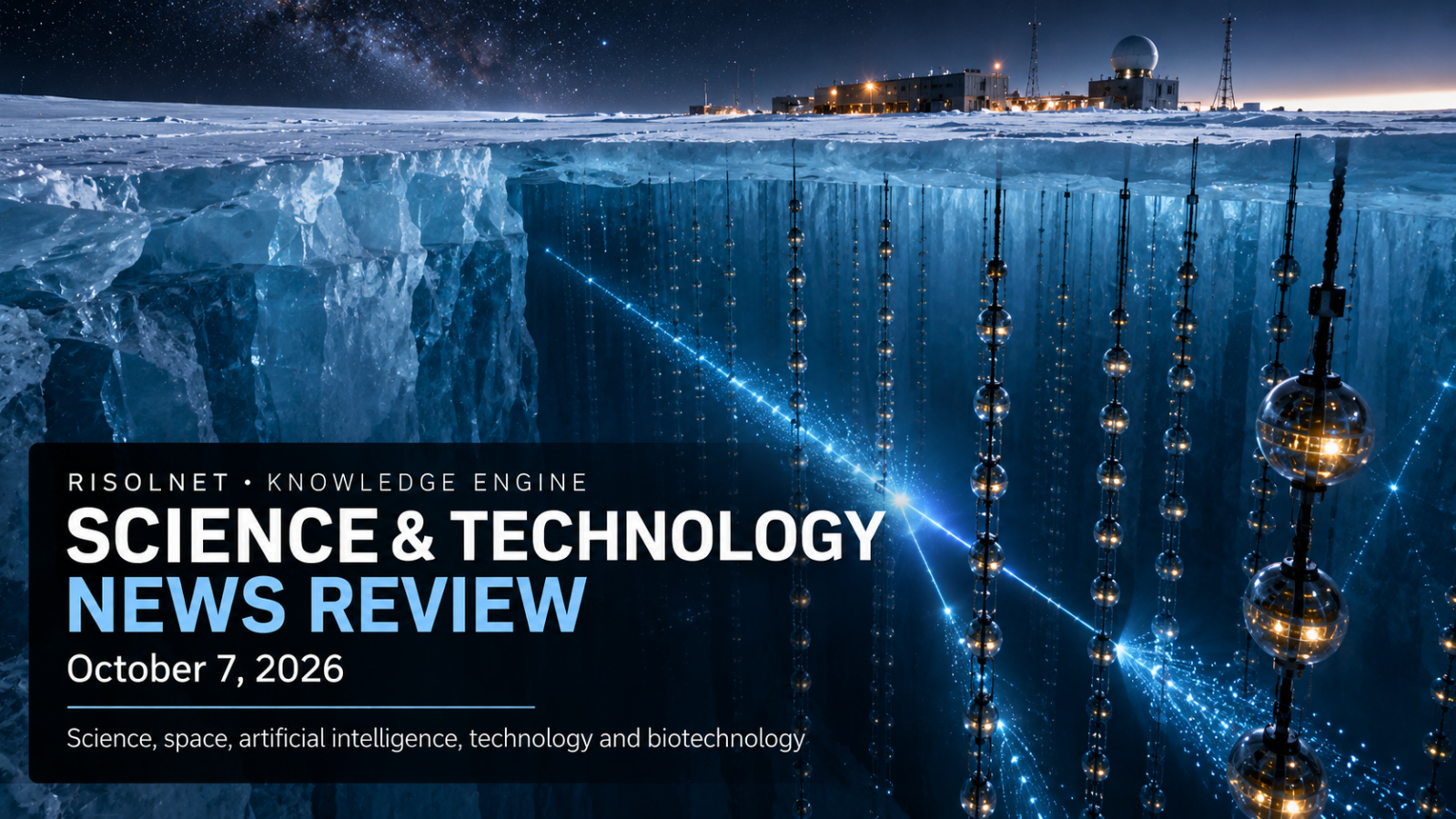
The 2026 Nobel Prize in Physics has been awarded to Francis Halzen for his decisive contributions to the IceCube Neutrino Observatory and the discovery of high-energy astrophysical neutrinos.
IceCube instruments roughly a cubic kilometre of pristine Antarctic ice with optical detectors that record Cherenkov light generated after neutrino interactions. The observatory established an astrophysical high-energy neutrino flux in 2013 and has since reported evidence connecting neutrinos with extragalactic sources including TXS 0506+056 and NGC 1068, as well as emission from the Milky Way.
Analysis
IceCube helped establish neutrino astronomy as a practical observational discipline. Neutrinos can escape environments that are opaque to electromagnetic radiation, providing information complementary to photons, cosmic rays and gravitational waves.
Their extremely weak interaction with matter is both their scientific advantage and their experimental limitation. Detection rates remain low, requiring enormous detector volumes and long observing periods. The proposed IceCube-Gen2 would substantially increase the instrumented volume and sensitivity.
Astronomy & Space
02
SMILE Captures a Complete Auroral Oval from Space
Ultraviolet observations reveal the full auroral structure around Earth’s magnetic pole and show how rapidly it changes as the solar wind interacts with the magnetosphere.
The ESA–Chinese Academy of Sciences SMILE mission has observed a complete auroral oval from orbit. Such a global view cannot be obtained from the ground because the auroral structure spans a vast region around a magnetic pole.

A time-lapse covering roughly one hour shows the oval changing rapidly. SMILE’s broader scientific goal is to study how the solar wind transfers energy into Earth’s magnetosphere and ultimately produces phenomena including auroras.
Analysis
Global imaging complements point measurements made by satellites within the magnetosphere, allowing researchers to study solar-wind interactions as a connected system. Better understanding of these processes is relevant to space-weather forecasting and the protection of satellites, astronauts and electrical infrastructure.
The auroral oval is a visible consequence of magnetospheric activity rather than a direct image of the complete magnetosphere, so interpretation requires combining it with other measurements.
Artificial Intelligence
03
Mistral Large 4 Crosses the One-Trillion-Parameter Mark
Europe’s Mistral AI has launched a public preview of its largest model yet, combining a sparse Mixture-of-Experts architecture, multimodal capabilities and a one-million-token context window.
Mistral Large 4 is a natively multimodal Mixture-of-Experts model with approximately 1.05 trillion total parameters and about 49 billion active parameters. It also includes a 1.6-billion-parameter vision encoder and supports context windows of up to one million tokens.
The model is currently available through a public-preview API. Mistral says the weights will be released on October 26, following a preview period intended to support further evaluation of the model’s capabilities and behaviour.
Analysis
The total parameter count is less informative than it appears because the sparse architecture activates only a fraction of the model for each token. More strategically, a competitive European open-weight model expands options for local deployment, customization and technological sovereignty.
Performance claims in cybersecurity, finance, manufacturing and multimodal tasks currently rely heavily on Mistral’s own evaluations. Independent benchmarking will be necessary before firm comparisons with competing frontier and open-weight models can be made.
Life Sciences
04
Visionary AI Uses the Retina to Predict Preeclampsia Risk Before Symptoms
An interpretable system converts retinal images into quantitative maps of microvascular structure, revealing signatures associated with hypertensive disorders of pregnancy before clinical onset.
A study published in Nature Biotechnology introduces Visionary AI, an interpretable platform that analyzes retinal vascular topology, geometry, branching and network complexity to predict hypertensive disorders of pregnancy.
In a prospective development cohort of 1,267 pregnancies, the model achieved an AUC of 0.91 and average precision of 0.81 for preeclampsia. A stability-optimized model transferred without retraining to an independent external cohort and achieved an AUC of 0.81 and average precision of 0.68.
Analysis
The work supports the concept of the maternal retina as a minimally invasive window into systemic vascular health. Unlike a purely black-box image classifier, the framework derives biologically interpretable vascular features that may reflect endothelial and placental dysfunction.
The findings are promising rather than clinically definitive. The independent validation cohort contained only 79 participants, and much larger multi-centre studies will be required before retinal AI can become a routine screening tool.
Technology
05
AMD Prepares a Major Expansion of AI Chip Supply for 2027
The semiconductor company is working across Taiwan and South Korea to secure advanced wafer capacity, manufacturing partnerships and memory supply for the next phase of AI infrastructure growth.
AMD CEO Lisa Su says the company plans to substantially increase chip supply in 2027 as demand for AI processors continues to grow. During a visit to Taiwan, Su met manufacturing partners including Foxconn and planned discussions with TSMC regarding additional advanced production capacity.
The trip also includes South Korea, where AMD is seeking memory supply from manufacturers including Samsung and SK hynix. Su said the company is planning its capacity requirements on a three-to-five-year horizon.
Analysis
Competition in AI hardware increasingly extends beyond processor architecture into the entire manufacturing chain: advanced wafers, packaging, high-bandwidth memory, networking and data-centre infrastructure. Securing capacity years in advance is therefore becoming a strategic requirement.
AMD has not publicly quantified the planned supply increase. Greater manufacturing capacity also does not automatically translate into market share, particularly against Nvidia’s established AI hardware and software ecosystem.
The RKE Signal
Today’s common thread is instrumentation. IceCube makes almost invisible particles observable. SMILE turns auroral activity into a global image. Visionary AI converts retinal microvasculature into quantitative biomarkers. Mistral uses sparse architecture to make a trillion-parameter model computationally manageable, while AMD must translate abstract AI demand into physical semiconductor capacity. Scientific progress often begins not with a new theory, but with a new way of measuring something that was previously beyond reach.