RKE / RISOLNET KNOWLEDGE ENGINE
DAILY SCIENCE & TECHNOLOGY BRIEF
From a remarkable cosmic structure shaped by black-hole activity to experimental techniques for programming immune cells inside the body, this edition explores five developments at the intersection of observation, computation and biological engineering.
The research window covers developments published between October 13 and 18, 2026, with information reviewed on October 18 at approximately 13:00 Central European Summer Time. This edition was prepared later than the usual morning publication time.
The central question is not simply what researchers have discovered, but how confidently those findings can be interpreted and how far they remain from practical application.
Astronomy & Space
01
Chandra Investigates the Cosmic Origins of the Treble Clef
A striking radio structure appears to preserve the history of a supermassive black hole and a collision between galaxy clusters.
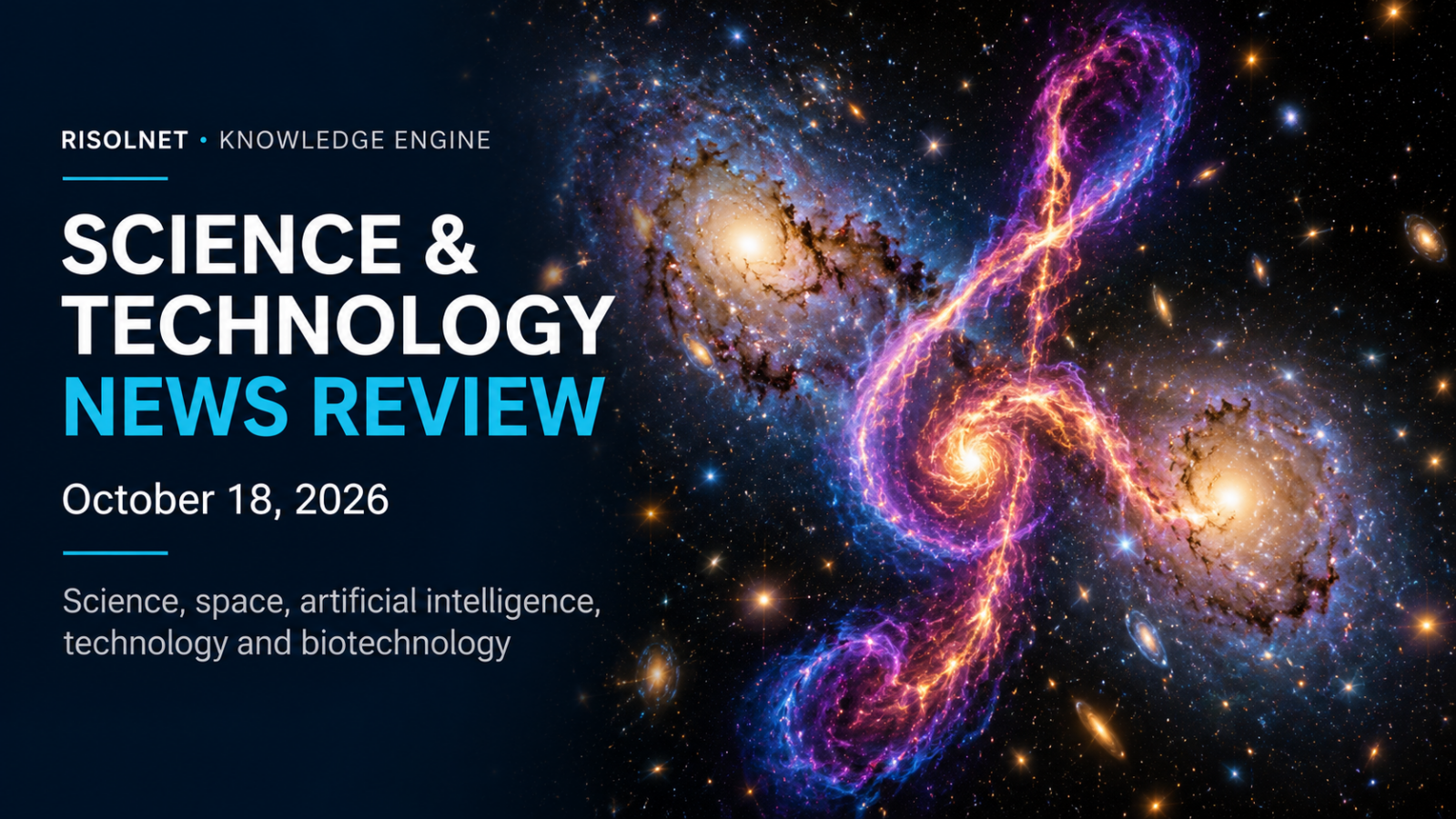
On October 14, NASA presented new findings about an extraordinary astronomical structure nicknamed the Treble Clef because its radio emission resembles the familiar musical symbol.
Astronomers used observations from NASA’s Chandra X-ray Observatory together with radio and infrared data to investigate the physical processes responsible for its unusual appearance.
The researchers propose that the structure was shaped by two major events: an energetic outburst associated with a supermassive black hole, followed by the collision of two galaxy clusters.
Such interactions can disturb enormous quantities of hot gas and influence the distribution of energetic particles and magnetic fields throughout the surrounding environment.
The investigation was particularly challenging because the structure lies almost directly behind the plane of the Milky Way. Stars, gas and dust within our own galaxy obscure the region, making observations at multiple wavelengths essential.
The result illustrates why modern astronomy increasingly depends on combining different observational techniques. X-ray, radio and infrared measurements reveal different components of the same physical system, allowing astronomers to reconstruct events that unfolded over immense timescales.
Analysis
Established facts: NASA reported the multiwavelength investigation on October 14, 2026. The research concerns a radio structure associated with galaxy-cluster interactions and black-hole activity.
Interpretation: The proposed sequence of black-hole activity followed by cluster collision offers a physical explanation for the structure’s unusual morphology.
Limitations: The reconstruction remains an interpretation of astronomical observations rather than a direct recording of the events. Foreground material in the Milky Way complicates the analysis.
Artificial Intelligence
02
Artificial Intelligence Reveals New Links Between Brown Fat and Human Health
A large clinical analysis uses machine learning to investigate metabolically active adipose tissue and its associations with cardiovascular, metabolic and psychiatric conditions.
A study published in Nature on October 14, 2026, demonstrates how artificial intelligence can help investigate the biological significance of brown adipose tissue in humans.
Unlike white adipose tissue, which primarily stores energy, brown adipose tissue consumes energy to generate heat. Its metabolic activity has attracted considerable scientific interest because of possible connections with cardiovascular and metabolic health.
The researchers analyzed clinical information from 101,243 patients at a major cancer center. Their investigation identified associations between detectable brown fat and lower prevalence of several cardiovascular and psychiatric conditions.
Using machine-learning techniques, the team also semi-automatically quantified brown-fat activity in approximately 8,700 patients.
Higher activity, particularly in axillary brown-fat deposits, was associated with more favorable cardiometabolic characteristics and healthier white-fat distribution.
The researchers also investigated medication use. They identified a positive association between angiotensin receptor blockers and brown-fat presence, then explored the biological effects of losartan in proof-of-concept experiments.
The broader significance lies in the ability to extract biological information from large collections of clinical imaging data. Artificial intelligence makes it possible to investigate relationships that would be difficult to quantify manually across thousands of patients.
Analysis
Established facts: The study analyzed 101,243 patients and used machine learning to quantify brown-fat activity in approximately 8,700 individuals. The authors reported associations with several favorable health indicators.
Interpretation: Brown-fat activity may represent a useful biological marker and a potential target for future metabolic research. The findings also illustrate how artificial intelligence can support large-scale clinical phenotyping.
Limitations: Observational associations do not establish that brown fat directly prevents disease. The patient population and imaging methods may introduce selection effects. The findings do not establish losartan or other medications as approved treatments for activating brown fat.
Biotechnology
03
Lipid Nanoparticles Engineer CAR Natural Killer Cells Inside the Body
An experimental delivery platform uses targeted nanoparticles to introduce genetic instructions into natural killer cells without first removing those cells from the organism.
Research published in Nature Biotechnology on October 13, 2026, describes an approach to engineering natural killer cells directly inside living organisms.
Natural killer cells are components of the innate immune system. They can recognize and destroy certain infected or abnormal cells, making them attractive candidates for cancer immunotherapy and other immune-based treatments.
Conventional cellular engineering often involves collecting cells, modifying them outside the body and subsequently administering them to a patient. This process can be technically demanding and expensive.
The researchers developed targeted lipid nanoparticles designed to deliver messenger RNA into natural killer cells. Engineered ligands on the nanoparticle surface promote receptor-specific uptake.
According to the published abstract, the leading formulations achieved approximately 80 percent natural killer cell transfection in mice, with limited off-target effects in the tested systems.
Delivery of messenger RNA encoding chimeric antigen receptors generated CAR natural killer cells in vivo.
The researchers reported depletion of circulating B cells using CD19-targeted CAR natural killer cells and elimination of most autoreactive T cells in an experimental autoimmune hepatitis model using CD3-targeted cells.
The platform was also investigated in tumor models, including humanized hematologic malignancy models, where the authors reported antitumor activity.
The technological idea is particularly interesting: instead of manufacturing a modified immune-cell product entirely outside the body, a delivery system supplies the molecular instructions needed to generate the desired cellular function in vivo.
Analysis
Established facts: The published abstract reports targeted messenger RNA delivery to natural killer cells, in vivo generation of CAR natural killer cells and activity in several experimental disease models.
Interpretation: If successfully translated into clinical practice, targeted nanoparticle delivery could simplify some forms of cellular immunotherapy and expand the range of possible immune-cell engineering strategies.
Limitations: These are preclinical results. Mouse experiments and humanized models do not establish safety or efficacy in patients. The full article was not available for unrestricted review, so this summary is limited to the accessible abstract and publication metadata.
Life Sciences
04
Precise Stimulation of Motor-Cortex Neurons Can Trigger Learned Movements in Mice
A neuroscience experiment identifies conditions under which activating a small group of neurons can reproduce aspects of a previously learned motor behavior.
A study published in Nature on October 14, 2026, investigates how neural activity in the primary motor cortex contributes to the execution of learned movements.
Researchers combined two-photon calcium imaging with holographic optogenetic stimulation in mice trained to perform a skilled lever-pressing task.
The technique allowed the team to observe neural activity and selectively stimulate small groups of neurons associated with particular phases of the learned behavior.
Brief synchronous stimulation of approximately 20 neurons whose activity normally preceded movement onset was sufficient, under appropriate conditions, to induce movements resembling the learned action.
The stimulation also generated patterns of activity in other motor-cortex neurons that resembled those observed during normal execution of the task.
Importantly, the results depended on the animal’s behavioral state and on which neurons were stimulated. The same intervention did not reliably produce the learned movement when animals were disengaged from the task.
Stimulating neurons whose activity normally followed movement onset also failed to reproduce the learned action.
These findings support the hypothesis that specific neural populations in the motor cortex actively contribute to generating learned movement patterns, rather than merely reflecting movements initiated elsewhere.
Analysis
Established facts: The researchers used targeted optogenetic stimulation and neural imaging to demonstrate context-dependent induction of learned movement patterns in mice.
Interpretation: The results strengthen evidence that precisely timed activity in specific motor-cortex ensembles can play a causal role in generating learned actions.
Limitations: The experiments involved mice performing a particular trained task. They do not demonstrate a general method for controlling complex human movements or establish a clinical neurostimulation treatment.
Technology
05
NASA Launches New Research Cargo and Solar Arrays Toward the International Space Station
A commercial resupply mission combines scientific experiments, station logistics and additional power-generation hardware for the orbiting laboratory.
NASA announced the successful launch of SpaceX’s 35th commercial resupply mission to the International Space Station on October 13, 2026.
A Falcon 9 rocket carrying a Dragon spacecraft lifted off from Space Launch Complex 40 at Cape Canaveral Space Force Station in Florida at 6:33 a.m. Eastern Daylight Time.
The spacecraft carried more than 6,300 pounds of supplies and hardware, including new scientific investigations and equipment intended to support continued operations aboard the International Space Station.
Among the most significant components was the final pair of International Space Station Roll-Out Solar Arrays, commonly known as iROSAs.
These deployable solar arrays are designed to supplement the station’s existing power-generation infrastructure.
Electrical power is a fundamental resource aboard the station. Scientific instruments, environmental control systems, communications equipment and many other essential technologies depend on reliable power availability.
The mission therefore illustrates an important aspect of space research that receives less attention than dramatic discoveries: maintaining and upgrading the infrastructure required to conduct experiments in orbit.
The launch is also an example of the increasingly established role of commercial transportation systems in supporting government-operated scientific infrastructure.
Analysis
Established facts: NASA confirmed the October 13 launch and reported that Dragon carried more than 6,300 pounds of supplies and hardware, including the final pair of station roll-out solar arrays.
Interpretation: Continued investment in orbital infrastructure supports scientific productivity and provides operational experience relevant to future space facilities.
Limitations: A successful launch does not by itself demonstrate completion of every subsequent mission objective. The original launch announcement should not be interpreted as confirmation that all equipment was installed or operational.
The RKE Signal
Scientific progress increasingly depends on understanding how complex systems respond to precisely defined interventions.
Astronomers reconstruct the history of a cosmic structure by combining observations across different wavelengths. Artificial intelligence extracts metabolic information from large clinical datasets. Targeted nanoparticles deliver genetic instructions to immune cells. Neuroscientists investigate how stimulation of selected neural populations influences learned movements. Engineers expand the power infrastructure supporting research in orbit.
These developments differ in scale, from individual neurons to galaxy clusters, but they share a methodological principle: reliable understanding requires careful measurement, controlled investigation and explicit recognition of uncertainty.
The most important distinction remains the boundary between what has been demonstrated and what may become possible. A compelling mechanism or successful experiment is the beginning of scientific validation, not its conclusion.
Note: For technical reasons, this news review doesn’t contains any image,
we apologize for that.