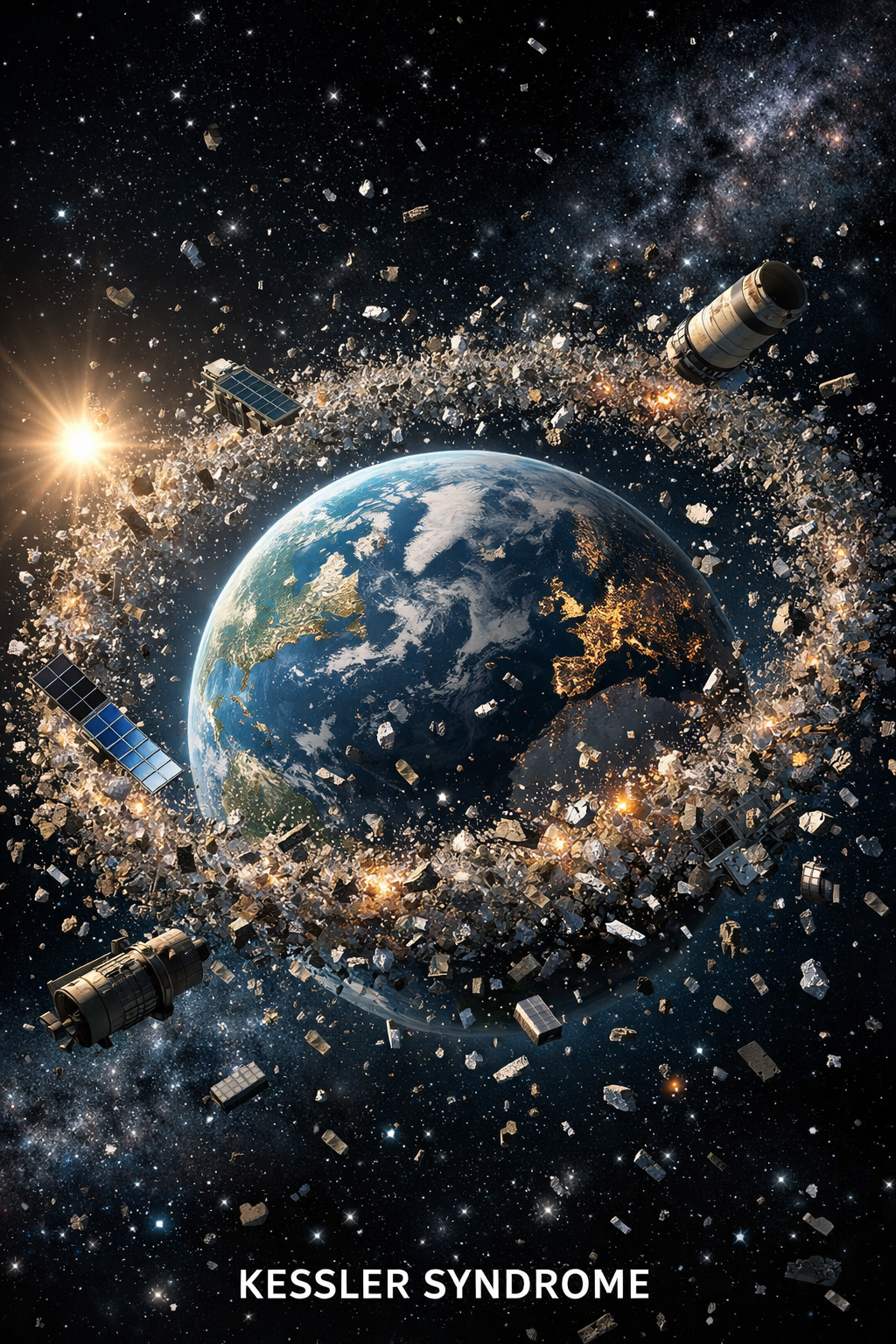
🌍🛰️ What is Kessler Syndrome?
The Kessler Syndrome is a theoretical scenario proposed in 1978 by astrophysicist Donald J. Kessler.
It describes what happens when the density of space debris in low Earth orbit (LEO) exceeds a critical threshold.
In practice:
- A satellite collides with another object
- The collision generates thousands of fragments
- Those fragments hit other satellites
- New debris shower
- Uncontrollable chain reaction
A kind of cosmic domino effect, but at 28,000 km/h.
🔬 Why it’s a serious problem (spoiler: very serious)
If the syndrome really kicks in:
- ❌ Some orbits become unusable for decades or centuries
- 📡 Satellites for GPS, telecommunications, and weather at risk
- 🚀 More dangerous and expensive space launches
- 🧑🚀 ISS and future stations with increased risk
- 🌐 Internet, navigation, finance… suddenly less reliable
In short, digital civilization with a slight existential crisis.
🧠 Has it happened before?
Not quite, but we came very close:
- Cosmos 2251 – Iridium 33 collision (2009)
- Military anti-satellite tests that created clouds of debris
- Thousands of satellites launched in a few years (hello, mega-constellations)
We’re currently in the phase called:
“Still manageable, but let’s stop being idiots”
🛠️ Can it be avoided?
Yes, in theory:
- Controlled deorbiting of end-of-life satellites
- Continuous debris tracking
- Automatic evasive maneuvers
- Space debris removal technologies Space debris removal (nets, harpoons, lasers… no, it’s not science fiction)
The problem isn’t physics. It’s human coordination. Worse.
🧩 Brutal summary
- is not a clinical syndrome
- is a potential orbital catastrophe
- caused by too many objects and too much carelessness
- avoidable only with global discipline
And no, space isn’t infinite as we like to think. Useful orbit is a limited resource. Just like common sense…