Introduction
Kepler’s laws are a set of three laws of planetary motion developed by the German astronomer Johannes Kepler in the 17th century. These laws describe the motion of the planets around the Sun and are still used today to explain the motion of planets and other objects in the Solar System. Kepler’s laws are fundamental to our understanding of the Solar System and have been used to discover new planets and calculate the orbits of comets and asteroids. In this introduction, we will discuss Kepler’s three laws and their implications for our understanding of the Solar System.
Exploring Kepler’s Laws of Planetary Motion: How They Changed Astronomy
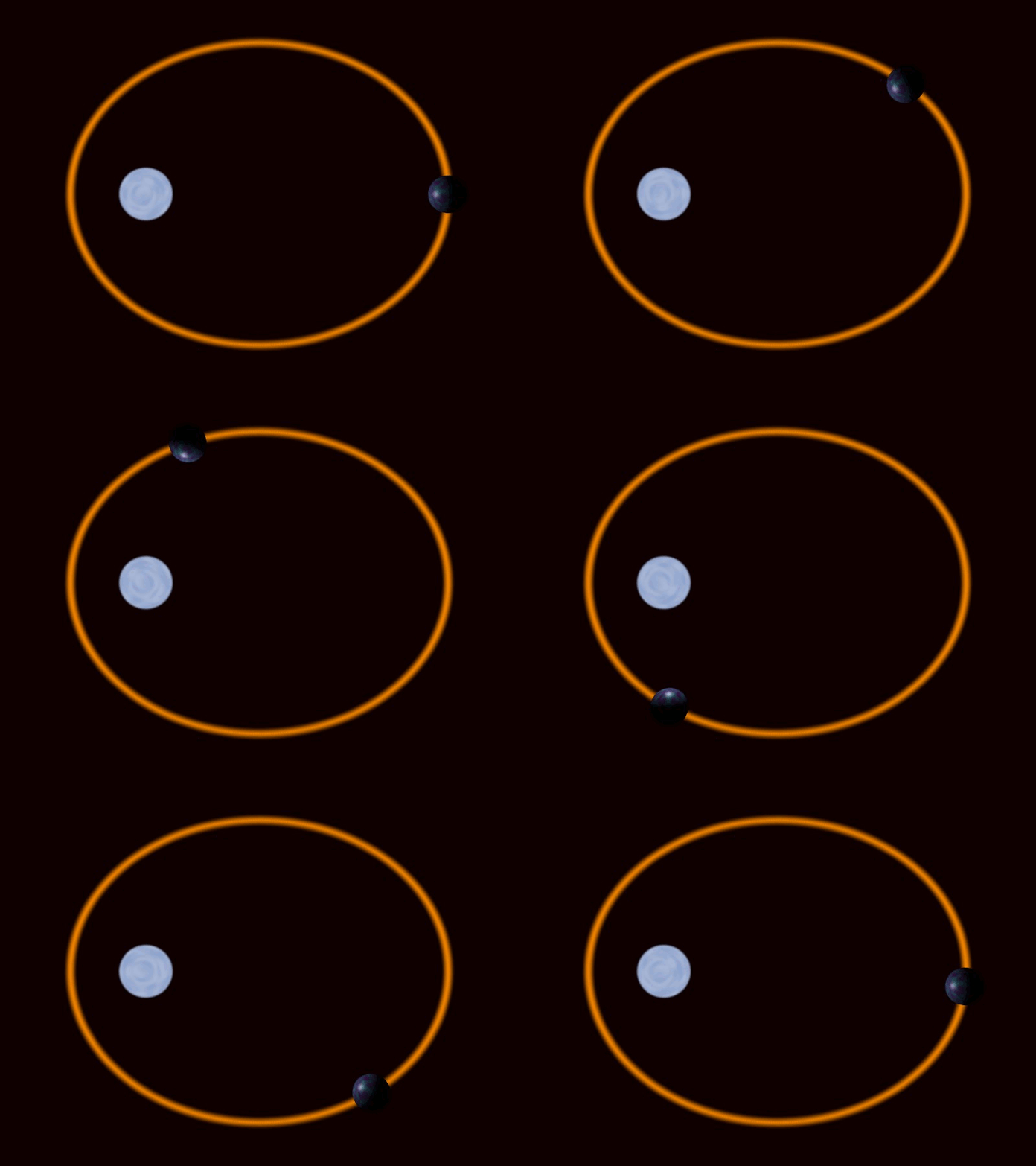
The first law states that the orbits of the planets are ellipses, with the Sun at one focus. This law overturned the long-held belief that the planets moved in perfect circles, providing a more accurate description of their motion. The second law states that a planet’s speed is not constant, but varies as it moves along its orbit. This law explains why the planets appear to speed up and slow down as they move around the Sun. The third law states that the square of a planet’s orbital period is proportional to the cube of its mean distance from the Sun. This law explains why planets farther from the Sun take longer to complete their orbits.
Kepler’s Laws of Planetary Motion revolutionized the field of astronomy by providing a more accurate description of the motion of planets in the Solar System. They also laid the foundation for modern physics, as they provided a mathematical description of the motion of objects in space. By understanding the motion of the planets, astronomers were able to make more accurate predictions about future planetary positions. This allowed them to make more accurate predictions about eclipses and other astronomical phenomena.
Kepler’s Laws of Planetary Motion also provided a basis for Newton’s law of universal gravitation, which states that every object in the universe attracts every other object with a force proportional to the product of their masses and inversely proportional to the square of the distance between them. This law explains why the planets move in elliptical orbits around the Sun, and why they accelerate and slow down as they move along their orbits.
These laws can be expressed mathematically using the language of calculus. The first law can be expressed as an equation of the form y = ax^2 + bx + c, where a, b, and c are constants. The second law can be expressed as a differential equation of the form dy/dt = kx, where k is a constant. The third law can be expressed as an equation of the form T^2 = kr^3, where T is the orbital period and r is the semi-major axis. By examining the mathematical foundations of Kepler’s Laws of Planetary Motion, we can gain a better understanding of the motions of planets, moons, asteroids, and comets. These laws have been used to explain the motion of celestial bodies for centuries and continue to be an important part of modern astronomy.
Conclusion
Kepler’s Laws are a set of fundamental principles that describe the motion of the planets in our solar system. They are a testament to the power of mathematics and its ability to accurately describe the physical world. Kepler’s Laws provide a foundation for understanding the motion of planets and other celestial bodies and are still used today in the study of astronomy and astrophysics. The laws are a remarkable example of how mathematics can be used to explain the physical world and continue to be an important part of our understanding of the universe.