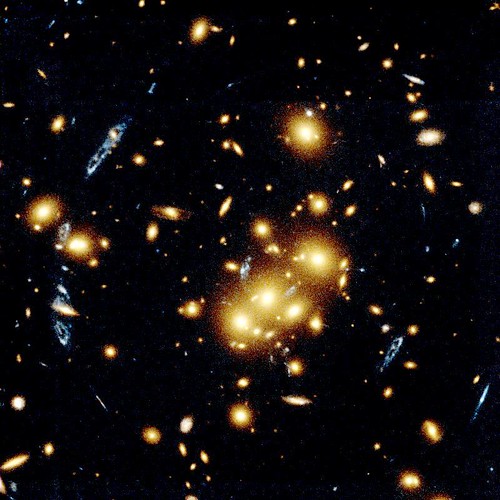
Exploring the Possibilities of Gravitational Lensing: How Astronomers Use This Phenomenon to Study the Universe
Gravitational lensing is a phenomenon in which the gravity of a massive object, such as a galaxy, bends and magnifies light from a distant source, such as a quasar. This phenomenon has been used by astronomers to study the universe in ways that would otherwise be impossible.
Gravitational lensing occurs when light from a distant source is bent by the gravity of a massive object, such as a galaxy, along its path to an observer. This bending of light makes the source appear brighter and magnified, and can also cause multiple images of the source to be seen. The amount of bending and magnification depends on the mass of the object, its distance from the source, and the distance between the object and the observer.
Astronomers use gravitational lensing to study the universe in a variety of ways. By measuring the amount of bending and magnification of light from a distant source, astronomers can determine the mass of the object causing the lensing. This can be used to study the distribution of dark matter in the universe, as well as to measure the mass of distant galaxies.
Gravitational lensing can also be used to study the properties of distant quasars. By measuring the amount of time it takes for light from a quasar to reach an observer, astronomers can determine the distance to the quasar and the size of the universe. This can be used to study the expansion of the universe and the nature of dark energy. Finally, gravitational lensing can be used to study the properties of black holes. By measuring the amount of light bent and magnified by a black hole, astronomers can determine the black hole’s mass and rotation. This can be used to study the evolution of black holes and the formation of galaxies.
Gravitational lensing is an invaluable tool for astronomers, allowing them to study the universe in ways that would otherwise be impossible. By measuring the amount of bending and magnifying of light from distant sources, astronomers can determine the mass of objects, the distance to quasars, and the properties of black holes. This phenomenon has opened up a wide range of possibilities for astronomers, allowing them to explore the universe in unprecedented detail.