RISOLNET • KNOWLEDGE ENGINE
SCIENCE & TECHNOLOGY NEWS REVIEW
The November 4 edition of the Risolnet Knowledge Engine explores five developments that demonstrate how scientific knowledge advances through precise measurements, improved instruments and increasingly sophisticated interpretations of complex systems.
At CERN, the LHCb collaboration has reported evidence of an exceptionally rare particle decay that could become a powerful test of the Standard Model. In Australia, researchers investigating a 115-million-year-old dinosaur fossil have identified chemical signatures associated with ancient blood, while debate continues over the interpretation of microscopic cell-like structures.
NASA satellite observations reveal the remarkable behavior of two powerful Pacific storm systems, illustrating how tropical cyclones can transform as they enter higher latitudes. Meanwhile, NASA’s twin ESCAPADE spacecraft are preparing for an unusual sequence of powered Earth flybys on their journey to Mars.
Finally, the European Space Agency’s Hera mission has achieved an important observational milestone by resolving the two components of the Didymos asteroid system, bringing its investigation of humanity’s first asteroid-deflection experiment closer to its next phase.
These stories include new experimental evidence, peer-reviewed research, satellite observations, mission announcements and operational milestones. Their scientific status differs, and the following analysis distinguishes established results from interpretations, unresolved questions and future objectives.
01
CERN’s LHCb Experiment Finds Evidence of an Exceptionally Rare Particle Decay
After decades of searching, physicists have identified a signal consistent with a beauty meson decaying into two muons, offering a new opportunity to test fundamental particle interactions with extraordinary precision.
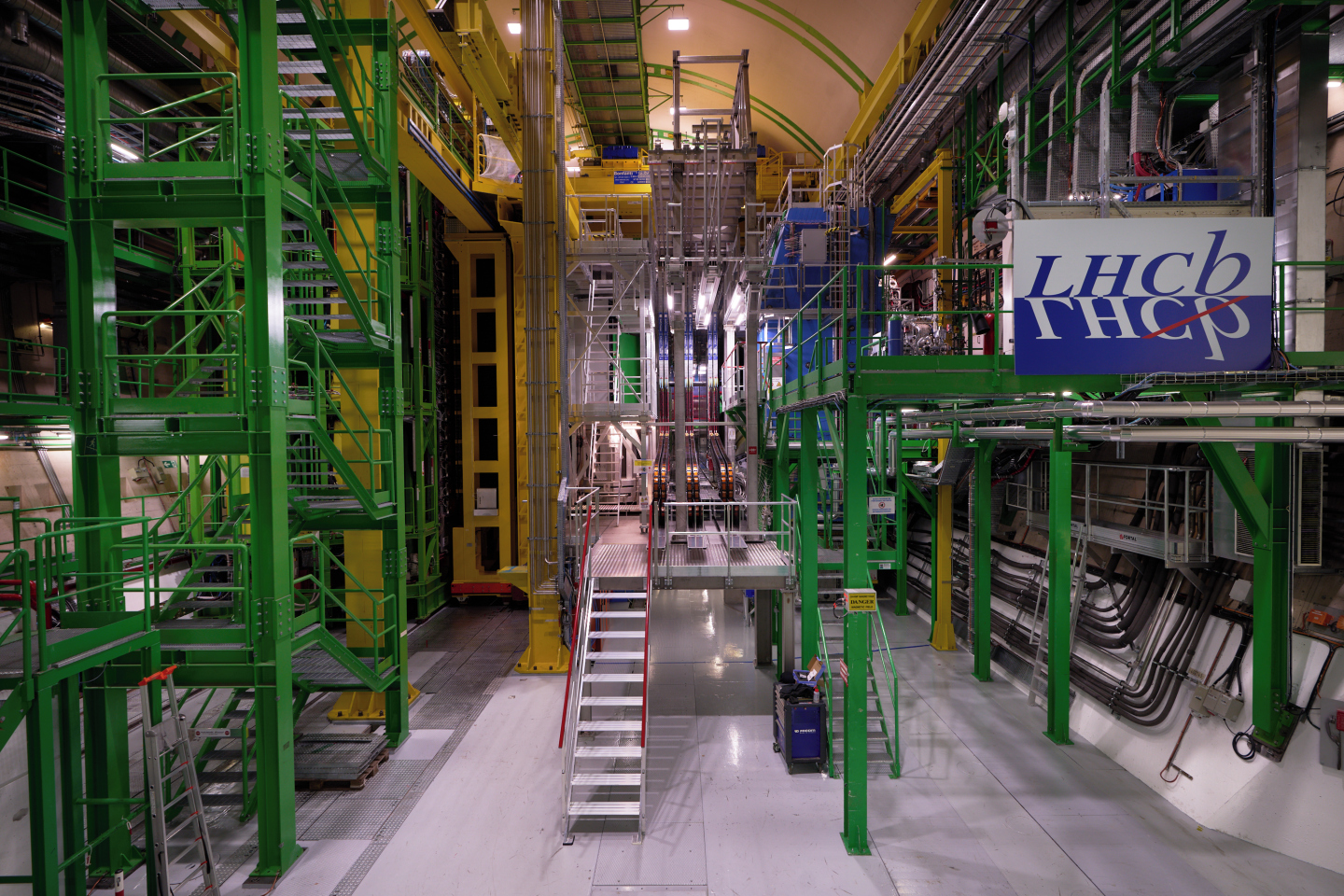
Particle physics often advances by studying processes that occur so rarely that enormous quantities of experimental data are required to identify them.
At CERN’s Large Hadron Collider, the LHCb collaboration has reported evidence of one such process: the decay of a neutral beauty meson, known as Bd, into a positively charged muon and a negatively charged muon.
The result was announced on November 3, 2026, following a search extending over several decades.
The decay is extraordinarily uncommon. According to CERN, the process is expected to occur approximately once in ten billion relevant decays.
The Bd meson consists of a beauty quark and a down antiquark. Its decay into a muon-antimuon pair is strongly suppressed within the Standard Model of particle physics.
This suppression makes the process particularly interesting because hypothetical particles beyond the Standard Model could influence its probability through quantum effects.
Physicists therefore regard such rare decays as sensitive probes of fundamental interactions.
The LHCb collaboration analyzed data collected during 2024 and 2025, taking advantage of improvements introduced through the experiment’s detector upgrade.
The upgraded instrumentation allows substantially higher data-collection rates and improved discrimination between different particle signatures.
Machine-learning techniques also contributed to reducing the enormous background of more common processes that can resemble the desired signal.
The collaboration reported evidence at a statistical significance of approximately three standard deviations.
This exceeds the conventional threshold often used to describe evidence of a phenomenon, but remains below the five-standard-deviation threshold generally required to claim a particle-physics discovery.
The distinction is important. The reported signal is promising, but additional measurements are required before the decay can be considered definitively established.
The result is consistent with Standard Model expectations and therefore does not constitute evidence for a new fundamental particle or force.
Nevertheless, increasingly precise measurements of the decay rate could reveal discrepancies between observation and theoretical predictions.
Such discrepancies might indicate contributions from particles too massive to be produced directly in current accelerator experiments.
The achievement also illustrates the importance of detector technology, data processing and statistical analysis in modern experimental physics.
Discoveries at the frontier of particle physics increasingly depend not only on producing energetic collisions, but also on extracting extremely weak signals from vast datasets.
Analysis
Established findings: CERN’s LHCb collaboration has reported single-experiment evidence for the rare Bd-to-two-muons decay using data collected in 2024 and 2025. The reported significance reaches approximately three standard deviations.
Interpretation: The decay provides a sensitive test of the Standard Model because hypothetical particles could influence its probability through quantum processes.
Limitations: The result does not meet the conventional five-standard-deviation discovery threshold. Its agreement with theoretical expectations does not establish new physics. Independent confirmation and improved precision remain necessary.
Scientific significance: Rare-decay measurements provide an indirect method for investigating fundamental physics at energy scales that may be inaccessible through direct particle production.
Publication context: Official CERN experimental announcement dated November 3, 2026. The institutional communication was examined; this report does not claim an independent review of the complete underlying analysis.
02
Chemical Traces of Ancient Blood Identified in a 115-Million-Year-Old Dinosaur Fossil
Advanced chemical analysis of fossilized dinosaur bones reveals heme-related signatures and microscopic structures that may preserve information about ancient biological tissues, although the cellular interpretation remains contested.
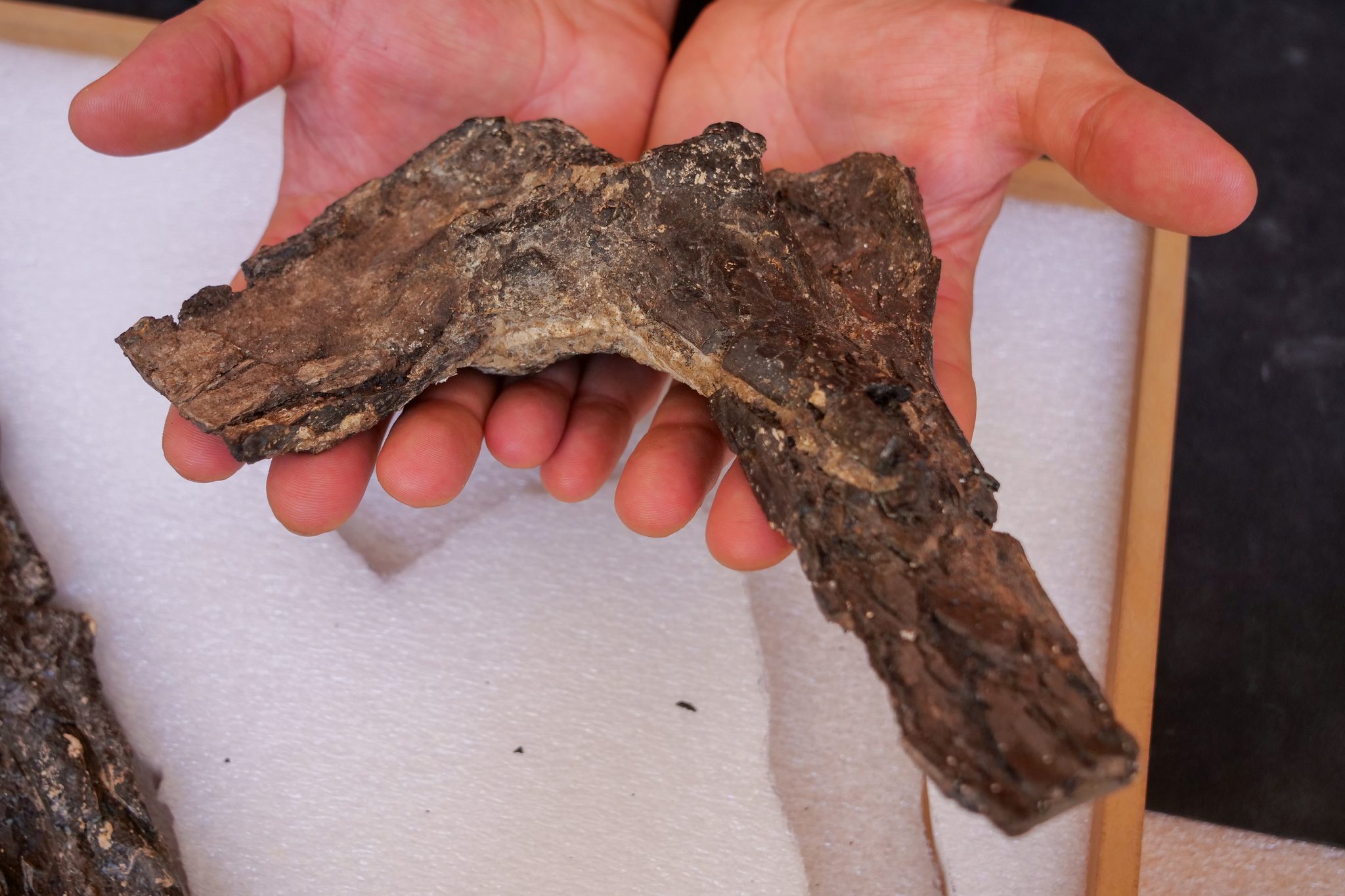
Fossils are traditionally understood as mineralized remains that preserve the shape and structure of organisms from the distant past.
However, advances in analytical chemistry and microscopy have demonstrated that some fossils can also retain chemical information associated with their original biological composition.
An international research team led by Curtin University has reported evidence of blood-related chemical signatures in the bones of a dinosaur that lived approximately 115 million years ago.
The findings concern Aratasaurus museunacionali, a theropod dinosaur whose remains were recovered from the Romualdo Formation in northeastern Brazil.
The researchers investigated fossilized limb bones using microscopic and chemical techniques designed to identify structures and compounds associated with ancient biological tissues.
Within vascular canals, the team observed microscopic structures resembling red blood cells.
Chemical analysis also detected signatures associated with heme, the iron-containing molecular component responsible for oxygen binding in hemoglobin.
The researchers additionally identified amino acids associated with collagen, a major structural protein in vertebrate connective tissues.
The findings were reported in Proceedings of the National Academy of Sciences and described in a Curtin University communication dated November 3, 2026.
One proposed explanation for the preservation involves mineralization by manganese-containing compounds, including hausmannite.
The researchers suggest that rapid burial in a low-oxygen environment, combined with microbial activity and subsequent mineralization, may have helped stabilize the microscopic structures and chemical remnants.
Such processes could potentially preserve information about ancient biological materials over geological timescales.
However, the interpretation requires careful distinction between original biological tissue and mineralized structures that resemble it.
Independent specialists have questioned whether the observed microscopic structures can confidently be identified as dinosaur red blood cells.
The shape and dimensions of some structures differ from expectations for nucleated red blood cells in birds and non-mammalian vertebrates.
The chemical evidence is therefore particularly important, but the presence of heme-related compounds does not automatically establish that intact blood cells survived unchanged.
The discovery does not indicate the survival of dinosaur DNA or complete, functional proteins.
Instead, it suggests that chemically transformed remnants of ancient biological molecules may remain detectable under exceptional preservation conditions.
The broader implications extend beyond paleontology.
Understanding how molecular signatures survive extreme periods of time could improve analytical strategies used to investigate ancient environments and possible biosignatures elsewhere in the Solar System.
The immediate priority is independent replication and further investigation of the mechanisms responsible for preserving these structures and chemical compounds.
Analysis
Established findings: Researchers reported microscopic cell-like structures and chemical signatures associated with heme and collagen-related amino acids in fossilized dinosaur bones approximately 115 million years old.
Interpretation: Mineralization and unusual burial conditions may have contributed to the preservation of chemically transformed biological remnants.
Limitations: The identification of the microscopic structures as genuine red blood cells remains disputed. Chemical signatures do not demonstrate the survival of intact dinosaur blood, DNA or complete proteins.
Scientific significance: The research contributes to molecular paleontology and may help refine techniques for detecting ancient biological signatures in terrestrial and extraterrestrial materials.
Publication context: Peer-reviewed research published in Proceedings of the National Academy of Sciences, accompanied by a Curtin University announcement dated November 3, 2026. The full paper was not independently reviewed for this edition.
03
NASA Satellites Reveal the Complex Evolution of Pacific Super Typhoons
Observations of Super Typhoon In-fa and the remnants of Typhoon Champi illustrate how powerful tropical weather systems can maintain unusual structures and later interact with midlatitude atmospheric circulation.

Tropical cyclones are among the most energetic weather systems on Earth, transferring enormous quantities of heat and moisture between the ocean and atmosphere.
Their development and evolution depend on ocean temperatures, atmospheric circulation, wind shear and interactions with other weather systems.
NASA Earth Observatory has published a detailed examination of the unusually active 2026 Northwest Pacific storm season, highlighting two particularly interesting systems.
The report, dated November 3, 2026, combines satellite observations with meteorological analysis to describe Super Typhoon In-fa and the remnants of Typhoon Champi.
On October 29, NASA’s DSCOVR spacecraft observed In-fa near the Mariana Islands using its Earth Polychromatic Imaging Camera, known as EPIC.
The following day, the MODIS instrument aboard NASA’s Terra satellite captured the storm’s distinctive structure.
In-fa exhibited a nearly circular cloud pattern and a large, well-defined eye.
These characteristics are associated with annular tropical cyclones, a relatively uncommon class of storms that often possess fewer prominent outer spiral rainbands.
According to NASA’s report, annular storms account for only a small fraction of tropical cyclones in the western North Pacific.
Their structural organization can influence how they respond to environmental conditions, including changes in wind shear and oceanic energy availability.
At the same time, another powerful storm was undergoing a very different transformation.
Typhoon Champi had moved northward after crossing the western Pacific and was interacting with atmospheric systems over the Bering Sea.
As tropical cyclones move into higher latitudes, they can undergo a process known as extratropical transition.
During this transformation, the storm gradually loses characteristics associated with a warm-core tropical cyclone and becomes increasingly influenced by temperature contrasts and frontal systems.
The resulting extratropical cyclone may develop a much larger wind field and extensive comma-shaped cloud structures.
The remnants of Champi became incorporated into a larger midlatitude weather system affecting the North Pacific and Alaska.
NASA meteorologists suggest that the interaction may have contributed to the intensification of the broader storm system.
The report also discusses the possible influence of the strong El Niño conditions present during 2026.
El Niño can alter atmospheric circulation and influence tropical cyclone trajectories, potentially increasing the likelihood of storms moving toward higher latitudes.
However, the relationship between seasonal climate patterns and individual storms is complex, and a single event cannot establish a direct causal connection.
The observations demonstrate the importance of combining multiple satellite instruments with atmospheric models and historical weather records.
Such integrated observations help scientists investigate storm structure, track environmental changes and improve the physical understanding required for weather prediction.
Analysis
Established findings: NASA satellite observations documented the unusually organized structure of Super Typhoon In-fa and the extratropical evolution of Typhoon Champi during late October 2026.
Interpretation: The observations illustrate how different atmospheric environments can produce substantially different cyclone structures and evolutionary pathways.
Limitations: The report is an observational analysis rather than a new controlled experiment. The contribution of El Niño to individual storms remains an interpretation requiring broader meteorological evidence.
Technological significance: Combining satellite instruments such as EPIC and MODIS provides complementary information about cloud structure, storm organization and large-scale atmospheric circulation.
Publication context: NASA Earth Observatory observational report published November 3, 2026, based on satellite observations collected during October 2026.
04
NASA’s Twin ESCAPADE Spacecraft Prepare for an Unusual Journey to Mars
Two small spacecraft will use Earth’s gravity and precisely timed engine burns to begin their interplanetary transfer, demonstrating an alternative trajectory strategy before investigating the interaction between solar wind and the Martian atmosphere.

Interplanetary missions depend on carefully calculated trajectories that balance travel time, fuel consumption, spacecraft performance and the relative positions of planets.
NASA’s ESCAPADE mission is preparing to demonstrate an unusual approach to reaching Mars.
ESCAPADE, short for Escape and Plasma Acceleration and Dynamics Explorers, consists of two spacecraft designed to investigate the interaction between the solar wind and the Martian environment.
According to a NASA announcement published November 2, 2026, the spacecraft are scheduled to perform separate powered flybys of Earth on November 7 and November 9.
Each spacecraft will combine gravitational acceleration from Earth with a carefully timed engine burn near its closest approach.
This maneuver is related to the Oberth effect, which describes how a rocket engine can produce a greater change in orbital energy when operated at high velocity.
NASA expects each engine burn to last approximately nine minutes.
The maneuver is designed to increase spacecraft velocity and place the two vehicles on trajectories toward Mars.
The mission’s route differs from the conventional approach used by many previous Mars missions.
Instead of departing directly for Mars during a favorable planetary alignment, the ESCAPADE spacecraft initially followed a trajectory extending toward the Earth-Sun Lagrange point L2.
They subsequently returned toward Earth, allowing mission planners to exploit the planet’s gravitational field when the geometry became favorable for a Mars transfer.
This approach could provide greater flexibility in scheduling certain interplanetary missions.
The spacecraft were launched in November 2025 and are expected to arrive at Mars in September 2027 if the planned maneuvers and subsequent cruise proceed successfully.
At Mars, the two spacecraft will conduct coordinated measurements of the planet’s plasma environment.
Their instruments will investigate how charged particles from the Sun interact with the Martian magnetosphere and upper atmosphere.
Unlike Earth, Mars does not possess a strong global magnetic field capable of shielding its atmosphere in the same way.
Understanding how solar-wind energy and particles interact with the planet is therefore essential for reconstructing its atmospheric evolution.
The two-spacecraft configuration will allow simultaneous measurements from different positions, helping researchers distinguish spatial variations from changes occurring over time.
NASA also reports that the spacecraft have already collected observations while traveling through a distant region of Earth’s magnetotail.
These measurements may provide additional scientific information before the primary Mars mission begins.
However, the upcoming powered flybys remain planned operations, not completed achievements.
Their successful execution will need to be confirmed through spacecraft telemetry and subsequent trajectory analysis.
Analysis
Established facts: NASA has announced powered Earth flybys for the two ESCAPADE spacecraft on November 7 and 9, 2026. Each maneuver is planned to combine gravitational acceleration with an engine burn lasting approximately nine minutes.
Interpretation: The mission may demonstrate greater flexibility in interplanetary trajectory planning and provide valuable scientific observations of planetary plasma environments.
Limitations: The powered flybys have not yet occurred as of this edition. Their success, final trajectory accuracy and eventual scientific performance cannot be assumed in advance.
Scientific significance: ESCAPADE will investigate atmospheric escape at Mars using coordinated observations from two spacecraft, potentially improving understanding of how solar activity influences planetary evolution.
Publication context: NASA mission operations announcement dated November 2, 2026. This is an operational update, not a peer-reviewed publication of completed Mars observations.
05
ESA’s Hera Spacecraft Resolves the Two Asteroids at the Center of the DART Experiment
The European planetary-defence mission has distinguished Didymos and Dimorphos in its own camera observations, marking an important step toward the detailed examination of the asteroid deliberately struck by NASA’s DART spacecraft.

Planetary defence requires more than demonstrating that an asteroid can be struck by a spacecraft.
Scientists must also understand how the physical properties of an asteroid influence its response to an impact.
The European Space Agency’s Hera mission is designed to investigate these questions through a detailed examination of the binary asteroid system Didymos and Dimorphos.
In September 2022, NASA’s DART spacecraft deliberately collided with Dimorphos, the smaller asteroid orbiting Didymos.
The impact measurably altered Dimorphos’s orbital period, demonstrating that a kinetic impactor can change the motion of a small celestial body.
However, the experiment left several important questions unresolved.
Researchers still need more precise information about Dimorphos’s mass, internal structure, composition and the physical changes produced by the collision.
Hera was developed to provide these measurements.
In a communication published October 27, 2026, ESA announced that Hera had successfully resolved Didymos and Dimorphos as separate objects using its Asteroid Framing Camera.
The observation was obtained on October 18, when the spacecraft was approximately 1,280 kilometers from the asteroid pair.
The image shows the two asteroids as distinct points of light.
Although Dimorphos occupies only approximately one pixel in the initial observation, its separation from the larger asteroid is clearly detectable.
The achievement confirms that Hera’s imaging system can distinguish the two components of its target system as the spacecraft approaches.
The observation followed successful braking maneuvers that reduced the spacecraft’s velocity relative to the asteroids.
As Hera moves closer, its instruments are expected to obtain increasingly detailed measurements of the system.
The mission will investigate the consequences of the DART impact and help determine how momentum was transferred to Dimorphos.
This information is essential because an asteroid’s response to an impact depends not only on the impactor’s momentum but also on the amount and direction of material ejected during the collision.
The resulting recoil can significantly influence the total change in the asteroid’s motion.
Hera’s measurements may therefore improve models used to predict the effectiveness of future kinetic-impact deflection missions.
The spacecraft also carries equipment designed to investigate the asteroid environment and will deploy small CubeSats for additional observations.
These instruments will help researchers characterize the asteroid system at scales that cannot be resolved from Earth.
The October observation is an important operational milestone, but it is not yet the mission’s final scientific result.
Detailed conclusions about Dimorphos’s structure and the physical consequences of the DART impact will depend on subsequent measurements.
The mission illustrates how coordinated international spacecraft investigations can transform a successful engineering demonstration into a more quantitative understanding of planetary defence.
Analysis
Established findings: ESA’s Hera spacecraft resolved Didymos and Dimorphos as separate objects in an image acquired October 18, 2026. ESA published the observation on October 27.
Interpretation: The observation marks an important step toward the detailed investigation of the DART impact and the physical properties controlling asteroid deflection.
Limitations: The initial image does not resolve surface details or establish the internal structure of Dimorphos. Measurements of its mass, composition and impact-related changes require closer observations.
Scientific significance: Hera will help convert the DART experiment into a more quantitative framework for evaluating kinetic-impact asteroid-deflection techniques.
Publication context: ESA operational announcement dated October 27, 2026, concerning an observation acquired October 18. The original publication date is retained; the story is not presented as a discovery made on November 4.
The RKE Signal
Today’s central theme is the relationship between technological capability and the limits of scientific interpretation.
At CERN, improved detectors and sophisticated data analysis have made it possible to identify evidence of a particle decay occurring with extraordinary rarity. The achievement expands the precision with which physicists can test fundamental theories, but it does not yet establish a definitive discovery or reveal physics beyond the Standard Model.
The dinosaur-fossil investigation illustrates a related challenge in analytical science. Modern instruments can detect chemical signatures associated with ancient biological materials, but identifying the origin and preservation history of those signatures requires careful interpretation.
The distinction between chemically transformed biological remnants and intact original tissues is fundamental. It determines what researchers can legitimately conclude about molecular preservation over geological timescales.
NASA’s observations of Pacific tropical cyclones demonstrate the complementary importance of continuous measurement. Satellite instruments provide a global perspective on atmospheric processes that evolve across thousands of kilometers.
The unusual structure of Super Typhoon In-fa and the extratropical transformation of Champi reveal how different physical environments influence storm behavior. Understanding these processes requires observations, theoretical models and historical comparisons rather than reliance on individual images.
The ESCAPADE mission represents another form of scientific progress: the development of new operational strategies that may expand the possibilities of future exploration.
Its planned powered Earth flybys exploit orbital mechanics to create an alternative route toward Mars. The mission’s eventual scientific value will depend on successful spacecraft operations and the measurements collected after arrival.
ESA’s Hera mission provides a complementary example of engineering designed to answer questions left open by an earlier experiment.
NASA’s DART mission demonstrated that a spacecraft impact could change an asteroid’s orbit. Hera aims to investigate the physical processes responsible for that change and improve the predictive models required for future planetary-defence planning.
Across these five stories, the distinction between evidence and conclusion remains essential.
A rare particle signal is not yet a confirmed discovery. Chemical traces in fossils do not automatically establish the survival of intact biological structures. Satellite observations reveal atmospheric behavior but require models to explain its causes. Planned spacecraft maneuvers remain objectives until successfully executed. Initial asteroid images establish successful detection, not complete physical characterization.
These distinctions do not diminish the importance of the developments. They make their scientific meaning clearer.
The RKE Signal for November 4, 2026: scientific progress becomes most valuable when increasingly powerful instruments are accompanied by equally rigorous interpretation, transparent uncertainty and a clear understanding of what remains to be demonstrated.