
RISOLNET • KNOWLEDGE ENGINE
SCIENCE & TECHNOLOGY NEWS REVIEW
The October 31 edition of the Risolnet Knowledge Engine explores five scientific developments published on October 30, 2026. From the early growth of supermassive black holes to the evolutionary origins of immune signalling, today’s research examines how complex systems acquire new capabilities, adapt to their environments and sometimes reveal mechanisms that have remained hidden for decades.
Astronomers have reported compelling evidence of two actively accreting supermassive black holes within a gas-rich galaxy merger at redshift 4.5. Their observations provide an important perspective on how black holes and their host galaxies developed during the early history of the Universe.
In healthcare, researchers have evaluated an artificial intelligence system designed to identify specialist referrals that were discussed during medical consultations but never formally ordered. The findings demonstrate measurable improvements in detecting potentially overlooked cases, while also revealing important limitations in sensitivity.
A separate advance in photonics combines infrared detection with visible-light emission through a low-voltage semiconductor device. The research could contribute to future compact night-vision technologies, although practical deployment remains a separate engineering challenge.
Two biological investigations complete today’s selection. One identifies molecular mechanisms connecting nuclear protein condensates, cancer treatment resistance and immune suppression. The other reveals how an ancient molecular system associated with platelet adhesion was repurposed during the evolution of adaptive immunity in jawless vertebrates.
All five stories concern peer-reviewed publications dated October 30. Where research was previously available as a preprint, the distinction between initial disclosure and formal journal publication is maintained. Experimental findings are not presented as established clinical or commercial applications.
01
Two Growing Supermassive Black Holes Reveal a Hidden Phase of Early Galaxy Evolution
Combined observations from James Webb and ALMA identify two active galactic nuclei separated by approximately 1.5 kiloparsecs, providing evidence of rapid black-hole growth during a gas-rich merger in the young Universe.

Understanding how supermassive black holes acquired enormous masses during the early history of the Universe remains one of the major challenges of modern astrophysics.
A study published in Nature Astronomy on October 30, 2026, reports a particularly informative system known as LID-1166. The object contains two active galactic nuclei associated with a gas-rich galaxy merger at a redshift of approximately 4.5.
At this redshift, astronomers observe the system as it existed roughly 1.3 billion years after the Big Bang.
The two active nuclei have a projected separation of approximately 1.5 kiloparsecs, equivalent to about 4,900 light-years. This is the separation measured across the sky, not necessarily their actual three-dimensional distance.
The research combines observations from two powerful astronomical facilities operating at different wavelengths.
The James Webb Space Telescope used its Near-Infrared Spectrograph, NIRSpec, to obtain spatially resolved spectra of the system. These measurements revealed two distinct components in the emission from hydrogen gas.
The components exhibit a line-of-sight velocity difference of approximately 164 kilometers per second.
Importantly, both components display broad hydrogen-alpha emission. Such emission is a characteristic signature of rapidly moving gas in the vicinity of an actively accreting black hole.
The presence of broad emission associated with both locations supports the interpretation that the system contains two active supermassive black holes rather than a single active nucleus surrounded by unrelated gas structures.
Independent observations from the Atacama Large Millimeter/submillimeter Array, ALMA, provide additional evidence.
ALMA detected two spatially and kinematically distinct components of cold interstellar gas through emission associated with singly ionized carbon.
The correspondence between the infrared and millimeter observations strengthens the interpretation that LID-1166 is a merger involving two gas-rich galactic components.
The authors also investigate how rapidly the black holes are growing. Their analysis suggests that the system may be experiencing accretion above the conventional Eddington limit.
The Eddington limit describes a theoretical balance between gravitational attraction and radiation pressure in an accreting system. Accretion above this limit can occur under particular physical conditions, but determining the actual rate depends on models of the source’s radiation and obscuration.
Another important result concerns the relationship between black-hole mass and the mass of the surrounding host galaxies.
The researchers find that the system is already broadly consistent with the black-hole-to-host-mass relationship observed in massive elliptical galaxies in the nearby Universe.
This suggests that rapid black-hole growth and galaxy evolution may become closely linked relatively early in cosmic history.
The observations also raise the possibility that many similar systems remain undetected because their active nuclei are obscured by surrounding gas and dust.
LID-1166 therefore provides an observational example of a potentially important stage in the development of massive galaxies and their central black holes.
Analysis
Established findings: Webb spectroscopy identifies two spatially and kinematically distinct active nuclei. ALMA independently detects corresponding cold-gas components. The projected separation is approximately 1.5 kiloparsecs at redshift 4.5.
Interpretation: The observations support a scenario in which gas-rich galaxy mergers contribute to the rapid growth of supermassive black holes during the early Universe.
Limitations: The measured separation is projected rather than three-dimensional. The inferred accretion rate depends on assumptions about obscuration and emission models. The observations do not establish when the two black holes will eventually merge.
Scientific significance: The system provides evidence for a population of close, heavily obscured dual active galactic nuclei that may have been underrepresented in previous surveys.
Publication context: Peer-reviewed Nature Astronomy article published October 30, 2026. The underlying research was previously disclosed in an arXiv preprint submitted in July 2026. The journal publication is the new event reported here.
02
AI Helps Detect Specialist Referrals Missing from Primary Care Records
A clinical evaluation across seven Singapore primary care clinics finds that automated surveillance can identify overlooked referral orders, while highlighting the need for human review and better preventive workflows.

A specialist referral can be an important step in diagnosing or managing a medical condition. However, the process is not complete simply because a clinician discusses the need for further evaluation.
A referral must also be formally recorded and transmitted through the appropriate clinical workflow.
When this final step is missed, patients may experience delays in specialist assessment even though the original consultation documented the intention to refer them.
Researchers in Singapore have investigated whether artificial intelligence can help identify these discrepancies.
Their study, published in npj Digital Medicine on October 30, 2026, evaluates a system called MR-AI across seven primary care clinics.
The system examines electronic consultation notes and searches for indications that a clinician intended to arrange a specialist referral.
It then checks whether the corresponding referral order exists in the clinical information system.
This distinction is important because the presence of a recommendation in a medical note does not necessarily mean that the administrative and clinical processes required to implement it have been completed.
According to the researchers, MR-AI analyzed approximately 25,000 consultation notes each week.
The study used a quasi-experimental design to evaluate changes in the detection of missed referrals following the introduction of AI-supported surveillance.
The researchers reported an estimated sevenfold increase in weekly missed-referral detection, associated with a 4.7-percentage-point level increase.
Across the evaluation, the system flagged 428 potential cases. Clinicians verified 225 of these, while another 31 cases were reported by patients, resulting in 256 total detections.
The system demonstrated a reported specificity of 99.9 percent and sensitivity of 48.8 percent.
These figures require careful interpretation.
High specificity indicates that the system correctly classified most consultations without a missed referral. However, sensitivity below 50 percent means that the system failed to identify a substantial proportion of the cases it was designed to detect.
The researchers also compared MR-AI with seven physician reviewers in a blinded one-week evaluation.
In that comparison, the AI system achieved a positive predictive value of 61.8 percent, while the human review process produced a confirmation rate of 51.8 percent across the evaluated flagged cases.
The authors estimated that the automated approach required approximately 41 fewer projected staff-hours.
These results suggest that AI-supported surveillance can improve the efficiency of identifying certain documentation and workflow failures.
Nevertheless, the findings do not demonstrate that artificial intelligence can independently guarantee the completeness of clinical referrals.
The researchers emphasize that sustainable improvements will require changes to the underlying clinical workflow, together with further evaluation of costs and long-term effectiveness.
Analysis
Established findings: MR-AI was evaluated across seven primary care clinics and processed approximately 25,000 consultation notes weekly. The system demonstrated 99.9 percent specificity and 48.8 percent sensitivity, with an estimated sevenfold improvement in weekly missed-referral detection.
Interpretation: AI may provide substantial value as a secondary safety mechanism capable of identifying inconsistencies between clinical documentation and completed administrative actions.
Limitations: Sensitivity remained relatively low. The quasi-experimental design does not eliminate every possible source of bias. The reported results do not establish equivalent performance across other healthcare systems or electronic record platforms.
Clinical significance: The most appropriate role for this technology is supplementary surveillance combined with clinician verification and improved referral workflows.
Evidence level: Peer-reviewed clinical implementation research. Findings are based on the published abstract and accessible study information.
03
A Low-Voltage Phototransistor Converts Extremely Weak Infrared Signals into Visible Light
A semiconductor device combines avalanche amplification and transistor gain to drive a visible-light LED from weak infrared illumination, suggesting a possible route toward compact electronic night-vision systems.
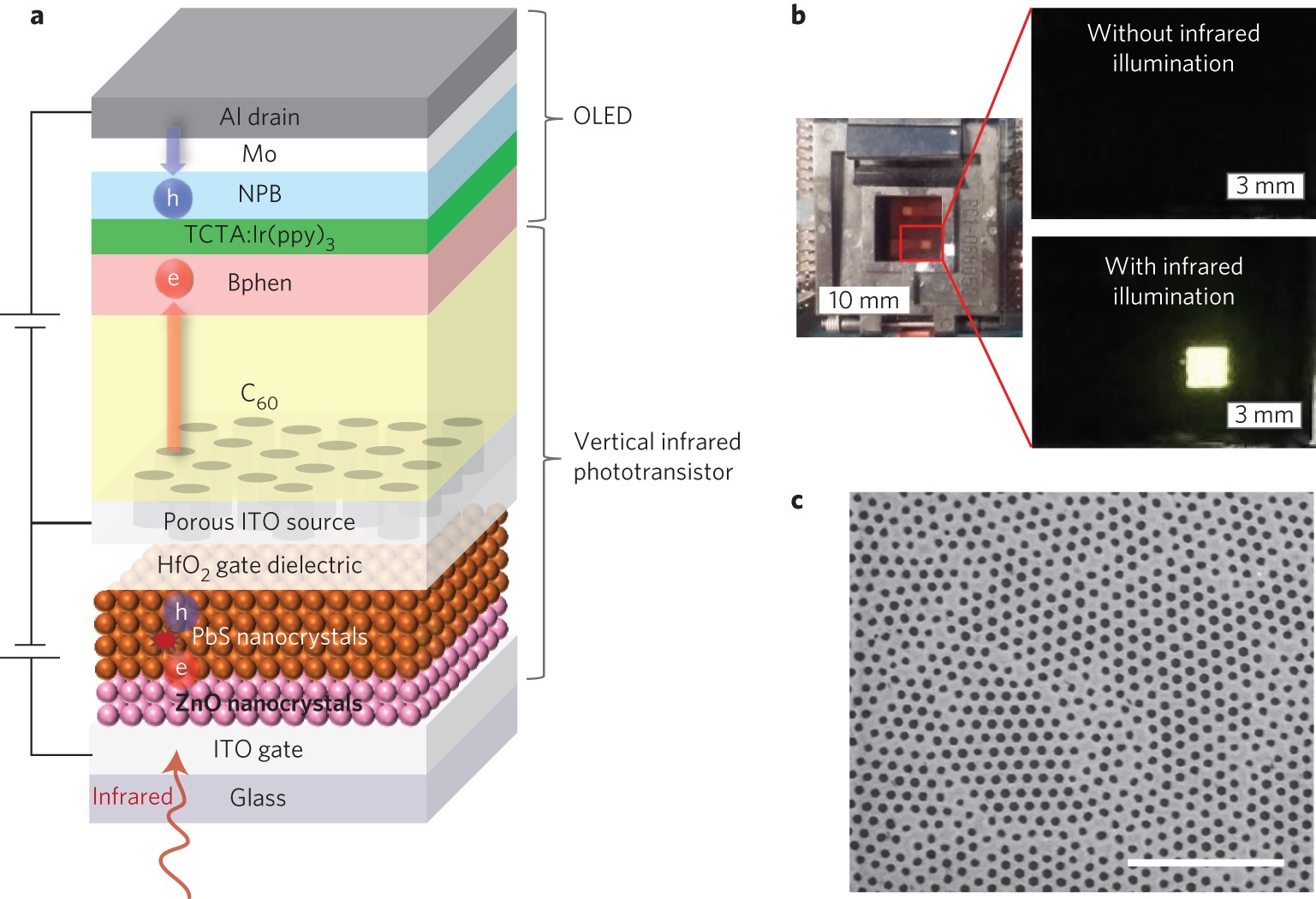
Infrared radiation contains information that is invisible to the human eye but can be detected using suitable semiconductor materials.
Night-vision technologies exploit this property to observe environments under conditions where ordinary visible-light imaging becomes difficult.
However, converting extremely weak infrared signals into visible light presents several engineering challenges.
Conventional optical upconversion techniques often require nonlinear optical materials, strong optical pumping or relatively complex optical arrangements.
An alternative approach uses an electronic detector to convert infrared photons into electrical current, which subsequently powers a visible-light emitter.
A study published in Nature Photonics on October 30, 2026, demonstrates an improved implementation of this principle.
The researchers developed an avalanche heterojunction phototransistor based on indium gallium arsenide and indium phosphide semiconductor materials.
The device combines conventional transistor amplification with avalanche multiplication.
Avalanche multiplication occurs when charge carriers accelerated by an electric field generate additional carriers through impact ionization.
The resulting amplification can make very weak optical signals easier to detect.
In the reported architecture, an internal positive-feedback mechanism links transistor gain with avalanche amplification.
This arrangement enables a breakdown voltage as low as 1.4 volts, according to the researchers.
The phototransistor was connected to an amber-light-emitting diode, allowing infrared illumination to produce visible emission.
The authors report that the emitted visible light was more than 17,000 times brighter than the incident infrared illumination under the specified experimental conditions.
The infrared intensity used in the experiment was approximately 6.4 nanowatts per square centimeter, a level described as being close to natural nightglow conditions.
These results demonstrate that electronic amplification can support infrared-to-visible conversion at extremely low incident optical intensities.
An important distinction is that the device does not create energy from nothing. Electrical energy supplied to the semiconductor system contributes to the amplified visible output.
The brightness ratio therefore should not be interpreted as a violation of energy conservation or as a conventional optical conversion efficiency exceeding physical limits.
The research points toward possible applications in compact night-vision equipment, wearable imaging devices and other systems requiring the visualization of weak infrared signals.
Nevertheless, translating a laboratory phototransistor into a practical imaging product will require additional development.
Important considerations include spatial resolution, integration with imaging arrays, power consumption, operating stability and manufacturing scalability.
Analysis
Established findings: The researchers demonstrated an InGaAs/InP avalanche heterojunction phototransistor capable of driving an amber LED using weak infrared illumination. The reported breakdown voltage reached 1.4 volts, with visible emission more than 17,000 times brighter than the incident infrared signal under the stated conditions.
Interpretation: Combining electronic amplification and optical emission may offer a practical alternative to certain conventional nonlinear optical upconversion techniques.
Limitations: The reported results concern an experimental semiconductor architecture. They do not establish the performance of a complete wearable night-vision camera or a commercially available imaging system.
Technological significance: Lower operating voltages and high sensitivity could facilitate future compact devices designed to visualize weak infrared radiation.
Evidence level: Peer-reviewed experimental photonics research. The summary is restricted to the accessible abstract and associated publication information.
04
SMARCAL1 Nuclear Condensates Link Cancer Radioresistance with Immune Suppression
Researchers identify a molecular mechanism connecting nuclear protein organization, epigenetic regulation and tumor metabolism, suggesting a potential experimental strategy for improving responses to radiotherapy and immunotherapy.

Resistance to cancer treatment is rarely controlled by a single molecular process.
Tumor cells can modify DNA repair pathways, alter their metabolism and influence the surrounding immune environment in ways that reduce the effectiveness of therapy.
A study published in Nature Cell Biology on October 30, 2026, investigates a molecular mechanism connecting these processes.
The research focuses on SMARCAL1, a protein involved in maintaining genome stability and regulating cellular responses to DNA damage.
The authors report that SMARCAL1 can form nuclear condensates through a process known as liquid-liquid phase separation.
Liquid-liquid phase separation describes the organization of certain biological molecules into concentrated compartments without the need for a surrounding membrane.
These condensates can influence how proteins interact and how biochemical reactions are organized within cells.
According to the study, SMARCAL1 condensates enhance a chemical modification of histone H4 known as lactylation.
Histones are proteins around which DNA is organized. Chemical modifications of histones can influence chromatin structure and the accessibility of genetic information.
The researchers found that SMARCAL1-associated changes increase chromatin accessibility and facilitate the recruitment of proteins involved in DNA repair.
This mechanism contributes to resistance against radiotherapy in the experimental models investigated.
Radiotherapy damages cellular DNA. Cancer cells that repair this damage efficiently may survive treatment more successfully than cells with impaired repair mechanisms.
The study also identifies a connection between SMARCAL1 activity and methionine metabolism.
The researchers report that SMARCAL1 regulates the transcription of genes involved in the methionine cycle, influencing metabolic processes associated with the tumor microenvironment.
These metabolic changes were linked to T-cell exhaustion and reduced responses to immune checkpoint therapy.
T-cell exhaustion describes a state in which immune cells exposed to persistent stimulation progressively lose aspects of their normal functional activity.
This finding suggests that a molecular mechanism initially associated with DNA repair may also influence how tumors evade immune responses.
The researchers additionally investigated whether disrupting SMARCAL1 condensates could alter treatment sensitivity.
They report that digoxin, a pharmacologically active compound already known from cardiovascular medicine, disrupted the investigated condensates and increased sensitivity to radiotherapy and anti-PD1 treatment in multiple experimental models.
This result is scientifically interesting but requires particularly careful interpretation.
The observation does not establish that digoxin is an effective or safe cancer treatment in humans. Digoxin has a narrow therapeutic range, and its potential use in oncology would require independent pharmacological and clinical evaluation.
The authors also propose SMARCAL1 as a possible biomarker for predicting treatment response and stratifying patients.
Further validation will be necessary before such measurements can become part of routine clinical decision-making.
The broader significance of the study lies in its proposed connection between nuclear organization, epigenetic modifications, cellular metabolism and tumor immune resistance.
Analysis
Established findings: The study reports that SMARCAL1 forms nuclear condensates associated with histone H4 lactylation, increased chromatin accessibility, enhanced DNA repair and altered methionine metabolism. Pharmacological disruption of these condensates improved treatment responses in the investigated experimental models.
Interpretation: SMARCAL1 may coordinate several biological mechanisms that contribute to resistance against radiotherapy and immunotherapy.
Limitations: The findings are preclinical. They do not demonstrate that digoxin should be administered to cancer patients for this purpose, nor do they establish a validated clinical biomarker.
Biotechnological significance: Targeting the physical organization of proteins within cells may provide a complementary approach to conventional strategies focused on individual enzymes or signaling pathways.
Evidence level: Peer-reviewed experimental cell biology and cancer research, published October 30, 2026.
05
Ancient Vertebrates Reveal an Unexpected Evolutionary Origin of Immune Signalling
Research on lampreys and hagfish identifies a molecular complex used by specialized immune cells and traces its evolutionary history to a system originally associated with platelet adhesion.

The adaptive immune system is one of the most sophisticated biological defense mechanisms found in vertebrates.
In humans and other jawed vertebrates, adaptive immunity relies heavily on B cells, T cells and antigen receptors belonging to the immunoglobulin superfamily.
However, not all vertebrates evolved the same molecular architecture.
Lampreys and hagfish belong to an ancient group of jawless vertebrates that separated from the evolutionary lineage leading to jawed vertebrates hundreds of millions of years ago.
These animals possess an adaptive immune system that differs fundamentally from the antibody-based system familiar from mammalian biology.
Instead of conventional immunoglobulin receptors, they use variable lymphocyte receptors, commonly abbreviated VLRs.
Different VLR families perform distinct immune functions. One important family, VLRB, is associated with cells that exhibit functional similarities to mammalian B lymphocytes.
Although the ability of VLRB receptors to recognize antigens has been investigated extensively, the molecular mechanism connecting receptor engagement to intracellular activation has remained incompletely understood.
A study published in Nature Communications on October 30, 2026, identifies an important component of this missing signaling mechanism.
The researchers combined single-cell transcriptomics, full-length RNA sequencing, functional experiments and evolutionary analysis.
They identified a three-component molecular complex associated with VLRB-expressing immune cells.
The complex includes VLRB together with proteins designated GPIb beta-1 and GPIX-1.
According to the researchers, this assembly transmits activation signals through an immunoreceptor tyrosine-based activation motif, or ITAM, located within GPIb beta-1.
ITAM motifs are important components of several immune signaling pathways because they help convert receptor engagement into intracellular biochemical responses.
The discovery provides a possible explanation for how antigen recognition by VLRB receptors activates the corresponding immune cells.
The evolutionary analysis revealed an additional and unexpected connection.
The genes encoding this signaling complex appear to have originated through duplication of an ancestral molecular system associated with platelet adhesion.
In jawed vertebrates, platelet-related molecular complexes participate in processes associated with blood clotting and vascular interactions.
The researchers propose that an ancestral version of this molecular machinery underwent duplication during the evolution of jawless vertebrates.
The resulting gene copies subsequently developed different biological functions.
One lineage retained functions associated with thrombocytes, while another was recruited into the immune system to support VLRB-mediated signaling.
This process illustrates an important mechanism in evolutionary biology: existing molecular components can acquire new functions following gene duplication and subsequent specialization.
The researchers also identified transcriptional regulators, including BHLHE41 and FOS, that may influence expression of the signaling complex.
Single-cell analysis further suggested that VLRB-expressing cells progress through activation states associated with proliferation and plasma-cell-like characteristics.
These findings strengthen the functional comparison between VLRB immune cells and mammalian B cells, while preserving the important distinction between their underlying molecular architectures.
The study therefore contributes to understanding how different vertebrate lineages independently developed sophisticated adaptive immune responses.
It also demonstrates that biological evolution frequently produces new capabilities by modifying and repurposing pre-existing molecular systems.
Analysis
Established findings: The researchers identified a VLRB-associated signaling complex containing GPIb beta-1 and GPIX-1. Functional experiments support signal transmission through an ITAM motif, while evolutionary reconstruction links the complex to an ancestral platelet-adhesion system.
Interpretation: Gene duplication and functional specialization may have allowed an existing molecular module to acquire a new role in adaptive immune signaling.
Limitations: The evolutionary reconstruction is based on comparative molecular evidence. The findings do not imply that mammalian B-cell receptors use the same signaling architecture, nor do they establish a direct clinical application.
Scientific significance: The study identifies a previously unresolved component of adaptive immunity in jawless vertebrates and provides insight into how distinct immune systems evolved from earlier molecular structures.
Evidence level: Peer-reviewed experimental and comparative evolutionary biology research. The summary is based on the accessible abstract and publication information.
The RKE Signal
Today’s scientific developments reveal a recurring principle: major advances often emerge when researchers identify hidden relationships between systems that initially appear unrelated.
In astronomy, the discovery of two actively growing supermassive black holes within a distant galactic merger provides a new observational perspective on the relationship between black-hole growth and galaxy evolution.
The system demonstrates why combining observations across different wavelengths is essential. Webb identifies signatures of accretion through infrared spectroscopy, while ALMA reveals the cold gas associated with the merging galactic components.
Together, these measurements provide stronger evidence than either observational technique could deliver independently.
The clinical AI study illustrates a different kind of information problem. Medical records contain descriptions of clinical intentions, but those intentions do not always correspond to completed actions.
Artificial intelligence can help identify discrepancies between documentation and operational reality. However, the relatively low sensitivity observed in the study demonstrates why automated surveillance should supplement rather than replace clinical responsibility.
The photonics investigation shows how established physical mechanisms can be combined to achieve new technological capabilities. Avalanche multiplication and transistor amplification are familiar concepts, but their integration into a low-voltage infrared-to-visible conversion system creates new possibilities for compact optical devices.
The cancer biology research connects several molecular processes that are often investigated separately: protein phase separation, chromatin organization, DNA repair, cellular metabolism and immune suppression.
Its significance lies not only in identifying SMARCAL1 as a possible therapeutic target, but also in showing how changes in nuclear molecular organization may influence multiple aspects of tumor behavior.
The evolutionary immunology study extends this theme across hundreds of millions of years.
A molecular system originally associated with platelet adhesion appears to have been duplicated and adapted for immune signaling in jawless vertebrates. This provides a striking example of how biological evolution can create new functions from existing molecular components.
These findings also reinforce the importance of distinguishing scientific evidence from practical readiness.
A distant galaxy merger can be identified without determining the future orbital evolution of its black holes. An AI system can improve clinical surveillance without detecting every missed referral. A laboratory phototransistor can demonstrate exceptional signal amplification without becoming a finished imaging product.
Similarly, a promising molecular target does not automatically become a safe cancer therapy, and a discovery in evolutionary immunology does not necessarily produce an immediate medical application.
The transition from scientific discovery to reliable application requires independent validation, careful interpretation and an understanding of the limitations of each experimental system.
The RKE Signal for October 31, 2026: progress is driven not only by discovering new components, but by understanding how existing components interact, adapt and acquire new functions within complex systems.