
RKE / RISOLNET KNOWLEDGE ENGINE
DAILY SCIENCE & TECHNOLOGY BRIEF
How much can we learn from a signal that does not show its source directly? This edition moves from a galaxy's projected light and magnetic fields above a material to ocean-colour maps, neuronal rhythms and an early clinical endpoint. Five reports released on October 15–16 show both the power of better measurements and the care needed when interpreting them.
Astronomy & Space
01
A galaxy seen edge-on helps put small cosmic neighbours in context
Hubble's newly released NGC 1827 portrait illustrates a wider effort to test how low-mass galaxies fit cosmological models.
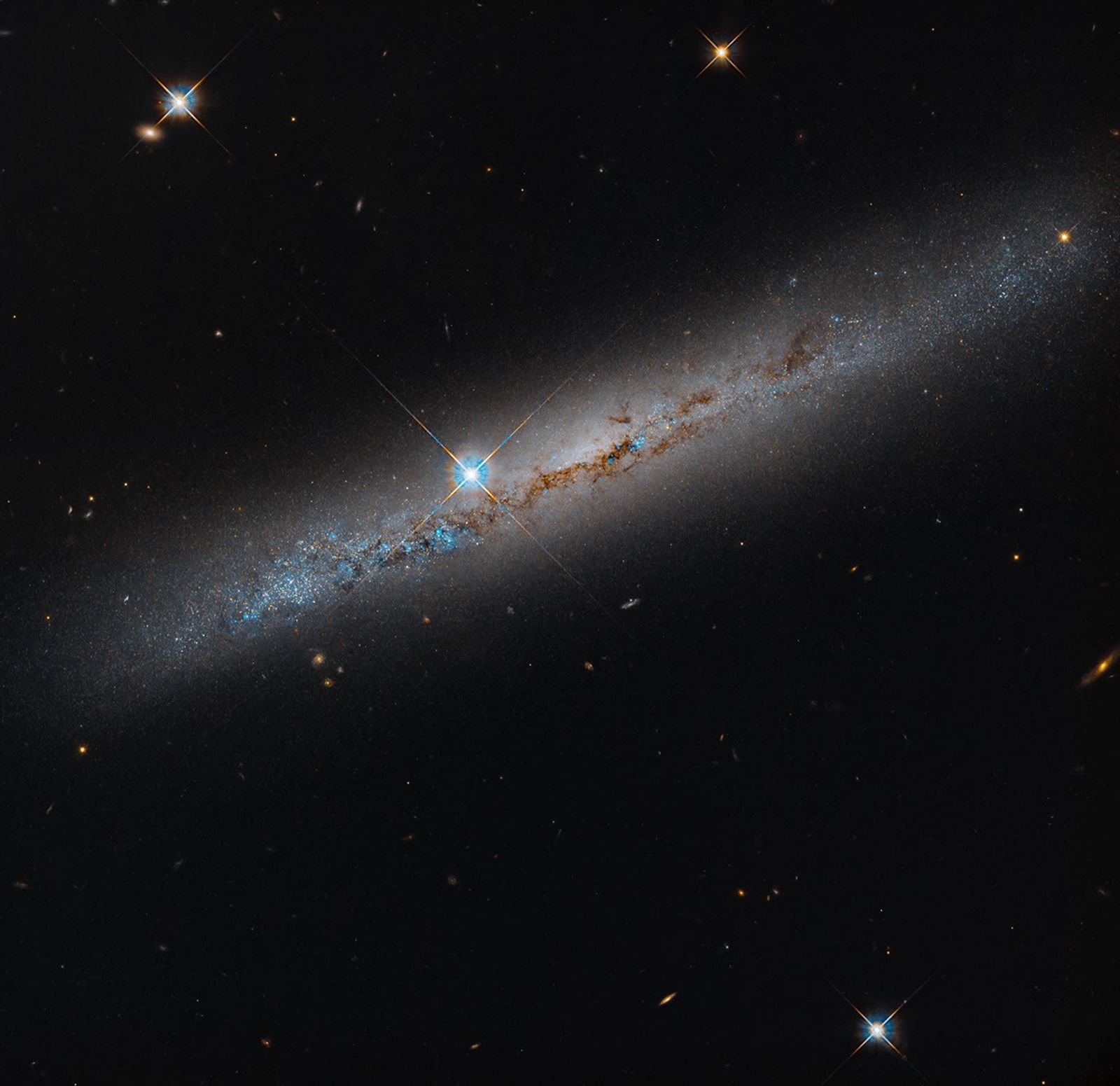
A new Hubble image released on October 16 shows NGC 1827 almost edge-on, its dusty disk cutting across a bright central region. The galaxy lies roughly 37 million light-years away in the constellation Columba. Blue patches along the disk mark regions where stars are likely forming; the prominent spiked point beside its centre is a foreground star, rather than an object inside the galaxy.
The release connects the observation to a larger programme examining small galaxies around systems resembling the Milky Way. These smaller neighbours matter because predictions for their properties are difficult to reconcile with observations.
Analysis
The value extends beyond a striking photograph: comparing many small galaxies can expose weaknesses in models of how galaxies assemble. This release is an observing-programme update, not a newly established explanation of dark matter. A single projected view cannot reveal a galaxy's complete three-dimensional structure or settle those model disagreements.
Artificial Intelligence
02
Physics helps machine learning reconstruct a hidden magnetic pattern
A reconstruction method fits magnetic structure and sensor distance together, reducing a source of uncertainty in nanoscale imaging.
A diamond sensor above a thin magnet measures the field extending outside the material. Working backwards is harder: several internal arrangements can explain a similar external signal, especially when the sensor's height is uncertain.
An October 15 University of Vienna report describes an approach that incorporates magnetic energy into the reconstruction. Physically implausible, high-energy solutions are penalised while the method fits the measured field. Applied to an ultrathin Fe3−xGaTe2 sample, it recovered a sensor distance of about 81 nanometres. The work is reported in Physical Review Letters; a preprint has been available since February, so this is a journal-stage research update rather than a discovery first made this week.

Analysis
This is useful machine learning because physical constraints narrow the possible answers. It does not make an inverse problem universally unambiguous: confidence still depends on the material model, measurements and assumptions. The reported reconstruction is evidence for the demonstrated sample, not proof that faster or lower-power commercial computers have already resulted.
Technology
03
Three satellite views track a changing Pacific
Ocean height, temperature and colour offer complementary clues to the evolving 2026 El Niño.
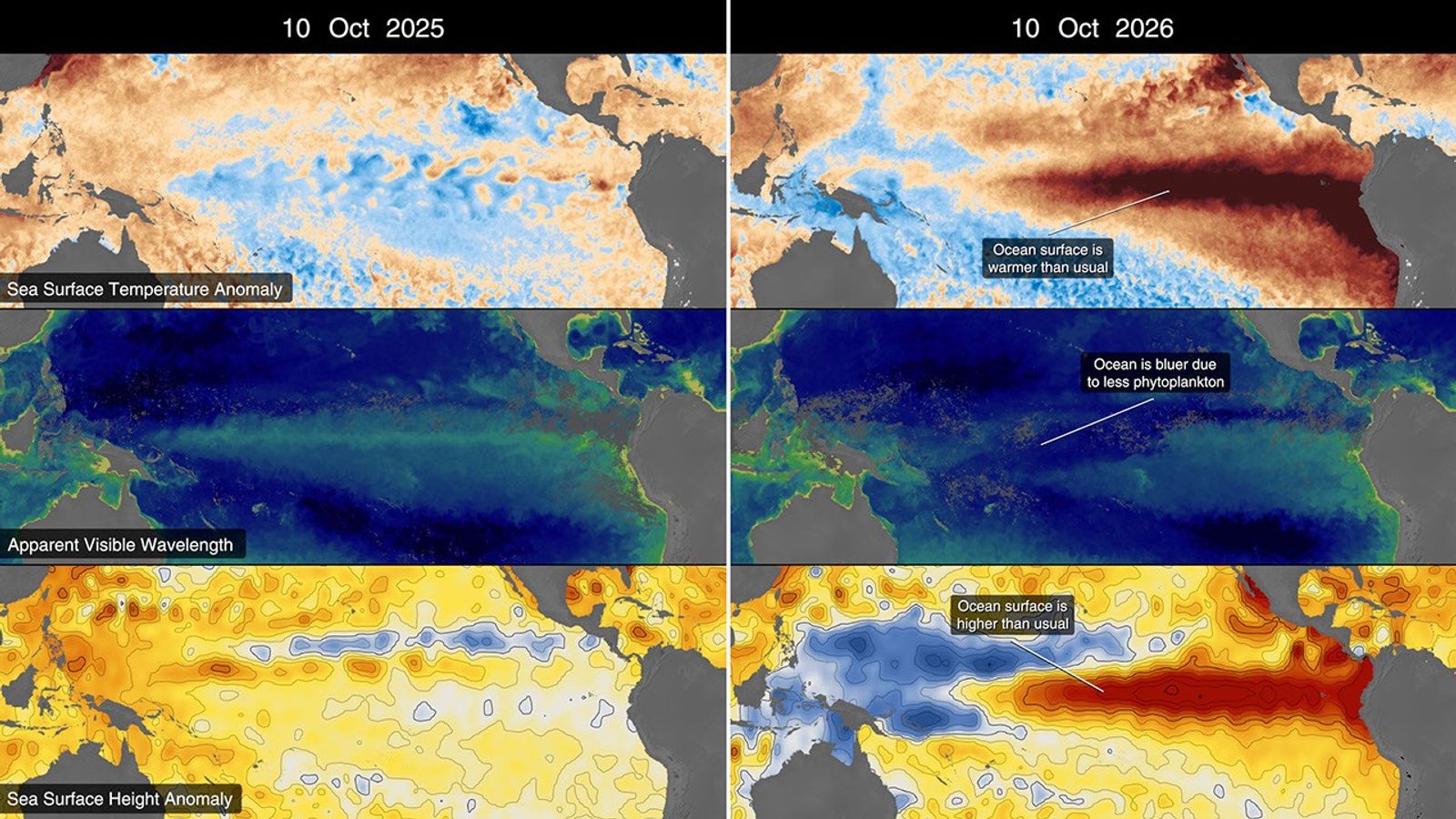
An October 15 NASA update brings together three ways of watching the Pacific: sea-surface height, temperature and ocean colour. The comparison with 2025 shows why a climate pattern cannot be understood from one attractive map alone.
Altimetry traces changes in water height, including the expansion associated with warming. Temperature observations reveal the warm equatorial band, while PACE ocean-colour measurements add information related to phytoplankton. During El Niño, weaker upwelling can reduce the supply of nutrients reaching surface waters, changing biological conditions as well as circulation.
Analysis
The strength of this approach is the combination of independent kinds of measurement. A colour change is an indicator interpreted through an ocean-colour product, not a direct census of every organism. These basin-scale observations also cannot prescribe the weather for a particular town: regional forecasts and local vulnerability still determine what communities should prepare for.
Life Sciences
04
Restoring neuronal timing improves a brain rhythm in mice
A study of parvalbumin interneurons links cellular function to the sequential recruitment that sustains gamma oscillations.
UTHealth Houston reported on October 15 that researchers restored aspects of parvalbumin interneuron function in mice engineered to reproduce amyloid-related features of Alzheimer's disease. The work appeared in Neuron.
These inhibitory cells help generate gamma oscillations, rapid rhythms associated with information processing. The team found a sequence in how the cells were recruited, rather than all participating uniformly at once. Enhancing their function with a sodium-channel subunit restored recruitment patterns and improved gamma oscillations in the experimental animals.

Analysis
The result is a proof of principle for manipulating a disrupted circuit. It does not show that Alzheimer's disease has been reversed in people, or that changing one rhythm is sufficient to treat the full disease. Mouse amyloid models reproduce selected features of a human condition; safety, delivery and clinically meaningful benefit remain separate questions. This summary relies on the institutional report because the journal page was inaccessible during review.
Life Sciences
05
Focused radiation before surgery earns a larger clinical test
A small kidney-cancer trial meets its screening target, with results that require confirmation in a randomised study.
A phase 2 study reported on October 15 tested stereotactic ablative radiotherapy before surgery for kidney cancer extending into the inferior vena cava. This tumour growth can make an already major operation more difficult.
The trial enrolled 23 patients; 22 completed kidney removal and thrombectomy after radiation. The reported one-year recurrence-free survival estimate was 71.4%, above the prespecified historical benchmark of 55.7%. The JAMA Oncology report describes the result as exploratory and supports further evaluation.

Analysis
The essential distinction is between clearing a phase 2 screening threshold and proving an improvement over current care. There was no concurrent randomised control group, and a small selected cohort leaves considerable uncertainty. The comparison is encouraging enough to justify a larger trial, not enough to establish a new standard for every patient. Reports of tumour regression outside the radiation field are also observations requiring investigation, rather than a predictable treatment effect.
The RKE Signal
Better measurements become useful when we ask what else could explain them. A magnetic field needs a physical model; ocean colour needs ecological context; a brain rhythm needs a disease model; and a clinical percentage needs an appropriate comparator. Today's common advance is a clearer path from an observed signal to a testable explanation. The next step is to challenge that explanation at the scale where it is meant to matter.