


RKE / RISOLNET KNOWLEDGE ENGINE
DAILY SCIENCE & TECHNOLOGY BRIEF
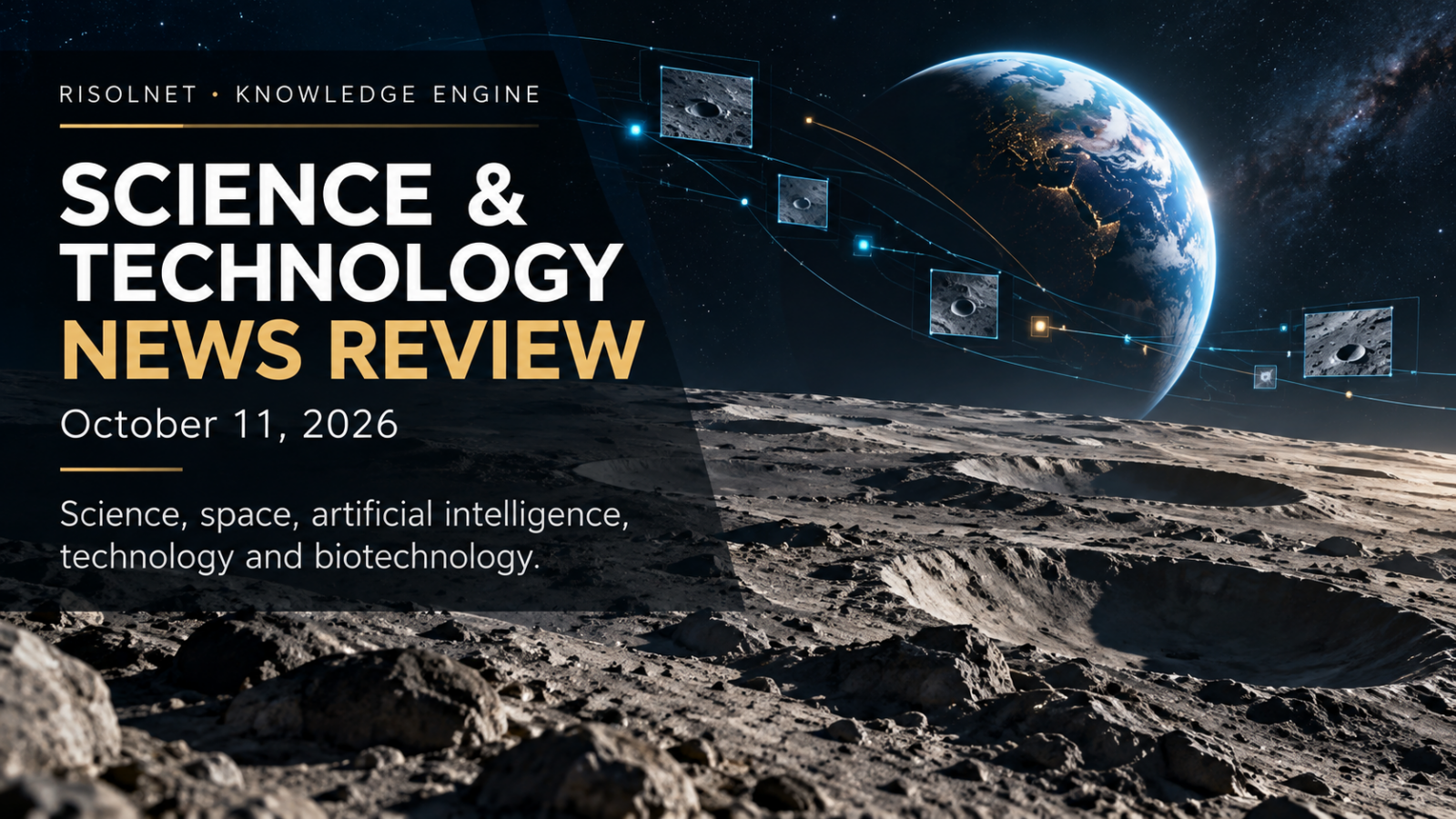
Today’s scientific briefing moves from the Moon to molecular biology, with artificial intelligence and European semiconductor technology in between. NASA has released a vast archive of lunar observations, US research institutions are building the data foundations for predictive biological AI, and GlobalFoundries has unveiled a new semiconductor roadmap for physical AI.
Meanwhile, two biological studies challenge established assumptions: genetically modified cattle can complete pregnancies without an embryonic protein long considered indispensable, and researchers have identified a mechanism that maintains aggressive brain tumour cells in an immature developmental state.
Astronomy & Space
01
NASA Releases More Than 800 GB of Artemis II Lunar Science Data
Thousands of high-resolution images, astronaut observations, audio recordings and annotated lunar photographs are now available to researchers worldwide, creating a remarkable scientific legacy from the 2026 crewed lunar flyby.

on April 6, 2026.
Credit: NASA, image hosted by ESA.
Original NASA mission photograph, used for editorial
reporting with NASA attribution; not a new October image.
Original image and credits
.
On October 7, NASA announced the public release of more than 800 gigabytes of scientific data collected during the Artemis II mission, which carried four astronauts around the Moon in April 2026. The material is available through NASA’s Planetary Data System, the agency’s long-term archive for planetary science observations.
The dataset includes more than 11,000 high-resolution images and videos from handheld and spacecraft cameras, approximately eight and a half hours of audio recordings documenting the crew’s scientific observations, and photographs annotated by the astronauts. Some of the material had not previously been released.
Unlike a purely robotic mission, Artemis II combined instrumental observations with human interpretation. Astronauts could select targets, describe subtle differences in lunar colour and texture, and identify short-lived events during the flyby. Observations included brief flashes on the lunar surface consistent with meteoroid impacts.
NASA also published three technical documents: the Artemis II Preliminary Lunar Science Report, the Lunar Science Operations Report and the Lunar Science Data User Guide. Together, they provide the scientific and operational context required to analyse the archive.
The release represents the first major planetary science dataset collected primarily by humans beyond Earth orbit in more than half a century. It will support investigations of lunar geology, surface composition and impact processes while informing preparations for subsequent Artemis missions.
Analysis
Established findings: NASA has made the lunar science archive public, including images, audio, astronaut annotations and supporting technical reports.
Interpretation: Human observations complement automated imaging by adding contextual descriptions, target selection and recognition of transient events. Combining these sources may improve scientific interpretation of the lunar surface.
Limitations: Public release does not mean every observation has been fully analysed or independently confirmed. Geological interpretations and transient events require further comparison with other datasets.
Artificial Intelligence
02
DOE, NIH and Biohub Join Forces to Build Predictive Models of Living Cells
A major research partnership aims to combine biological datasets, advanced imaging, automated laboratories and supercomputing to develop AI systems capable of predicting how cells respond to interventions.

head and neck cancer cells.
Not an image generated by the new research partnership.
Photo: Bibeh100, 2011.
CC BY-SA 4.0.
Unmodified image.
Image source.
On October 7, the US Department of Energy, the National Institutes of Health and Biohub announced a memorandum of understanding to develop the data and computational infrastructure needed for advanced predictive models of biology.
The long-term objective is to create AI systems capable of forecasting how cells and biological systems respond to genetic modifications, drug treatments, environmental changes and other interventions. Such models could help researchers identify promising experiments before conducting them in physical laboratories.
Achieving this objective requires exceptionally large and carefully standardized datasets. Cellular behaviour depends on gene expression, protein activity, metabolism, three-dimensional structure and interactions with surrounding cells. A useful model must learn relationships across these different biological layers.
The Department of Energy announced investments exceeding 500 million dollars over five years in cellular research, measurement technologies, imaging, computation and modelling. Biohub is investing 500 million dollars over five years through its Virtual Biology Initiative. The NIH will coordinate existing biomedical datasets, research infrastructure and resources.
The collaboration plans to use national laboratory supercomputers, advanced microscopy, automated experiments and integrated biological data systems to support the development and independent testing of predictive models.
Analysis
Established findings: The institutions have formalized their collaboration and announced research investments and infrastructure plans. Existing scientific facilities and data resources will contribute to the effort.
Interpretation: Predictive biological AI could help shift part of biomedical research toward model-guided experimentation, reducing the number of physical tests needed to investigate large spaces of possibilities.
Limitations: A universal, experimentally validated virtual cell does not yet exist. Large datasets alone cannot guarantee predictive accuracy, especially across different cell types, organisms and experimental conditions. Biological predictions must still be tested against real observations.
Technology
03
GlobalFoundries Unveils FDX Fusion Semiconductor Roadmap for Physical AI
A new European FD-SOI manufacturing platform aims to combine energy efficiency, specialized functions and seven-nanometre-class digital performance for intelligent machines and connected devices.

This does not depict an FDX Fusion prototype.
Photo: 2×910, 2019.
CC BY-SA 4.0.
Unmodified image.
Image source.
On October 9, GlobalFoundries announced FDX Fusion, a new semiconductor technology roadmap designed for physical AI applications. The company plans to begin manufacturing the platform in 2028 at its Dresden facility in Germany.
Physical AI refers to intelligent systems that perceive and interact with the real world, including robots, industrial equipment, autonomous machines and advanced sensor networks. Unlike cloud-based AI services, these devices frequently operate under strict constraints involving power consumption, heat, latency and reliability.
FDX Fusion is based on fully depleted silicon-on-insulator technology, or FD-SOI. This transistor architecture places an extremely thin semiconductor layer above an insulating substrate, improving electrostatic control and potentially reducing leakage and energy consumption.
GlobalFoundries expects the first generation to deliver seven-nanometre-class digital performance. The platform is being developed for workloads summarized by the acronym STAC: Sense, Think, Act and Communicate.
The announcement highlights the growing importance of specialized semiconductor technologies optimized for local intelligence rather than exclusively for maximum data-centre computing power.
Analysis
Established findings: GlobalFoundries has published a development roadmap and identified 2028 as its intended manufacturing start date in Dresden.
Interpretation: Energy-efficient specialized chips may become increasingly important as AI capabilities move into sensors, robots, instruments and industrial control systems.
Limitations: FDX Fusion is not yet in commercial production. The announced performance characteristics are development targets, not independently verified benchmarks. Seven-nanometre-class performance does not necessarily correspond to a single physical transistor dimension of seven nanometres.
Biotechnology
04
Healthy Calves Are Born Without a Protein Long Considered Essential for Pregnancy
Gene-edited bovine embryos lacking all functional interferon tau genes have established pregnancies and developed to term, challenging a longstanding model of reproductive biology in ruminants.

in a German pasture.
These are not the genetically modified
animals described in the study.
Photo: Hubert Berberich, 2014.
CC BY 3.0.
Unmodified image.
Image source.
A study published in Nature Communications on October 8 challenges one of the established assumptions of ruminant reproductive physiology. For decades, embryonic interferon tau, or IFNT, has been regarded as an indispensable signal through which the embryo informs the maternal organism that pregnancy has begun.
Under the conventional model, IFNT prevents regression of the corpus luteum, the ovarian structure responsible for producing progesterone and maintaining the hormonal environment required for gestation. Complete absence of the signal was therefore expected to prevent pregnancy establishment.
Researchers at Ludwig Maximilian University of Munich directly tested this hypothesis. Using CRISPR-Cas9, they eliminated all functional copies of the IFNT genes from bovine cells. The edited cells were subsequently used to produce embryos through somatic cell nuclear transfer, followed by embryo transfer into recipient cattle.
Surprisingly, the embryos developed normally through early stages, established pregnancies and maintained the corpus luteum despite the absence of the characteristic interferon-driven maternal uterine response.
On February 26, 2026, two healthy female calves were born from a twin pregnancy. Both lacked functional IFNT genes. The findings provide direct genetic evidence that IFNT is not absolutely indispensable for successful gestation in the experimental system studied.
The result points toward alternative embryo-maternal communication mechanisms. Prostaglandin E2 has been proposed as one possible candidate, but the replacement signalling pathway has not yet been established.
Analysis
Established findings: Complete genetic loss of embryonic IFNT did not prevent pregnancy establishment, luteal maintenance or the birth of two healthy calves in the reported experiment.
Interpretation: Alternative biological signals can apparently maintain pregnancy under some conditions even when the canonical interferon pathway is absent. This challenges the assumption that IFNT is universally essential.
Limitations: The findings come from a specific experimental system involving genome editing, cloning and embryo transfer. The two calves were born from one twin pregnancy rather than two independent full-term pregnancies. The compensatory mechanism remains unidentified.
Life Sciences
05
Researchers Identify a Mechanism That Maintains Aggressive Brain Tumour Cells in an Immature State
A new study reveals how the H3K27M histone mutation cooperates with the transcription factor ASCL1 to maintain progenitor-like tumour cell states, suggesting a potential vulnerability in diffuse midline gliomas.

of pediatric diffuse intrinsic pontine glioma.
Not an image from the 2026 ASCL1 study.
Authors: Benjamin T. Himes, Liang Zhang
and David J. Daniels, 2019.
CC BY 4.0.
Unmodified image.
Image source.
A study published in Nature Communications on October 10 provides new insight into the molecular mechanisms driving diffuse midline gliomas, aggressive brain tumours that can affect children and young patients.
Many of these tumours carry the H3K27M mutation, an alteration affecting histone proteins that help organize DNA and regulate gene expression. The mutation disrupts epigenetic mechanisms that normally control cell differentiation.
The researchers investigated how H3K27M interacts with ASCL1, a transcription factor involved in neural development. They found that the mutation interferes with normal silencing of ASCL1, allowing the factor to remain active in tumour cells.
ASCL1 cooperates with the chromatin-remodelling protein BRG1 to maintain gene-expression programs associated with immature neural and oligodendroglial progenitor states. This helps preserve the developmental plasticity of the tumour cells.
Functional experiments provided a particularly important result: loss of ASCL1 markedly impaired tumour formation in the in vivo experimental models used. Removing ASCL1 also enabled alternative differentiation pathways that had previously been restricted.
The findings suggest that some H3K27M-mutant gliomas may depend on developmental programs that prevent tumour cells from progressing toward more differentiated states.
Analysis
Established findings: The study identified functional interactions involving H3K27M, ASCL1 and BRG1-mediated chromatin regulation. Loss of ASCL1 substantially impaired tumour formation in experimental models.
Interpretation: ASCL1 may represent a biological vulnerability in some H3K27M-mutant gliomas. Strategies that alter abnormal differentiation programs could provide a direction for future therapeutic research.
Limitations: These findings are preclinical. They do not establish the safety or effectiveness of an ASCL1-targeted treatment in patients. Further work is required to determine whether this mechanism can be exploited therapeutically.
The RKE Signal
Scientific progress depends on understanding the difference between a model and the reality it describes. Artemis II provides observations that researchers must still interpret. Predictive biological AI aims to model cellular responses, but those predictions require experimental validation. GlobalFoundries is developing semiconductor technology for intelligent systems that must operate in the physical world.
The two biological studies offer particularly compelling examples of why assumptions must be tested. In cattle, a protein previously considered indispensable proves unnecessary under specific experimental conditions. In diffuse midline gliomas, a developmental transcription factor helps maintain malignant cellular states.
The central lesson is that scientific models become more useful when they are exposed to experiments capable of disproving them. Artificial intelligence can accelerate this process, but the essential work remains the same: generate hypotheses, collect reliable evidence, test predictions and revise explanations when reality disagrees.