




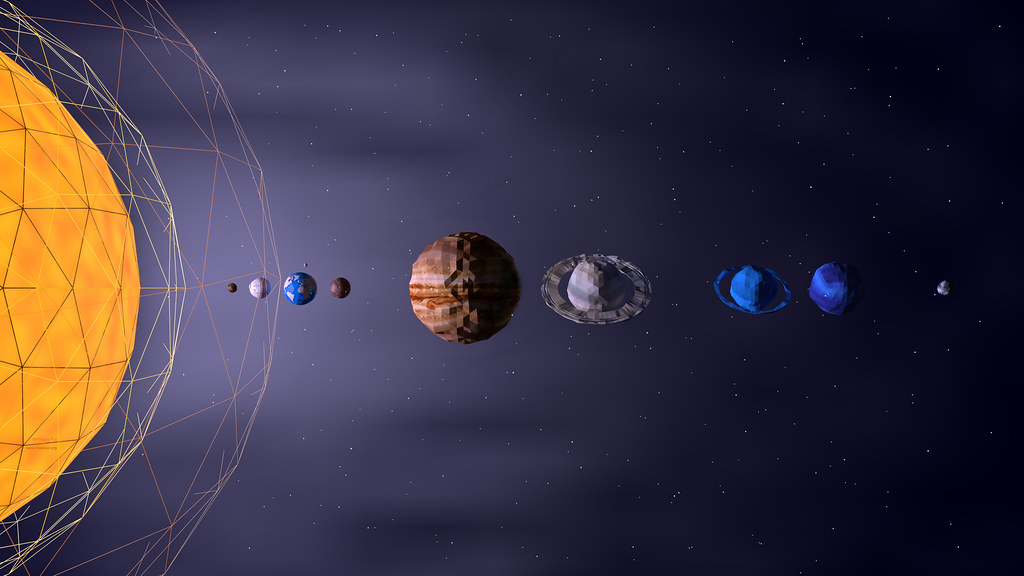
Discover the wonders of our Solar System!
Welcome to the fascinating world of the Solar System! Here, you’ll discover the eight planets orbiting our Sun, their moons, and the asteroid belt between them. You’ll also learn about the dwarf planets, comets, and other objects that inhabit our Solar System. From the boiling temperatures of Venus to the cooler temperatures of Neptune, and all the other fascinating characteristics of the planets, you’ll discover the wonders of our Solar System. Exploring the Mysteries of Neptune, the Eighth Planet in the Solar System
Neptune, the eighth-most distant planet in the Solar System, is an immense and mysterious gas giant with a complex atmosphere of hydrogen, helium, and methane. With a mean radius of 24,6222 km and an average density of 1.638 g/cm3, it is the fourth-most massive planet in the Solar System and the densest of the gas giants.
At its distance from the Sun of approximately 30 AU (4.5 billion km), Neptune is often referred to as an “ice giant” due to its extremely cold temperatures, ranging from -218°C to -224°C. Neptune’s atmosphere is composed primarily of hydrogen and helium, with methane and other hydrocarbons making up a smaller fraction. This composition gives the planet its characteristic blue-green hue, which is due to the absorption of red light by methane in the atmosphere.
Neptune has a complex and dynamic system of weather patterns, with strong winds and storms. It also has a number of moons and rings, including the small moon Nereid, which has an eccentric orbit, and faint rings of dust and debris. Neptune’s magnetic field is the strongest in the Solar System and is thought to be generated by the convection of electrically conductive fluids in the planet’s core. The field is highly tilted and offset from the planet’s rotational axis, pointing at a 47-degree angle toward the Sun.
Neptune has many mysterious features, including its unusual dual-core structure, which scientists are still trying to understand. Furthermore, its internal structure and composition remain largely unknown, despite the efforts of numerous space probes. In conclusion, Neptune is a mysterious and fascinating planet, with a number of unique characteristics that have yet to be fully explored and understood. Its complex atmosphere and magnetic field, as well as its dual-core structure, have fascinated scientists for many years. As we continue to learn more about the outer planets, we can only hope to uncover more secrets about this distant world.
The importance of knowing the distances between planets in the solar system Understanding the distances between the planets in the Solar System provides insight into the vast expanse of our Solar System. Knowing the distances between the planets allows us to measure the relative size of the Solar System and gain a better understanding of its structure. By calculating the distances between the planets, we can gain insight into the lengths of time it takes for the planets to orbit the Sun. Furthermore, by calculating the distances between the planets, we can gain insight into the gravitational forces that influence their motion. The distances between planets also provide a basis for astronomical observations. Astronomers use precise measurements of the distances between planets to study their interactions and behavior. By measuring the distances between planets, we can gain insight into the existence of planets with similar orbits and determine their characteristics. Furthermore, the distances between planets can help us determine the location of potential space habitats and suitable landing sites. In conclusion, understanding the distances between the planets in the Solar System is important for a better understanding of the Solar System. Measurements of the distances between the planets can be used to study their interactions and behavior, as well as to determine the location of potential space habitats and suitable landing sites.
A look at Pluto’s unusual planetary motion in the Solar System
Pluto, the ninth and outermost planet in our Solar System, has a unique and complex orbital pattern. Its orbit is much more inclined than the orbits of all the other planets, and it also has a significantly higher eccentricity. Consequently, Pluto’s orbit is highly inclined, and its perihelion and aphelion distances vary greatly.
To begin with, Pluto’s orbital inclination is approximately 17.2 degrees relative to the ecliptic plane, which is the plane of the Solar System. This angle is much greater than that of the eight remaining planets, which all have inclinations less than 7 degrees. Furthermore, Pluto’s orbital eccentricity is 0.248, much higher than that of the other planets, ranging from 0.007 for Mercury to 0.056 for Neptune. This means that Pluto’s orbit is more elongated and less circular than the orbits of the other planets.
Furthermore, due to its highly elliptical orbit, Pluto’s distance from the Sun varies greatly. Pluto’s perihelion is 4.4 billion kilometers from the Sun, and its aphelion is 7.3 billion kilometers. This means that Pluto’s distance from the Sun can change by almost 3 billion kilometers during its orbit, much more than any other planet. Furthermore, Pluto’s orbital period is 248 years, much longer than all the other planets, and it takes about 20 years to pass through each of the four planetary zones.
In short, Pluto has a unique orbital pattern compared to the other planets in the Solar System. Its orbital inclination and eccentricity are much higher than those of the other planets, and its perihelion and diaphelion distances vary greatly. Furthermore, its orbital period is significantly longer than that of all the other planets, and it takes about 20 years to pass through each of the four planetary zones. All these factors create an unusual and complex planetary motion for Pluto in the Solar System.
The Conclusion
The solar system is an incredibly complex and fascinating place, with much still to be discovered. Even with all that has been learned, it is still too early to say that we have a complete picture of the solar system. As we continue to explore and learn more about our corner of the universe, the mysteries of the solar system will continue to be revealed.