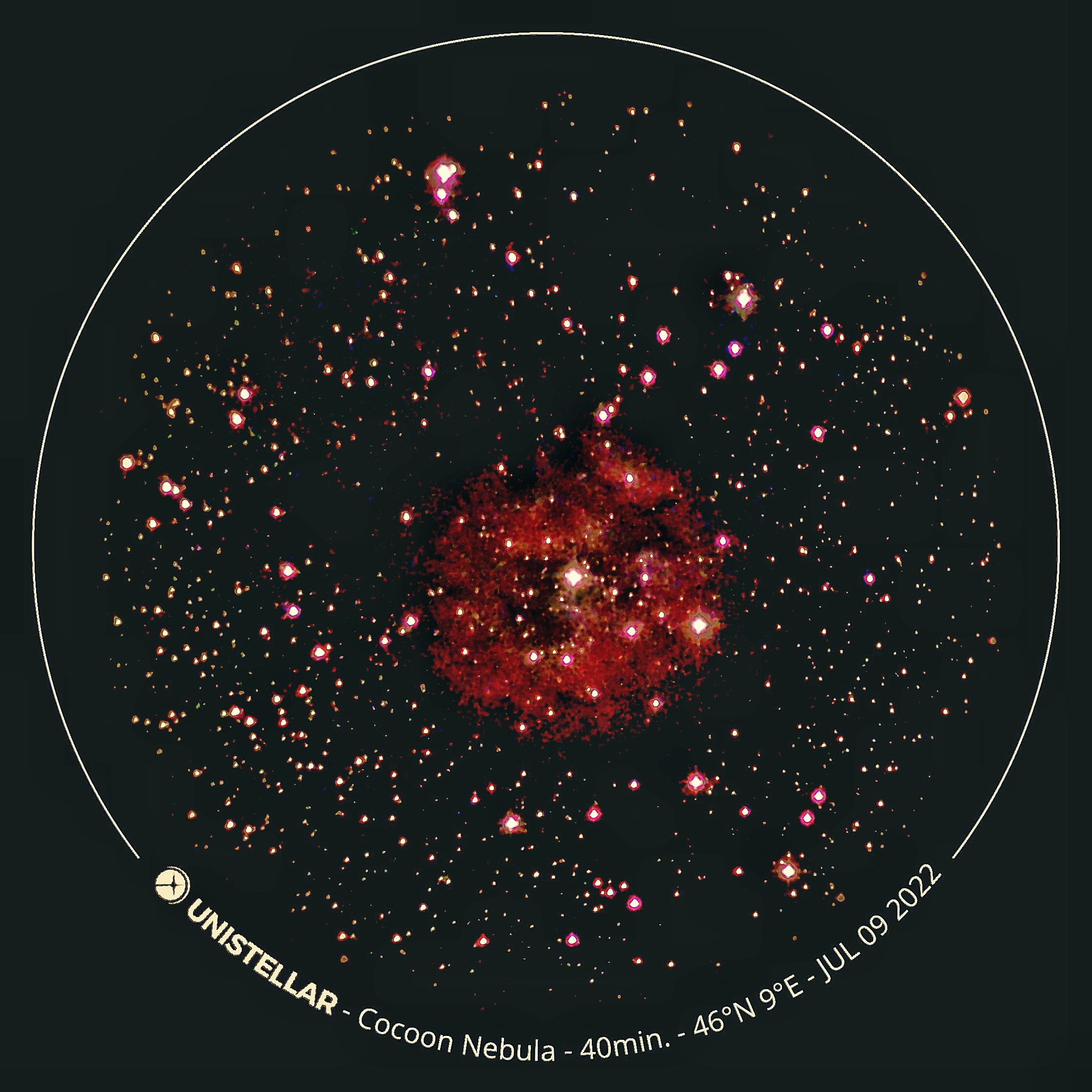
The Cocoon Nebula, also known as IC 5146, is a large and active star-forming region located in the constellation Cygnus. It is located about 3,000 light-years from Earth and is one of the most studied star-forming regions.

The Cocoon Nebula is a bright and colorful cloud of gas and dust illuminated by the intense radiation of massive young stars that have formed within it. The nebula is shaped like a cocoon and is about 10 light-years across.
The nebula is composed primarily of hydrogen gas and dust, with small amounts of other elements such as helium, oxygen, and carbon. The dust in the nebula is responsible for the vivid colors visible in images of the nebula, as it scatters and absorbs light in different ways. The massive stars that formed within the Cocoon Nebula are responsible for the intense radiation illuminating it. These stars are incredibly hot and emit large amounts of ultraviolet radiation, which ionizes the hydrogen gas in the nebula and causes it to glow.
The Cocoon Nebula is also home to several protostars, which are young stars still in the process of forming. These protostars are surrounded by disks of gas and dust that are thought to be the building blocks of planets. The study of the Cocoon Nebula has provided valuable insights into the star formation process and the properties of young massive stars. It has also been used to study the properties of dust and gas in the interstellar medium, as well as to search for evidence of protoplanetary disks and planet formation.
Overall, the Cocoon Nebula is a fascinating and beautiful object that continues to be the subject of intense study by astronomers. Its proximity and active star formation make it an ideal laboratory for understanding the star formation process.