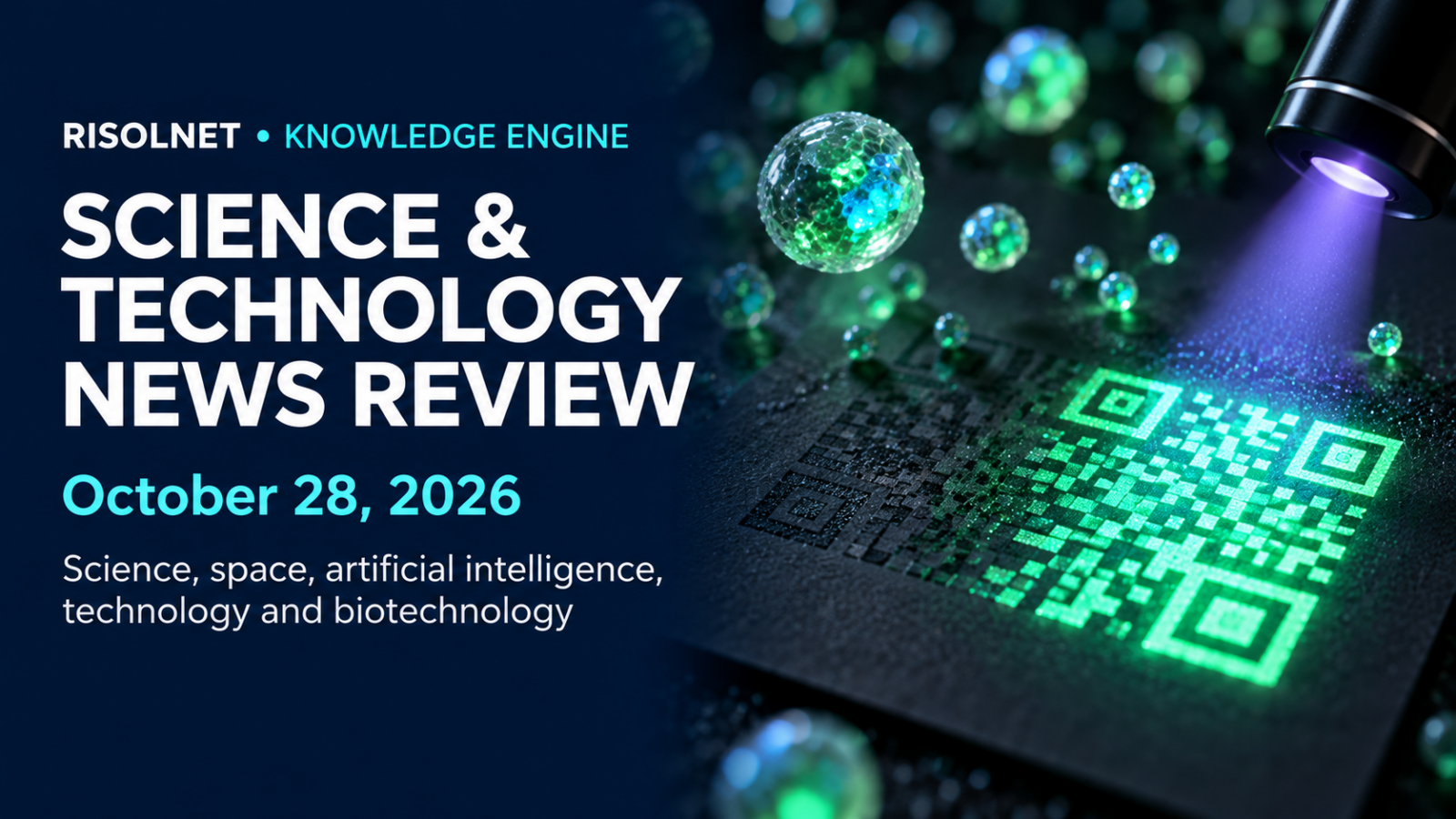
RKE / RISOLNET KNOWLEDGE ENGINE
SCIENCE & TECHNOLOGY NEWS REVIEW
Today’s Science & Technology News Review examines five developments reported on October 27, 2026, spanning satellite Earth observation, artificial intelligence, optical nanotechnology, cancer research and agricultural biotechnology.
A NASA satellite has documented the continuing journey of one of Antarctica’s large icebergs as it approaches South Georgia. Researchers have introduced a deep-learning model capable of estimating three-year breast cancer risk from screening mammograms, while a separate team has demonstrated a water-compatible nanomaterial ink that can encode information readable under near-infrared illumination.
Two additional studies investigate biological systems at very different scales. One reveals how subtle changes in the surface chemistry of nanoparticles influence their movement inside cells and the mechanisms of cancer-cell death. The other explores how beneficial bacteria may protect tomato plants from greenhouse whiteflies through a combination of insect suppression and stimulation of plant defenses.
The four research papers were published on October 27, 2026, in peer-reviewed Nature Portfolio journals. The NASA report was also released on October 27, although the satellite observation itself dates to October 20. Scientific findings are reported within the limits of the accessible abstracts and publication information. Experimental performance is distinguished from demonstrated clinical, agricultural or commercial effectiveness.
01
NASA Tracks Giant Antarctic Iceberg A-81 as It Approaches South Georgia
Satellite observations reveal how a massive iceberg, released from Antarctica in 2023, has traveled through the Southern Ocean and slowed near the underwater continental shelf surrounding a remote South Atlantic island.

Antarctica’s floating ice shelves periodically release enormous icebergs into the Southern Ocean. Some remain close to their parent ice shelves for years, while others eventually escape into ocean currents that transport them toward lower latitudes.
Iceberg A-81 is an example of the second trajectory, although its journey has been far from rapid.
On October 27, 2026, NASA Earth Observatory published a new account of the iceberg’s movement, supported by imagery acquired seven days earlier by the Moderate Resolution Imaging Spectroradiometer, or MODIS, aboard NASA’s Terra satellite.
The observation shows A-81 approaching South Georgia, a remote island in the South Atlantic Ocean approximately 2,300 kilometers north-northwest of the iceberg’s original location at Antarctica’s Brunt Ice Shelf.
A-81 separated from the Brunt Ice Shelf in January 2023. At the time of its formation, the iceberg covered approximately 1,550 square kilometers.
Its eventual separation followed a remarkably long geological process. A major fracture known as Chasm 1 had remained comparatively stable for approximately 35 years before beginning to expand again around 2012.
By 2019, the fracture was advancing rapidly enough that a major calving event appeared increasingly likely. Nevertheless, the ice shelf remained intact until January 2023.
After detachment, A-81 spent more than three years moving through the Weddell Sea. Its movement was influenced by the clockwise circulation of the Weddell Gyre, which transported the iceberg along the Antarctic coastline.
By May 2026, the iceberg had reached the northern end of the Antarctic Peninsula. It subsequently entered the Scotia Sea and continued toward South Georgia.
The October 20 satellite image revealed that A-81 had slowed significantly near the island’s underwater shelf.
According to specialists cited by NASA, the iceberg appeared to be interacting with the shallow submarine terrain surrounding South Georgia.
This region has previously influenced the movement of other large Antarctic icebergs. In 2025, iceberg A-23A temporarily grounded near South Georgia before subsequently breaking apart.
The Brunt Ice Shelf has experienced several major calving events in recent years. Iceberg A-74 separated in 2021, followed by A-81 in 2023 and A-83 in 2024.
NASA reports that A-83 remains intact and is following A-81 northward, together with several smaller icebergs.
These movements illustrate the importance of continuous satellite observations for understanding the evolution of Antarctic ice shelves and the subsequent behavior of detached icebergs.
The combination of repeated observations, oceanographic information and historical satellite imagery allows researchers to reconstruct iceberg trajectories over periods extending across several years.
Analysis
Established facts: NASA’s Terra satellite observed iceberg A-81 near South Georgia on October 20, 2026. The iceberg separated from the Brunt Ice Shelf in January 2023 and has traveled approximately 2,300 kilometers north-northwest of its original location.
Interpretation: The slowing of A-81 near South Georgia demonstrates how underwater topography can influence the movement of large floating ice masses. The region provides a useful natural setting for studying iceberg drift, grounding and eventual fragmentation.
Limitations: The satellite observation does not establish when A-81 will break apart or how its future trajectory will evolve. A single iceberg’s behavior cannot independently establish a long-term climate trend.
Scientific significance: Long-duration satellite monitoring makes it possible to follow large icebergs from the development of fractures within ice shelves through calving, ocean transport and eventual disintegration.
Publication context: This is an institutional NASA Earth Observatory report published October 27, 2026, based on satellite data acquired October 20. It is not a newly published peer-reviewed research paper.
02
BREST-AI Predicts Three-Year Breast Cancer Risk from Screening Mammograms
A deep-learning system developed using data from more than 65,000 women demonstrates improved risk discrimination over an established comparator in a large external UK validation cohort.

Breast cancer screening is designed to identify malignancies before they become clinically apparent. However, mammograms may contain information extending beyond the detection of cancers already present at the time of examination.
Researchers are increasingly investigating whether artificial intelligence can identify imaging patterns associated with the probability of developing breast cancer during subsequent years.
A study published in npj Breast Cancer on October 27, 2026, introduces BREST-AI, a deep-learning model designed to estimate three-year breast cancer risk using mammograms interpreted as negative at screening.
The research team, led by investigators associated with the University of Warwick and collaborating UK institutions, developed the system using data from 65,419 women.
The model was trained using data from 58,591 women, including 9,020 cancer cases, 1,633 benign cases and 47,938 women who remained cancer-free over the three-year observation period.
The researchers used a curriculum-learning strategy, an approach in which the training process is organized to help the model learn progressively from different examples or tasks.
The resulting system was evaluated against Mirai, an existing artificial intelligence model developed for mammography-based breast cancer risk prediction.
In a large external UK case-control validation cohort containing 1,899 cancer cases and 5,697 matched controls, BREST-AI achieved an area under the receiver operating characteristic curve, or AUC, of 0.751.
The reported 95 percent confidence interval ranged from 0.738 to 0.764.
Mirai achieved an AUC of 0.700 in the same comparison. The difference was statistically significant, with a reported p value below 0.001.
AUC measures how well a model discriminates between individuals who experience an outcome and those who do not. A value of 0.5 corresponds to chance-level discrimination, while 1.0 represents perfect discrimination within the evaluated dataset.
The researchers also evaluated performance in an external US cohort containing 97 cases and 291 matched controls.
BREST-AI achieved an AUC of 0.670, compared with 0.633 for Mirai. However, this difference was not statistically significant.
The authors describe the US analysis as exploratory because its relatively small sample size limited the ability to detect modest performance differences.
An additional UK cohort tested performance across mammography equipment from a different manufacturer.
In this cross-vendor evaluation, which included 400 cases and 1,200 matched controls, BREST-AI achieved an AUC of 0.719, compared with 0.685 for Mirai.
The results indicate that changes in imaging equipment affected discrimination, although BREST-AI retained an advantage in this particular evaluation.
The researchers also estimated how model performance might translate to the prevalence of breast cancer within the English screening population.
Using an assumed prevalence of eight cancers per 1,000 screening examinations and a high-risk operating point defined by 99 percent specificity, they estimated a positive predictive value of 8.0 percent.
This estimate illustrates an important distinction between ranking individuals by risk and accurately predicting the outcome for any particular person.
The findings suggest that BREST-AI may eventually contribute to risk-stratified screening strategies, in which follow-up schedules or additional assessments are tailored to individual risk.
However, the study does not establish that implementing the model would reduce breast cancer mortality or improve clinical outcomes.
Analysis
Established findings: BREST-AI achieved an AUC of 0.751 in the principal external UK validation cohort, outperforming Mirai’s AUC of 0.700. Performance was lower in the smaller US cohort and in a UK cross-vendor evaluation.
Interpretation: Screening mammograms may contain information relevant to future breast cancer risk even when no malignancy is identified during the examination. Artificial intelligence could potentially help extract this information for personalized risk assessment.
Limitations: The evaluations were based on retrospective datasets and case-control comparisons. The prevalence-adjusted positive predictive value was estimated rather than prospectively measured in a deployed screening program.
Clinical considerations: Discrimination, calibration, fairness across patient populations and the consequences of false-positive or false-negative risk classifications must be evaluated before routine implementation.
Scientific significance: The study provides further evidence that deep learning may support intermediate-term cancer risk prediction, while reinforcing the importance of independent validation across populations and imaging equipment.
03
Researchers Develop a Water-Compatible Nanoink for Invisible Printing and Optical QR Authentication
Lanthanide-doped nanoparticles enable printed information to become detectable under near-infrared illumination, opening an experimental route toward covert labels and product authentication.

Conventional printed security features are often visible under ordinary lighting. Although holograms, specialized pigments and other optical elements can make counterfeiting more difficult, researchers continue to investigate methods for encoding information that remains hidden until examined under specific conditions.
One promising approach uses upconversion nanoparticles, materials capable of absorbing lower-energy photons and emitting light at shorter wavelengths.
This behavior allows certain nanoparticles to produce visible emission when illuminated with near-infrared light.
A study published in Scientific Reports on October 27, 2026, describes a water-compatible nanoink based on lanthanide-doped upconversion nanoparticles.
The researchers developed lithium yttrium fluoride nanoparticles containing ytterbium and erbium ions, arranged in a core-shell architecture.
The particles were coated with polyacrylic acid to improve their compatibility with water-based formulations.
This surface treatment is important because particles suitable for optical experiments are not necessarily compatible with the viscosity, dispersion stability and processing requirements of printing systems.
The team used X-ray diffraction and transmission electron microscopy to investigate the structural characteristics of the nanoparticles.
The measurements supported retention of the tetragonal crystalline phase and particle morphology after surface treatment.
Fourier-transform infrared spectroscopy provided additional evidence of changes in surface chemistry associated with the polymer coating.
Optical measurements demonstrated that forming the lithium yttrium fluoride shell increased green photoluminescence intensity by approximately 2.7 times.
Across the investigated nanoink concentrations, the researchers also reported an approximately 28-fold increase in background-corrected green peak intensity.
The researchers evaluated four ink formulations before selecting a mixture containing aqueous ethanol and glycerol.
The selected formulation used a 65:35 volume ratio of 10 percent aqueous ethanol to glycerol.
Using a conventional inkjet printer, the team demonstrated the printing of covert text.
They also investigated the ability to encode information in QR codes that could be read after near-infrared excitation.
The experimental readout required a near-infrared imaging system to acquire the optical signal. A smartphone subsequently decoded the camera image displayed on a computer screen.
This distinction is important: the experiment did not demonstrate that an ordinary smartphone camera could independently detect the invisible printed code without specialized illumination and imaging equipment.
QR-code decoding performance depended strongly on nanoparticle concentration.
At concentrations of 1, 2.5 and 5 milligrams per milliliter, decoding success rates were 5, 25 and 85 percent, respectively, across 20 decoding attempts.
At concentrations of 7.5, 10 and 20 milligrams per milliliter, the researchers reported successful decoding in all 20 attempts for each concentration.
The results demonstrate that optical signal intensity and formulation concentration are critical factors in achieving reliable machine-readable covert printing.
Potential applications include anticounterfeiting labels, product authentication and specialized information encoding.
However, the reported experiments establish laboratory feasibility rather than commercial durability, resistance to sophisticated counterfeiting or compatibility with large-scale printing operations.
Analysis
Established findings: The researchers produced a water-compatible upconversion nanoink and demonstrated covert printing using an inkjet printer. Under the reported experimental conditions, QR-code decoding reached 100 percent success across 20 attempts at nanoparticle concentrations of 7.5 milligrams per milliliter or higher.
Interpretation: The study illustrates how nanoscale optical properties can be integrated into conventional manufacturing processes. Surface chemistry and formulation engineering are as important as the luminescent material itself.
Limitations: The experiments do not establish long-term stability, resistance to abrasion, performance across different substrates or security against deliberate replication. The decoding process also required specialized near-infrared imaging.
Practical significance: Water-compatible formulations could simplify the integration of upconversion materials into certain printing workflows, provided that future studies establish durability, reproducibility and appropriate manufacturing economics.
Scientific significance: The work connects materials chemistry, optical spectroscopy and information encoding through a reproducible laboratory demonstration.
04
Nanoparticle Surface Chemistry Determines How Cancer Cells Experience Iron-Dependent Cell Death
Changing a minority component of the molecular coating on nanoparticles redirects them toward different intracellular compartments and alters the mechanisms of cell death observed in laboratory experiments.

Nanoparticles are increasingly investigated as tools for interacting with biological systems at the cellular and molecular levels.
Their behavior depends not only on particle size and composition but also on the chemical groups attached to their surfaces.
Surface molecules influence how nanoparticles interact with proteins, cell membranes and intracellular compartments.
A study published in Nature Communications on October 27, 2026, investigates how relatively small changes in nanoparticle surface chemistry can produce substantially different biological outcomes.
The researchers focused on nanoparticles coated with mixed-charge molecular monolayers.
These coatings contain both positively and negatively charged ligands. Previous investigations had established that certain mixed-charge configurations can selectively induce cancer-cell death under experimental conditions.
The new study examined what happens when the overall proportions and electrical polarities of the surface ligands remain unchanged but the chemical identity of the minority negatively charged component is modified.
The researchers compared ligands containing carboxylic, sulfonic and phosphonic acid end groups.
Despite preserving the general charge imbalance, these substitutions produced different intracellular localization patterns.
Nanoparticles containing carboxylic acid groups accumulated preferentially in lysosomes.
Particles containing sulfonic acid groups were associated with autophagic compartments, while phosphonic acid groups promoted accumulation in late endosomes.
These compartments perform different functions within cells.
Lysosomes participate in the degradation and recycling of cellular material. Endosomes are involved in the internal transport and sorting of molecules, while autophagic compartments participate in processes that remove or recycle intracellular components.
The observed differences suggest that the precise chemistry of a nanoparticle’s surface can influence its intracellular destination.
The researchers also investigated the forms of cell death associated with these different localization patterns.
They observed iron-dependent lipid-peroxidation-driven processes resembling ferroptosis.
Ferroptosis is a regulated form of cell death associated with iron-dependent oxidative damage to membrane lipids.
However, the authors deliberately describe the observed responses as ferroptosis-like because caspase activation occurred concurrently.
Caspases are enzymes involved in several cellular signaling processes, including apoptosis. Their activation complicates the classification of the observed death mechanism as conventional ferroptosis alone.
Another important component of the study concerned the protein corona.
When nanoparticles encounter biological fluids, proteins can adsorb onto their surfaces, forming a molecular layer that changes how the particles interact with cells.
Proteomic analysis revealed highly complex protein coronas containing more than 800 different proteins.
Some proteins were enriched hundreds or thousands of times relative to their abundance in serum, and different nanoparticle formulations preferentially accumulated different protein groups.
These findings indicate that relatively subtle surface modifications can influence both the proteins associated with nanoparticles and their subsequent intracellular behavior.
The research provides a possible strategy for controlling subcellular targeting through materials chemistry.
However, selective cancer-cell death in laboratory experiments does not establish that the nanoparticles are safe or effective as treatments in living organisms or patients.
Analysis
Established findings: Changing the chemical identity of minority negatively charged ligands altered nanoparticle localization among lysosomes, autophagic compartments and late endosomes. These changes were associated with different ferroptosis-like cell-death responses and distinct protein-corona compositions.
Interpretation: The findings suggest that surface chemistry can provide a powerful means of influencing how engineered nanoparticles interact with intracellular structures.
Limitations: The study does not establish clinical anticancer efficacy. The observed biological responses cannot be described as pure ferroptosis because the researchers also detected caspase activation.
Biological considerations: Protein-corona formation may depend on the biological environment. Interactions observed in laboratory conditions may differ from those occurring in the circulation or tissues of a living organism.
Scientific significance: The work highlights the importance of molecular surface design in nanomedicine and provides experimental evidence linking ligand chemistry, protein adsorption, intracellular trafficking and cell-death mechanisms.
05
Beneficial Bacillus Bacteria Show Potential for Controlling Greenhouse Whiteflies in Tomato Crops
An experimental study finds that selected bacterial strains can reduce insect egg-laying, increase nymph mortality and stimulate plant defense responses through multiple biochemical mechanisms.

Greenhouse whiteflies are economically important agricultural pests capable of damaging crops through feeding activity and the transmission of plant pathogens.
Trialeurodes vaporariorum, commonly known as the greenhouse whitefly, affects numerous cultivated plants, including tomatoes.
Chemical insecticides are widely used for pest management, but their extensive application raises concerns about environmental exposure, resistance development and unintended effects on other organisms.
Biological control strategies seek to reduce pest populations through organisms or biological products capable of interfering with insect development, reproduction or survival.
A study published in Scientific Reports on October 27, 2026, investigates the potential of selected Bacillus bacterial strains to control greenhouse whiteflies while stimulating defensive responses in tomato plants.
The researchers evaluated Bacillus velezensis UTB96, Bacillus licheniformis NBT-192 and a genetically modified Bacillus velezensis strain designated UTB97.
The modified strain carried a deletion of the codY regulatory gene.
The study investigated several complementary outcomes, including insect egg-laying preferences, mortality during immature developmental stages, plant biochemical defenses and bacterial production of biologically active lipopeptides.
In free-choice preference tests, the bacterial treatments reduced whitefly oviposition.
Bacillus licheniformis NBT-192 produced the largest reported reductions in egg-laying, reaching 91.65 percent in one tomato cultivar and 83.33 percent in another when compared with untreated controls.
The researchers also examined mortality among whitefly nymphs and puparia.
Bacillus licheniformis produced the highest mortality in the reported bioassays, reaching 51.33 percent.
The results indicate that the bacterial treatments affected both insect reproduction and survival, although their relative effectiveness differed among the investigated strains.
The study also found changes in plant defense-related biochemical markers.
Bacterial treatments increased the accumulation of anthocyanins and phenolic compounds and enhanced peroxidase activity.
These responses are relevant because plant defensive metabolism can influence interactions with herbivorous insects and environmental stress.
In the reported experiments, peroxidase activity increased from 25.90 in control plants to 44.98 following treatment with Bacillus licheniformis.
The genetically modified Bacillus velezensis UTB97 strain produced the highest anthocyanin concentrations among the investigated treatments.
The researchers also measured bacterial production of three classes of lipopeptides: surfactin, iturin and fengycin.
These compounds are associated with several biological activities, including interactions with microbial membranes and plant defense signaling.
All three bacterial strains produced the investigated lipopeptides, but their relative production levels differed.
Bacillus velezensis UTB96 produced the highest reported concentrations of surfactin and iturin, while Bacillus licheniformis produced the highest fengycin concentration.
The bacterial treatments were additionally associated with increased uptake of several plant nutrients, including nitrogen, phosphorus, potassium, calcium, manganese, zinc, iron and boron.
Magnesium uptake did not show a statistically significant increase.
Taken together, the findings suggest that beneficial bacteria may influence pest management through several interacting mechanisms rather than a single insecticidal effect.
The researchers identify Bacillus licheniformis NBT-192 as a particularly promising candidate for further biological-control investigations.
Nevertheless, the study does not establish that these bacterial strains will provide reliable protection under all commercial greenhouse or open-field conditions.
Analysis
Established findings: Bacillus treatments reduced whitefly egg-laying and increased mortality in the experimental bioassays. Bacillus licheniformis NBT-192 produced the largest reported reduction in oviposition and the highest immature-stage mortality.
Interpretation: Biological pest management may benefit from microorganisms that influence both the pest and the host plant. The combined effects on insect behavior, defensive metabolism and nutrient uptake could provide advantages over approaches targeting only one biological process.
Limitations: The findings derive from controlled experimental conditions. Their effectiveness under commercial cultivation, different environmental conditions and varying pest pressures remains to be established.
Regulatory considerations: The experimental results do not imply that any of the investigated strains, particularly the genetically modified codY deletion strain, is approved for unrestricted agricultural application.
Scientific significance: The study expands understanding of plant-microbe-insect interactions and provides evidence supporting further research into Bacillus-based biological pest control.
The RKE Signal
Today’s research highlights a recurring scientific principle: meaningful technological progress depends on understanding interactions between systems, not simply improving individual components.
The satellite observations of iceberg A-81 demonstrate how large-scale environmental processes can be reconstructed through continuous measurements. The iceberg’s journey reflects interactions among ice dynamics, ocean currents and submarine topography. Its changing position can be observed directly, while its future behavior remains uncertain.
The BREST-AI study approaches complexity through statistical learning. Mammograms contain information that may help estimate future cancer risk, but the usefulness of such predictions depends on discrimination, calibration, population characteristics and the consequences of clinical decisions.
The nanoink research shows how materials chemistry can transform a familiar manufacturing process. By engineering the structure and surface compatibility of luminescent nanoparticles, researchers demonstrated the ability to print information that becomes readable under specialized optical conditions.
The cancer nanomedicine investigation reveals that even subtle molecular changes can substantially alter biological behavior. Replacing one type of negatively charged surface group with another redirected nanoparticles toward different intracellular compartments and changed the associated cell-death responses.
The agricultural biotechnology study illustrates another form of biological interaction. Beneficial bacteria influenced insect reproduction and survival while also modifying plant defense markers and nutrient uptake. The findings suggest that effective biological control may involve coordinated effects across multiple organisms.
These five developments operate across an extraordinary range of physical scales, from a giant Antarctic iceberg to nanoscale molecular coatings.
Yet the underlying scientific challenge is similar. Researchers must identify which mechanisms are responsible for observed outcomes, determine how reliably those mechanisms operate and establish whether experimental findings remain valid outside controlled conditions.
The distinction between demonstrated capability and practical implementation is especially important. A model that predicts cancer risk is not automatically a clinically beneficial screening intervention. A covert optical label is not necessarily resistant to sophisticated counterfeiting. Nanoparticle-induced cell death does not establish a safe cancer therapy, and promising biological pest control does not guarantee reliable agricultural performance.
The RKE Signal for October 28 is clear: the next generation of scientific technologies will be shaped by the ability to understand, measure and control interactions across complex systems, while preserving a rigorous distinction between experimental success and demonstrated real-world value.