




RKE / RISOLNET KNOWLEDGE ENGINE
DAILY SCIENCE & TECHNOLOGY BRIEF
Today’s selection is about hidden structures becoming visible: tidal scars around a famous galaxy, the economic limits behind apparently capable robots, photonic links between AI processors and memory, a molecular switch controlling bacterial spores, and a surprisingly dynamic form of archaeal locomotion.
Astronomy & Space
01
The Sombrero Galaxy Reveals the Scars of Its Violent Past
A remarkably deep view of M104 exposes an extended stellar halo, a diagonal ring and faint tidal streams that point toward a history of galactic collisions and mergers.
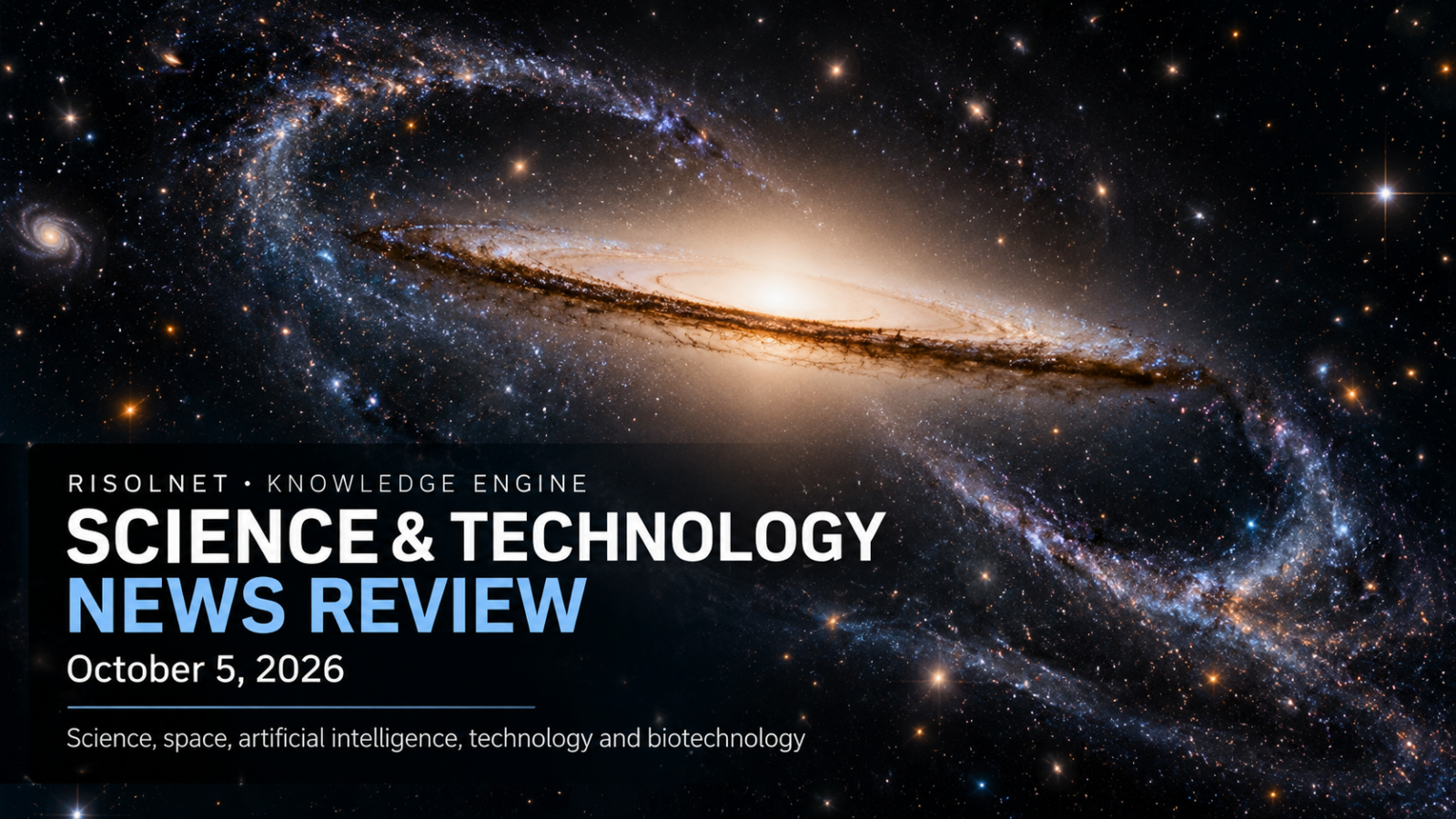
NASA’s Astronomy Picture of the Day for October 5 features a deep image of M104, the Sombrero Galaxy, assembled from observations made over seven days in Namibia. Beyond its familiar bright bulge and dark dust lane, the exposure reveals a much larger halo populated by unresolved stars, along with faint structures including a diagonal ring and tidal streams.
NASA’s accompanying scientific description interprets these structures as fresh evidence that M104 was shaped by collisions and mergers with smaller galaxies. Light from the system takes roughly 30 million years to reach Earth, while the galaxy and its extended structures span about 150,000 light-years.
Analysis
The observation illustrates the scientific value of surface-brightness depth: structures that are effectively invisible in shorter exposures can preserve evidence of interactions long after the main galaxies have relaxed. Tidal streams and stellar rings are therefore valuable pieces of galactic archaeology.
The image provides morphological evidence rather than a complete reconstruction of M104’s merger history. Determining the masses, number and timing of previous interactions requires additional observations and dynamical modelling.
Artificial Intelligence
02
Robots Can Perform 74% of Physical Tasks — but the Economics Tell a Very Different Story
Anthropic’s robot exposure index separates technical capability from economic deployment, revealing a striking gap between what machines can do and what currently makes financial sense.
Anthropic estimates that existing robots can perform 74% of physical work tasks in the United States in at least some environment. Those tasks represent about 34% of total working hours. Yet robots are currently estimated to be cost-competitive with human workers for only about 0.3% of job tasks.
The study classifies robotic capability according to the environment required, ranging from purpose-built robotic settings to unstructured human environments. Under a scenario in which robot prices continue to decline at historical rates, the researchers estimate that reaching cost competitiveness for 10% of work would take about forty years.
Analysis
The central lesson is that capability is not deployment. A robot that can perform a task on a purpose-built production line is not equivalent to a machine that can reliably perform it in an unpredictable human workplace. Manipulation, reliability, integration, regulation, human preferences and cost all intervene between demonstration and adoption.
The figures are model-based estimates focused on the US labour market, not forecasts of job losses. Anthropic also uses model-assisted task classification and approximate cost estimates, so the precise percentages should be read in the context of those assumptions.
Technology
03
Volantis Wants Light to Break AI’s Memory Bottleneck
The semiconductor startup has raised $88 million to develop photonic connections designed to move data between AI processors and far larger pools of memory.
San Francisco-based Volantis is developing interconnect technology that uses laser light rather than conventional short electrical links to move data between computing chips and memory. Reuters reports that the company has raised $88 million in venture funding for the project.
The approach uses vertical-cavity surface-emitting lasers, or VCSELs, components already manufactured at large scale for applications including consumer electronics. Volantis says photonic links could allow as many as 220 memory chips to be connected around a GPU, addressing the reach limitations of electrical interconnects. The company aims to deliver a chip next year.
Analysis
AI performance increasingly depends not only on arithmetic throughput but on memory capacity, bandwidth and the energy required to move data. Photonic interconnects are attractive because light can move information over greater distances at high bandwidth without reproducing every limitation of electrical wiring.
The architecture remains a development-stage technology rather than a commercially validated large-scale system. Claims about memory scale and resulting AI performance therefore remain engineering targets until demonstrated in deployed hardware.
Biotechnology
04
A Molecular Switch Helps Explain How C. difficile Forms Spores
Seven small membrane-associated proteins connect the bacterial messenger c-di-GMP with the machinery that allows the pathogen to enter its highly persistent spore state.
An open-access study published in Nature Communications on October 4 identifies a conserved family of seven small membrane-associated proteins involved in sporulation by Clostridioides difficile. Their genes are controlled by c-di-GMP-responsive riboswitches, providing a molecular link between a major bacterial signalling molecule and spore formation.
Increasing expression of one gene, CD1980.2, activated sporulation genes and increased spore production. Conversely, sporulation progressively declined as members of the seven-gene family were deleted, with deletion of all seven producing a severe defect.
Analysis
Because spores contribute to environmental persistence and transmission of C. difficile, defining the signalling circuit that controls their formation gives researchers a more detailed map of an important pathogenic process.
This is mechanistic biology, not a demonstrated therapy. The study does not show that manipulating the pathway reduces infection or transmission in patients, and translating a regulatory mechanism into a safe drug target requires substantial additional work.
Life Sciences
05
Asgard Archaea Have Been Filmed Crawling With Actin-Driven Protrusions
Live-cell microscopy reveals a surprisingly dynamic form of motility in microorganisms closely related to the archaeal lineage implicated in the origin of eukaryotic cells.
Researchers studying cultivated members of the Lokiarchaea and Hodarchaea lineages observed cells rapidly changing shape, extending and retracting long protrusions at roughly 1.5 to 4.8 micrometres per minute. Once attached to a glass surface, the cells used those structures to crawl.
Selected actin inhibitors arrested the dynamics, supporting a central role for the organisms’ actin-based cytoskeleton. The work is particularly notable because Asgard archaea are considered the closest known prokaryotic relatives of eukaryotes.
Analysis
Actin-dependent shape change and crawling are hallmarks of eukaryotic cell biology. Finding related capabilities in modern Asgard archaea suggests that some ingredients of sophisticated cellular dynamics may predate the emergence of eukaryotic cells and could have helped ancestral organisms establish close cellular interactions.
The organisms observed are modern species, not preserved ancestors of eukaryotes. Their behaviour can inform hypotheses about eukaryogenesis, but it does not directly show how the first eukaryotic cell formed.
The RKE Signal
Today’s common thread is the interface. M104’s faint stellar structures connect a galaxy’s present appearance with its gravitational past. Robotics meets economics at the boundary between technical capability and deployability. Volantis is redesigning the interface between memory and compute. C. difficile translates a signalling molecule into a developmental decision through small regulatory proteins, while Asgard archaea turn cytoskeletal dynamics into movement. Progress increasingly comes not only from inventing new components, but from understanding and redesigning how systems communicate with one another.