




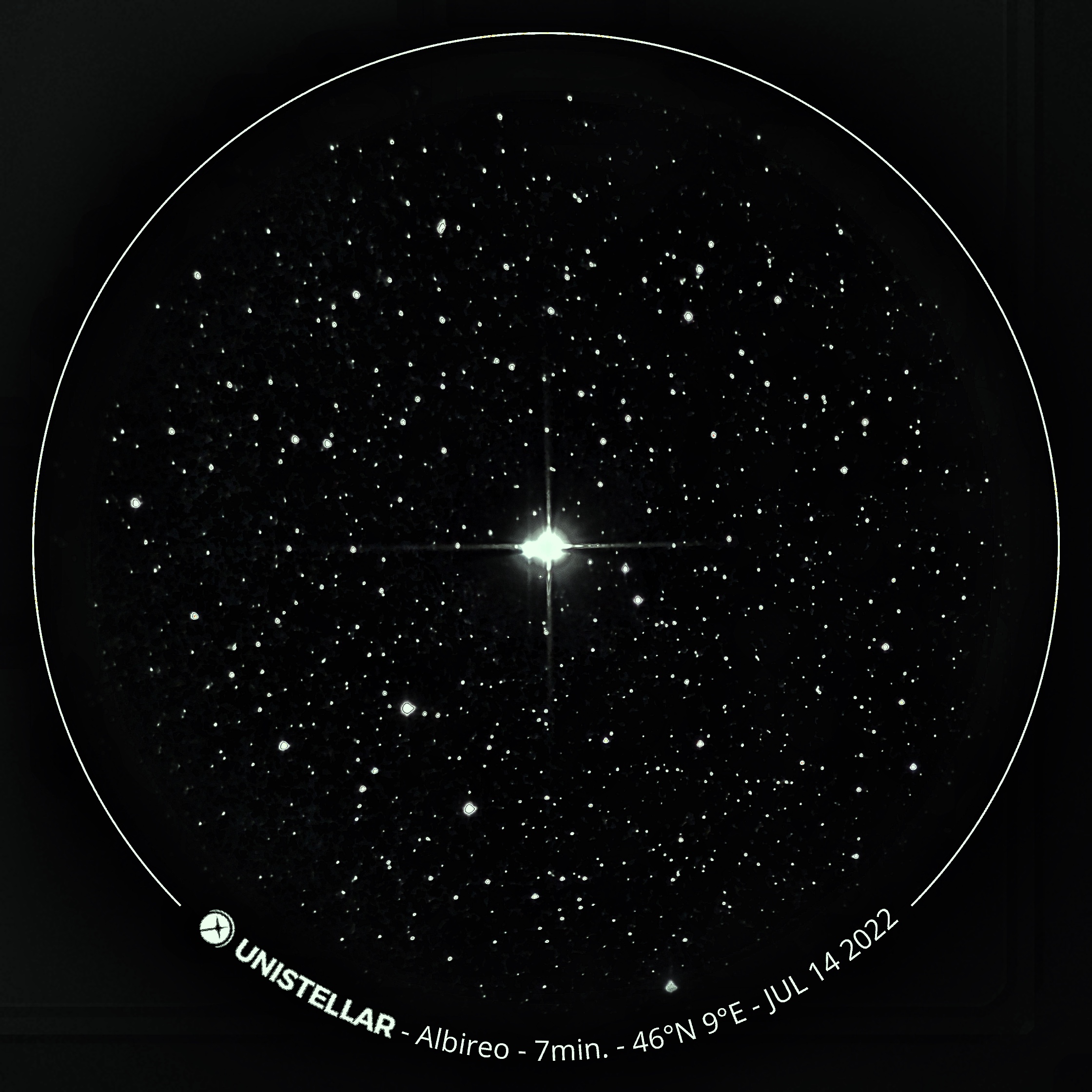
Albireo, also known as Beta Cygni, is a binary star system located in the constellation Cygnus. It is located approximately 380 light-years from Earth and is one of the most spectacular double stars in the night sky.
Albireo is composed of two stars: a yellow-orange primary star and a blue-green secondary star. The primary star is a giant G-type star with a surface temperature of approximately 5,500 K and a luminosity approximately 80 times that of the Sun. The secondary star is a main sequence, B-type star with a surface temperature of approximately 11,000 K and a luminosity approximately 20 times that of the Sun.
The two stars of the Albireo system are separated by approximately 35 arc seconds, equivalent to a physical distance of approximately 400 astronomical units (AU). This distance is large enough that the two stars are not interacting and are likely not gravitationally bound. The primary star of the Albireo system is a relatively mature star that has exhausted the hydrogen fuel in its core and expanded to become a giant. Its surface is rich in elements such as carbon, nitrogen, and oxygen, which were created through nuclear fusion in its core. The secondary star, on the other hand, is a much younger, hotter, and more massive star that is still burning hydrogen in its core.
The contrast in color between the two stars of the Albireo system is due to their different surface temperatures. The primary star is cooler and emits most of its light in the red and yellow parts of the spectrum, while the secondary star is hotter and emits most of its light in the blue and green parts of the spectrum.
The Albireo system has been extensively studied by astronomers and is often used as a testbed to study the properties of binary stars and their formation.
Overall, Albireo is a beautiful and interesting star system easily visible with a small telescope or binoculars. Its color contrast and proximity make it an ideal target for amateur astronomers and a valuable laboratory for studying the properties of binary stars.