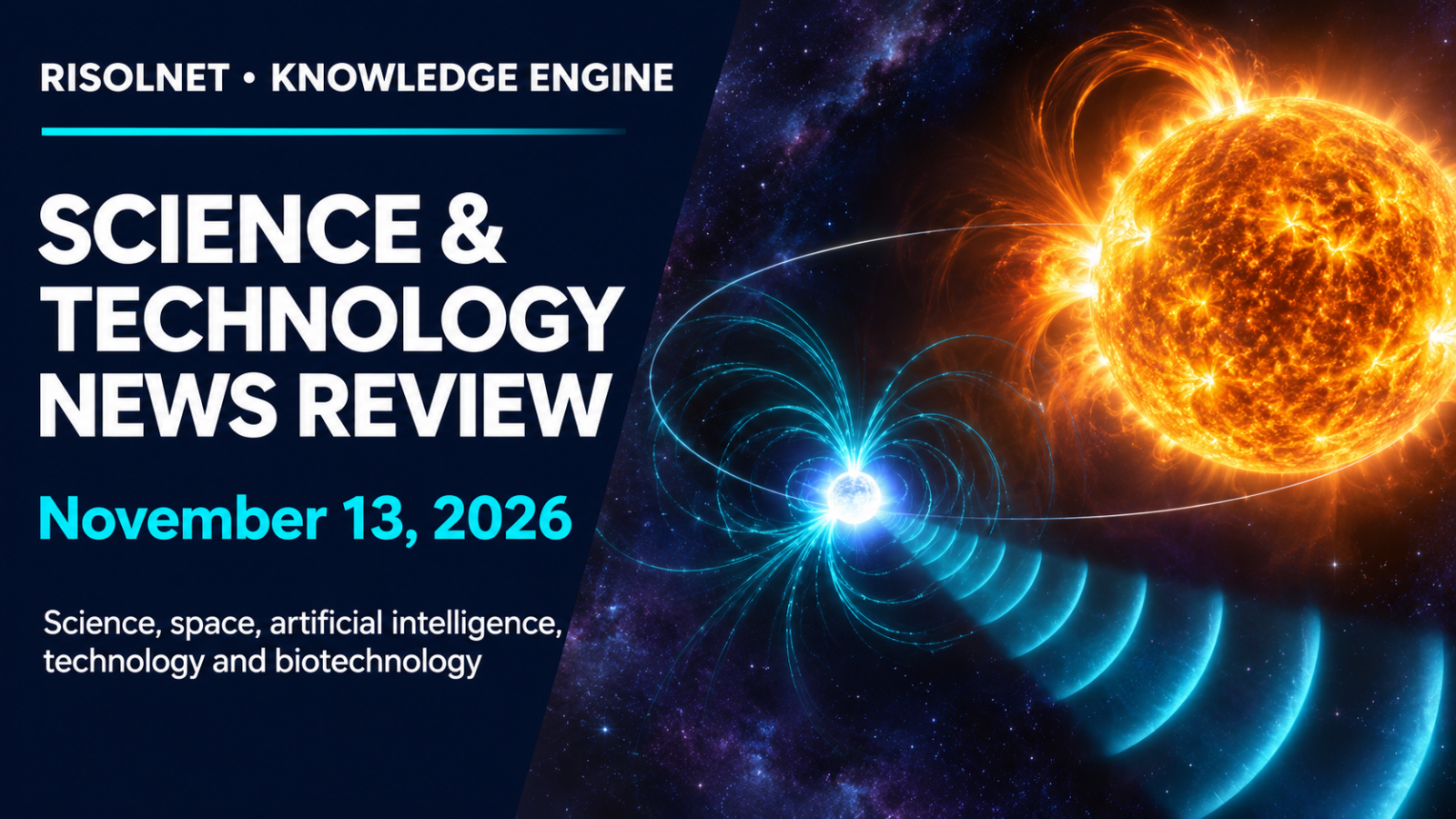
Science & Technology News Review
The scientific developments in today’s edition share an important characteristic: they reveal behaviours that become visible only when researchers examine how different parts of a system interact. Astronomers are using radio pulses to investigate a distant stellar partnership. Climate scientists are improving artificial intelligence by deliberately choosing unusual training scenarios. Biomedical engineers are recreating mechanical forces inside human heart tissue, while other researchers investigate the molecular control of cardiac scarring and the surprising transport of heat through atomic-scale glass.
These five reports draw on research published or communicated around November 11 and 12, 2026. Their evidence ranges from astronomical observations and computational experiments to engineered human tissues, mouse studies and nanoscale physical measurements. The distinction matters: discovering a mechanism is not the same as demonstrating a practical treatment or a deployable technology.
01
A White Dwarf and a Sun-Like Star Produce Radio Pulses Every Eight Minutes
An unusual stellar partnership provides new evidence about the origin of long-period radio transients and reveals magnetic activity thousands of light-years away.
Astronomers at the International Centre for Radio Astronomy Research, working through Curtin University in Australia, have identified an unusual binary star system responsible for repeating radio signals. The system, GPM J071507−114153, contains a low-mass white dwarf and a G-type star similar to the Sun.
The research was published in Nature Astronomy on November 12, 2026. The radio pulses repeat approximately every 7.9 minutes, placing the object among the emerging class of astronomical sources known as long-period transients. These objects emit strongly polarized radio signals at intervals much longer than those of conventional rapidly rotating radio pulsars.
Earlier observations had associated several long-period transients with white dwarfs paired with small, cool red dwarf stars. The newly identified system demonstrates that a Sun-like companion can also participate in the process.
The researchers combined observations from the Murchison Widefield Array in Australia, MeerKAT in South Africa and optical measurements from the W. M. Keck Observatory. More than 100 hours of radio data were processed to investigate the source and its orbital behaviour.
The timing of the pulses changes in a way consistent with the white dwarf’s movement around its companion. The longer modulation, approximately 1.3 days, is interpreted as the binary orbital period. This supports the conclusion that the coherent radio emission originates close to the white dwarf, potentially from the compact star itself.
The observations also provide information about the atmosphere of the Sun-like companion. Changes in the polarization of radio waves are consistent with their passage through magnetized plasma, including a possible stellar prominence. Such measurements allow astronomers to investigate magnetic activity in a system more than 5,000 light-years away.
The result strengthens the idea that interactions between compact stellar remnants and their companions are central to at least some long-period radio transients. Future observations with the Square Kilometre Array may help establish how common these systems are and which physical processes generate their intense, coherent emission.

Analysis
Evidence: Radio timing, polarization measurements and optical spectroscopy identify a long-period transient associated with a white dwarf and a G-type companion.
Interpretation: The discovery broadens the range of stellar systems capable of producing long-period coherent radio emission. Magnetic interactions within binary systems may be more important than previously recognized.
Limitations: The precise emission mechanism has not been established conclusively. The study constrains the location of the radio source but does not fully resolve its physical origin. The original journal abstract and institutional research communication were examined; the complete subscription-only article was not independently reviewed.
Publication: Peer-reviewed research, Nature Astronomy, November 12, 2026.
02
MIT Improves Climate AI by Training Models on Unusual Emissions Scenarios
Optimized synthetic training data could make climate emulators more adaptable while reducing their dependence on expensive Earth-system simulations.
Climate researchers rely on sophisticated Earth-system models to investigate how greenhouse gases, atmospheric chemistry and human activities may influence future environmental conditions. These physics-based models are powerful but computationally expensive, with individual scenarios sometimes requiring substantial supercomputing resources.
Artificial intelligence offers a complementary approach through climate emulators: smaller models trained to reproduce the behaviour of more complex simulations. Once trained, an emulator can evaluate many scenarios in seconds rather than requiring a full simulation for each one.
Researchers at the Massachusetts Institute of Technology have developed a method for improving how these emulators are trained. Their work, described in a research communication dated November 12, 2026, appears in the Proceedings of the National Academy of Sciences under the title “Optimal scenario design for climate emulation.”
Conventional training often relies on a limited collection of realistic emissions trajectories. Although these scenarios resemble plausible futures, they may not provide enough information for the emulator to generalize reliably to unfamiliar conditions.
The MIT team instead developed an optimization algorithm that generates synthetic emissions scenarios specifically designed to improve the emulator’s predictive ability. These training examples can contain abrupt changes and rapid fluctuations in emissions that would be unlikely in a real-world policy scenario.
The unusual training data serve a technical purpose: they expose the model to a broader range of system responses. In the researchers’ experiments, an emulator trained with carefully optimized synthetic data reproduced scenarios that it had not encountered during training more effectively than conventional approaches.
The method could also reduce the number of expensive Earth-system simulations required to construct a training dataset. The researchers describe a workflow in which a single reference simulation can help generate an optimized collection of scenarios, rather than requiring six or eight separate full-scale simulations.
An important test involved local pollutant-control policies. The optimized emulator captured responses to interventions that reduced one pollutant while other emissions continued increasing, a situation in which the conventional emulators evaluated by the team performed poorly.
The broader implication extends beyond climate science. In machine learning, realistic training examples are not always the most informative examples. Carefully designed synthetic data can sometimes reveal the structure of a system more efficiently than a larger collection of ordinary observations.

Analysis
Evidence: Optimized synthetic training scenarios improved emulator performance on previously unseen emissions conditions in the researchers’ computational evaluations.
Interpretation: Training-data design can be as important as model architecture. Deliberately informative scenarios may improve scientific AI without proportionally increasing computational expense.
Limitations: An emulator remains an approximation of its underlying physical model. Better reproduction of simulated climate behaviour does not eliminate uncertainty in the Earth-system model itself. Broader validation remains necessary.
Publication: Peer-reviewed computational research in Proceedings of the National Academy of Sciences, reported November 12, 2026.
03
Engineered Human Heart Tissue Reveals a Mechanism in Inherited Cardiomyopathy
A laboratory model that reproduces mechanical loading exposes protein aggregation and calcium-handling defects that simpler cell cultures can miss.
Researchers at Washington University in St. Louis have developed a human experimental model of a form of inherited cardiomyopathy associated with mutations in CRYAB, the gene encoding the protein alpha-B-crystallin.
The study was published in Science Advances on November 11, 2026. It addresses an important limitation in cardiovascular research: laboratory cells and animal models do not always reproduce the mechanical environment or molecular behaviour of the human heart.
CRYAB helps maintain the proper folding and stability of proteins. Disease-associated variants can contribute to abnormal accumulation of desmin, a structural protein important for maintaining the organization and function of heart muscle cells.
Earlier experimental models often required artificially high expression of mutant proteins. This can complicate interpretation because the amount of protein present may itself influence aggregation and cellular damage.
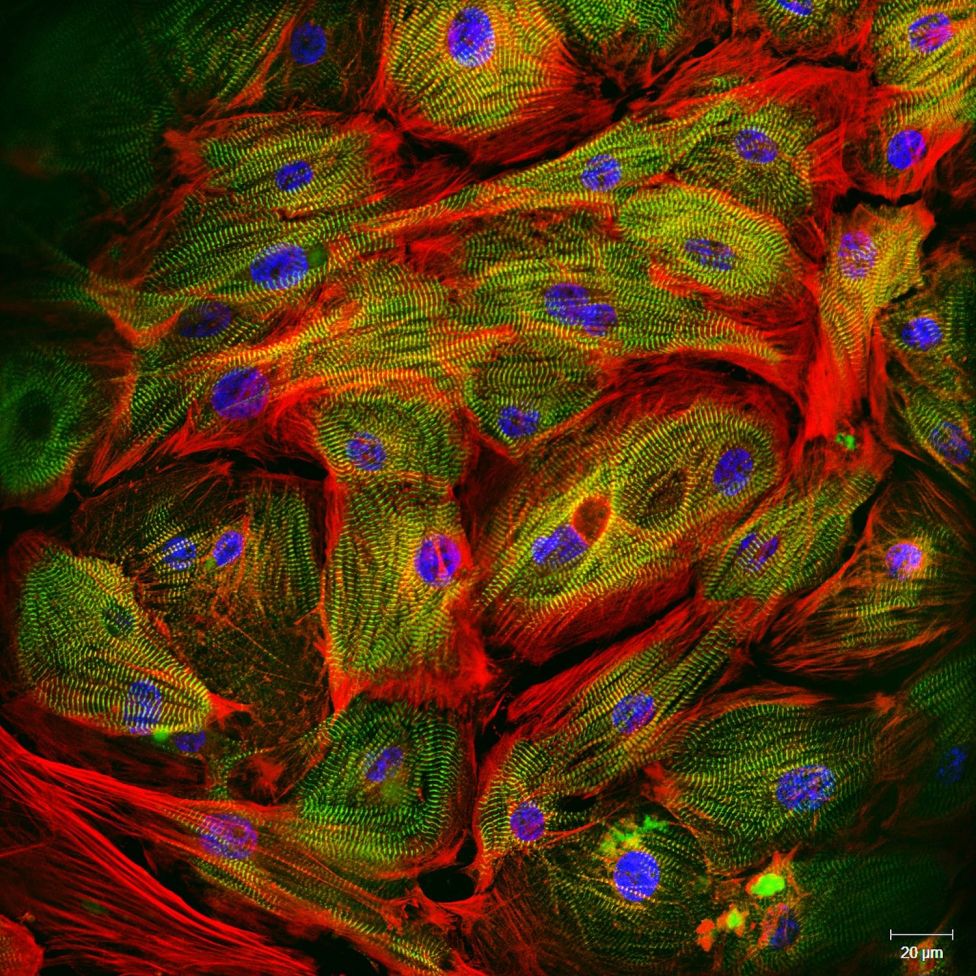
The Washington University team used genome-edited human induced pluripotent stem cells to produce cardiomyocytes carrying a disease-associated CRYAB mutation. The cells were assembled into miniature engineered heart tissues that contract against mechanical resistance.
This mechanical environment proved essential. In ordinary two-dimensional cell cultures, the organization and expression of desmin did not adequately reproduce important features of the human disease. In mechanically loaded engineered tissues, the cells developed more realistic structural organization and displayed abnormal desmin aggregation associated with the mutation.
The researchers also identified disturbances in calcium handling. Calcium signals coordinate the contraction and relaxation of cardiac muscle. Impairment of these signals provides a plausible additional explanation for reduced tissue contraction beyond the physical presence of protein aggregates.
The team tested inhibition of the JAK-STAT signalling pathway, an approach that had shown encouraging effects in earlier rat-cell experiments. In the human engineered tissues, a low dose produced some improvement in contraction, but did not restore normal function. Higher doses were toxic to both healthy and mutant tissues.
This negative therapeutic result is scientifically valuable. It demonstrates why a treatment that appears promising in simplified cell systems may fail when evaluated in a more physiologically realistic model.
The engineered tissue platform could support future investigations into the molecular mechanisms of inherited cardiomyopathy and potentially other forms of heart failure. It is a research model, not an established therapy or diagnostic test.
Analysis
Evidence: Genome-edited human stem-cell-derived heart tissues reproduced abnormal desmin aggregation and calcium-handling disturbances associated with CRYAB-linked cardiomyopathy.
Interpretation: Mechanical forces are not merely background conditions in cardiac experiments. They can determine whether disease mechanisms become visible and whether candidate treatments behave as expected.
Limitations: Engineered microtissues cannot reproduce every feature of a living human heart. The model has not demonstrated a successful disease-specific treatment, and its findings should not be generalized automatically to all cardiomyopathies.
Publication: Peer-reviewed experimental research, Science Advances, November 11, 2026.
04
Blocking AEBP1 Reduces Harmful Cardiac Scarring in Experimental Models
Research into the timing and regulation of fibrosis identifies a possible intervention point, while highlighting why normal tissue repair must be preserved.
Fibrosis is an essential part of the body’s response to injury. Following damage to the heart, fibroblasts produce extracellular matrix components that help stabilize affected tissue. However, excessive or persistent scarring can stiffen the heart and interfere with its ability to pump blood effectively.
Researchers at University of Utah Health have investigated the role of adipocyte enhancer binding protein 1, or AEBP1, in the development of pathological cardiac fibrosis.
The study was originally published in Nature Communications on November 6, 2026, and received a wider institutional research communication on November 12. It combines experiments in mice with observations involving human cardiac tissue.
In a mouse model of heart injury, lowering AEBP1 activity in fibroblasts after a heart attack reduced excessive scarring and preserved cardiac function. The researchers observed improved function four weeks after injury compared with the untreated experimental condition.
Timing was important. When AEBP1 was reduced after heart failure had already progressed, the same improvement in cardiac function was not observed. This distinction suggests that the intervention may be more effective at preventing damaging remodelling than reversing established disease.
The team also investigated the protein in human cardiac samples. AEBP1 gene activity was elevated in hearts from patients with advanced heart failure, and the protein was concentrated around areas of tissue injury.
Manipulating AEBP1 levels in cultured human heart tissue changed aspects of cellular organization and fibrosis. These observations provide supporting biological evidence, although they cannot establish that reducing AEBP1 will improve clinical outcomes in patients.
The study implicates signalling mechanisms involving MRTFB and RUNX2 in the regulation of fibrotic remodelling. Further research will be required to determine which pathways are most suitable for therapeutic targeting.
An important conclusion is that completely suppressing fibrosis would be undesirable. Early scar formation protects injured tissue from structural failure. The therapeutic challenge is to preserve necessary repair while limiting the excessive fibrotic response that contributes to long-term dysfunction.
No AEBP1-targeted treatment has been established for human heart failure on the basis of these experiments. The findings identify a promising mechanism for investigation rather than a clinically validated intervention.

Analysis
Evidence: AEBP1 reduction limited excessive fibrosis and preserved function in an experimental mouse model when intervention occurred during disease development. Human tissue observations supported the biological relevance of the pathway.
Interpretation: Future anti-fibrotic strategies may need to target specific molecular drivers at appropriate stages of cardiac remodelling rather than suppressing scar formation indiscriminately.
Limitations: The functional benefit was demonstrated in mice, not in a human clinical trial. The optimal timing, safety and potential off-target effects of AEBP1 inhibition remain unresolved.
Publication: Peer-reviewed experimental study, Nature Communications, November 6, 2026; institutional communication November 12, 2026.
05
Glass Conducts Heat Differently When Reduced to an Atomic-Scale Contact
Measurements of heat transfer through an extremely narrow glass junction reveal behaviour that conventional descriptions of bulk insulating materials cannot capture.
Glass is generally regarded as a poor conductor of heat. In bulk materials, its disordered atomic structure scatters the vibrations that carry thermal energy, limiting the efficient movement of heat through the material.
Researchers led by Longji Cui at the University of Colorado Boulder have investigated what happens when the dimensions of a glass contact approach the scale of individual atoms. Their findings, reported in Nature Nanotechnology and communicated on November 12, 2026, reveal an unexpected transport regime.
The team used a scanning thermal probe microscope to investigate heat transfer between two glass surfaces. The experimental system allowed the researchers to bring the surfaces into contact and then slowly separate them, narrowing the connection until it approached an atomic-scale junction.
At these extremely small dimensions, the researchers observed discrete changes in thermal conductance. According to the institutional research report, the heat flow occurred in steps corresponding to approximately 40% of the maximum thermal conductance quantum associated with a single transport channel.
This is significant because thermal transport in such narrow contacts is governed by physical conditions different from those found in ordinary glass. When the contact becomes extremely small, the scattering mechanisms associated with the disordered structure of the bulk material no longer operate in the same way.
The results provide evidence for quantized heat transport associated with atomic vibrations, or phonons, through glass contacts. They also illustrate why familiar material properties cannot always be extrapolated directly to nanometre and atomic dimensions.
Thermal management is an increasingly important challenge in electronics. As components become smaller and more densely integrated, controlling heat becomes essential for performance, energy efficiency and device reliability.
Silicon dioxide, a form of glass, is widely used in electronic devices as an insulating material. A better understanding of its atomic-scale thermal behaviour could eventually inform the design of nanoscale electronic and photonic systems.
The experiment does not mean that ordinary glass has become a useful bulk heat conductor. It demonstrates a particular transport phenomenon under highly controlled conditions involving extremely narrow contacts. Translating the finding into practical thermal-management devices will require further engineering.

Analysis
Evidence: Thermal-probe measurements revealed discrete changes in heat conductance through glass contacts narrowed to atomic dimensions.
Interpretation: The physical behaviour of a material at atomic scale can differ fundamentally from its macroscopic properties. Such effects may become increasingly relevant as electronic components continue to shrink.
Limitations: The measurements concern controlled nanoscale junctions rather than practical integrated circuits. No commercial cooling or thermal-management device has been demonstrated. The research communication was examined; access to the complete journal article was restricted.
Publication: Peer-reviewed research in Nature Nanotechnology, reported November 12, 2026.
The RKE Signal
The central theme of today’s edition is that scientific behaviour depends strongly on context, scale and interaction. A white dwarf does not generate observable radio phenomena in isolation from its stellar environment. A climate emulator cannot be judged solely by its performance on familiar emissions scenarios. Heart cells behave differently when subjected to realistic mechanical loading. Fibrotic repair changes from protective to harmful depending on its intensity and timing. Even glass displays unexpected thermal behaviour when its dimensions approach the atomic scale.
The astronomical discovery demonstrates the value of combining different observational methods. Radio timing reveals the motion of a compact stellar object, while polarization measurements provide information about the magnetized environment surrounding its companion. What initially appears to be a repeating radio signal becomes a probe of a complex binary system.
The MIT climate study illustrates a parallel principle in computational science. More realistic training examples are not necessarily more informative. Carefully optimized synthetic scenarios can expose a model to system responses that ordinary training datasets fail to represent. This could improve the reliability and efficiency of scientific machine learning, provided that the underlying physical models remain sound.
The two cardiovascular studies highlight different stages of biomedical discovery. Washington University’s engineered heart tissues provide a more physiologically relevant way to investigate protein aggregation and calcium handling. The University of Utah’s AEBP1 experiments identify a potential mechanism for controlling excessive fibrosis. Both advance understanding, but neither establishes a new treatment for patients.
The nanoscale glass experiment provides a reminder that materials science becomes increasingly counterintuitive at very small dimensions. Properties familiar from everyday experience can change when atomic structure, transport channels and quantum effects become dominant.
These findings also share a methodological lesson: scientific models are most useful when they preserve the mechanisms that matter. Mechanical forces must be included when studying contracting heart tissue. Training scenarios must challenge the limits of an AI emulator. Observational data must distinguish competing explanations for astrophysical signals. Measurements at atomic scale must account for physics that bulk approximations may overlook.
The evidence is at different levels of maturity. The radio discovery rests on astronomical observations and peer-reviewed interpretation. The climate results arise from computational evaluations. The cardiomyopathy work uses engineered human tissues, while the fibrosis study includes mouse experiments and human tissue observations. The glass findings concern highly controlled physical measurements. Their practical implications remain subjects for further investigation.
The RKE Signal for November 13, 2026: progress increasingly depends on reproducing the right interactions at the right scale, whether the system is a distant binary star, an artificial intelligence model, a contracting human heart or a contact only one atom wide.