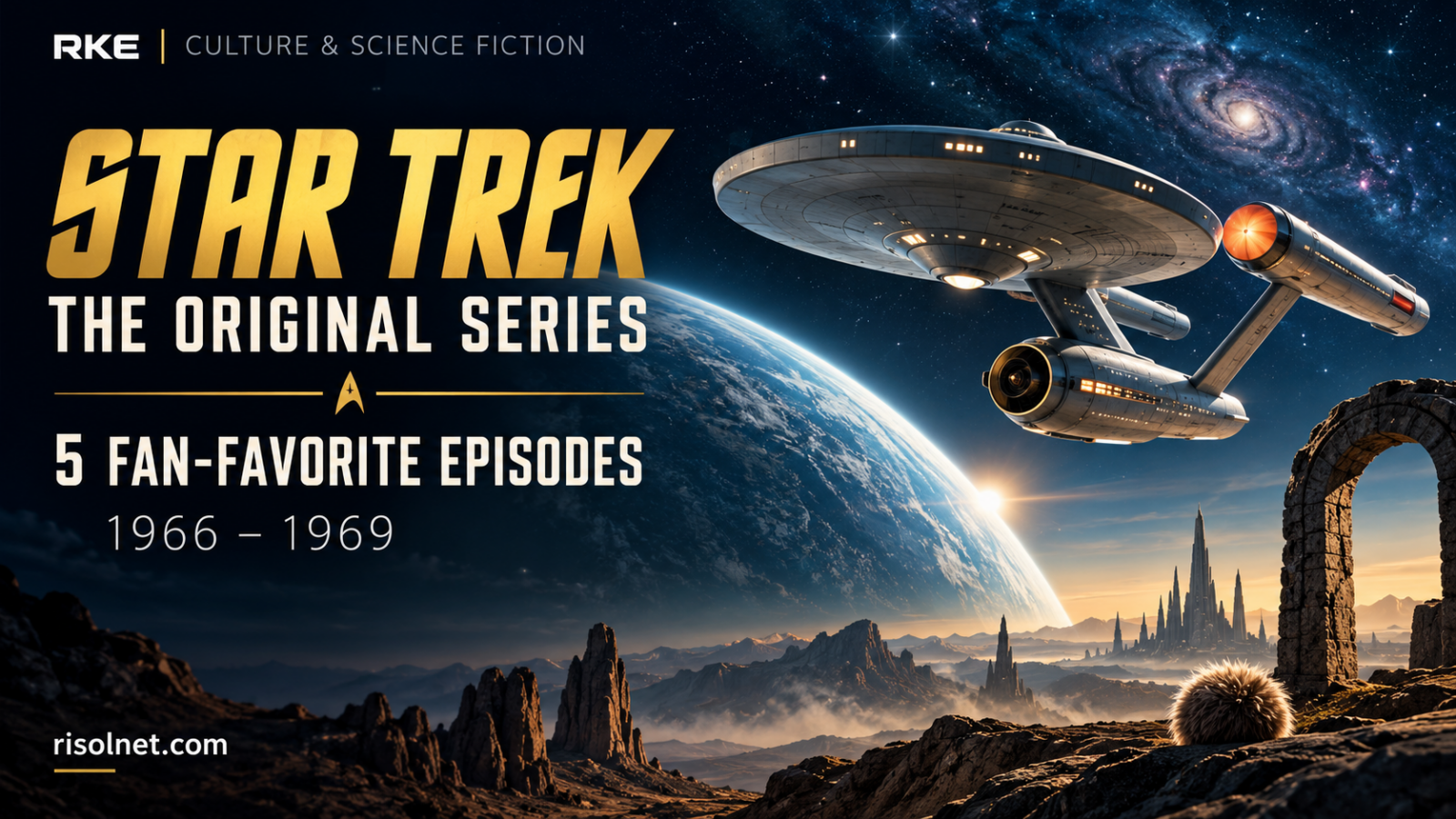
RKE | CULTURE & SCIENCE FICTION
Five Episodes. Sixty Years of Star Trek.
In September 1966, a television series about a starship exploring the galaxy began a journey that would change science fiction forever. Sixty years later, Star Trek: The Original Series remains a cultural landmark, celebrated for its imagination, ethical dilemmas, memorable characters and extraordinary influence on popular culture.
But which episodes do fans love most? We examined historical fan polls, online community rankings and anniversary surveys to identify five stories that repeatedly emerge as enduring favorites. The results reveal something fascinating: Star Trek’s greatest strength was never simply its technology. It was its ability to explore the human condition.
01
The City on the Edge of Forever
Season 1, Episode 28 (1967) — When saving someone you love could destroy the future.
Frequently regarded as the finest achievement of the original series, this remarkable episode transports Captain Kirk and Mr. Spock to Depression-era New York after Dr. McCoy accidentally alters history by passing through the mysterious Guardian of Forever.
Kirk falls in love with Edith Keeler, a compassionate woman whose life becomes entangled with the future of humanity. He eventually confronts an unbearable choice: save the woman he loves or preserve the timeline that allows his own civilization to exist.
The episode combines speculative science, historical consequences and emotional tragedy without allowing any one element to overwhelm the others. Its central dilemma remains remarkably powerful decades later.
Why fans remember it: The story demonstrates that heroic decisions do not always produce happy endings. Sometimes doing the right thing means accepting a devastating personal loss.
02
Mirror, Mirror
Season 2, Episode 4 (1967) — A familiar universe with a terrifyingly different moral compass.
A transporter malfunction sends Kirk, McCoy, Scotty and Uhura into a parallel reality where the peaceful Federation is replaced by a ruthless Terran Empire.
The Enterprise is now a vessel of conquest. Loyalty depends on fear, advancement frequently requires assassination and even familiar officers behave according to brutal principles.
One unforgettable detail is the alternative Spock, complete with his now-iconic beard. But beneath the memorable visual changes lies a serious philosophical question: are civilizations defined by their institutions, their values or the choices of individuals?
Why fans remember it: The episode introduced the Mirror Universe, a concept that later became an important recurring element throughout the Star Trek franchise.
03
Balance of Terror
Season 1, Episode 14 (1966) — Two commanders, two starships and the dangerous logic of war.
When a Romulan warship attacks Federation outposts near the Neutral Zone, the Enterprise enters a tense tactical confrontation that resembles a submarine battle.
Kirk must anticipate the decisions of an intelligent and experienced adversary while avoiding an incident that could ignite a larger conflict. Meanwhile, prejudice emerges aboard his own ship when the Romulans are revealed to resemble Vulcans.
The Romulan commander, portrayed by Mark Lenard, is not presented as a simplistic villain. He is a professional soldier who understands the consequences of his mission and respects the opponent pursuing him.
Why fans remember it: Outstanding suspense and military strategy are combined with a powerful examination of xenophobia, mutual respect and the human cost of conflict.
04
Amok Time
Season 2, Episode 1 (1967) — What happens when logic confronts biology, tradition and friendship?
Spock begins exhibiting behavior radically inconsistent with his normally disciplined personality. The explanation is the pon farr, a Vulcan biological condition that compels him to return to his home planet.
Kirk risks his career to help his first officer, but the visit to Vulcan takes an unexpected turn when local traditions force Kirk and Spock into a potentially deadly confrontation.
The episode introduced audiences to essential aspects of Vulcan culture and gave unprecedented emotional depth to a character previously defined by logic and self-control.
Why fans remember it: At the center of the drama is the friendship between Kirk, Spock and McCoy, arguably the most important relationship in the original series.
05
The Trouble with Tribbles
Season 2, Episode 15 (1967) — The galaxy’s most adorable ecological disaster.
During a mission involving an important agricultural shipment, the Enterprise encounters tribbles: small, furry creatures that appear completely harmless but possess an extraordinary reproductive capacity.
Their rapidly growing population creates chaos aboard the ship and a nearby space station. What initially seems like an amusing inconvenience becomes a problem involving logistics, resource consumption and an unexpected investigation.
The episode succeeds through precise comic timing, clever dialogue and the increasingly frustrated reactions of Captain Kirk. Its humor remains accessible even to audiences unfamiliar with Star Trek.
Why fans remember it: Tribbles became one of the franchise’s most recognizable creations, demonstrating that science fiction can be intelligent, entertaining and genuinely funny.
06
What the Fan Polls Actually Reveal
There is no single definitive ranking of all Original Series episodes. Surveys were conducted at different times, involved different audiences and sometimes asked different questions. Nevertheless, several patterns emerge.
In 2010, an official StarTrek.com competition narrowed eight fan-nominated episodes to two finalists: The City on the Edge of Forever and The Trouble with Tribbles.
A separate StarTrek.com poll published in 2013 asked which Original Series episode would have made the best movie. Mirror, Mirror won with 28% of the vote, followed by The City on the Edge of Forever.
In 2016, a CBS Action audience ranking, reproduced in a contemporary Digital Spy forum discussion, placed The Trouble with Tribbles first, The City on the Edge of Forever second, Balance of Terror third and Mirror, Mirror fourth.
More recently, an August 2026 fan poll conducted by the Inglorious Treksperts podcast ranked episodes across the entire Star Trek franchise. A published fan transcription placed The City on the Edge of Forever first overall, Balance of Terror third, Amok Time sixth, Mirror, Mirror seventh and The Trouble with Tribbles ninth.
A separate September 2026 survey of 13 Star Trek experts published by 13th Dimension produced another revealing result: The City on the Edge of Forever ranked first, Mirror, Mirror second, Balance of Terror third, Amok Time fourth and The Trouble with Tribbles sixth. This was an expert panel, not a general-audience poll.
The five episodes featured in this article form an editorial synthesis of recurring favorites, rather than a statistically calculated aggregate ranking. Survey populations, questions and voting methods are not directly interchangeable.
Analysis | What Makes These Episodes Timeless?
Each episode explores a different aspect of human behavior. The City on the Edge of Forever examines sacrifice; Mirror, Mirror explores morality and power; Balance of Terror confronts prejudice and military escalation; Amok Time examines friendship and identity; and The Trouble with Tribbles demonstrates how humor can transform a science-fiction premise.
Their appeal cannot be reduced to visual effects or technological predictions. These stories endure because their central conflicts remain understandable across generations. The technological setting provides the laboratory; human decisions remain the experiment.
07
Beyond the Top Five
Other episodes repeatedly attract enthusiastic support. The Doomsday Machine is especially appreciated for its tense confrontation with an apparently unstoppable planet-destroying weapon. The Devil in the Dark offers one of the series’ clearest arguments for understanding unfamiliar forms of life rather than fearing them. Space Seed introduced Khan Noonien Singh, whose legacy would continue into the Star Trek films.
Interestingly, the highest-ranking episodes in the surveys examined here are concentrated in the first two seasons. The third season still includes notable stories, but it is less prominent in these particular rankings.
The RKE Signal | Great Science Fiction Is About Humanity
Six decades after its premiere, the original Star Trek continues to resonate not because it predicted every technology correctly, but because it asked questions that remain relevant: What makes a society civilized? Can enemies understand one another? Where does loyalty end and moral responsibility begin?
Spaceships evolve. Visual effects improve. The most compelling questions remain remarkably unchanged. That may be Star Trek’s most important legacy.
Sources & Methodology
StarTrek.com — Best Original Series Episode competition (2010)
StarTrek.com — Which TOS Episode Would Have Made the Best Movie? (2013)
Digital Spy community — CBS Action audience ranking reported in 2016
The Trek BBS — Season One community ratings (2014)
The Trek BBS — Season Two community ratings (2015)
Inglorious Treksperts — Top 60 Episodes fan poll (August 2026)
Community transcription of the 2026 Top 60 results
13th Dimension — 60th Anniversary expert panel (September 2026)
Source review: October 19, 2026. These sources represent selected historical surveys and editorial comparisons, not a census of every fan or a comprehensive statistical meta-analysis.