




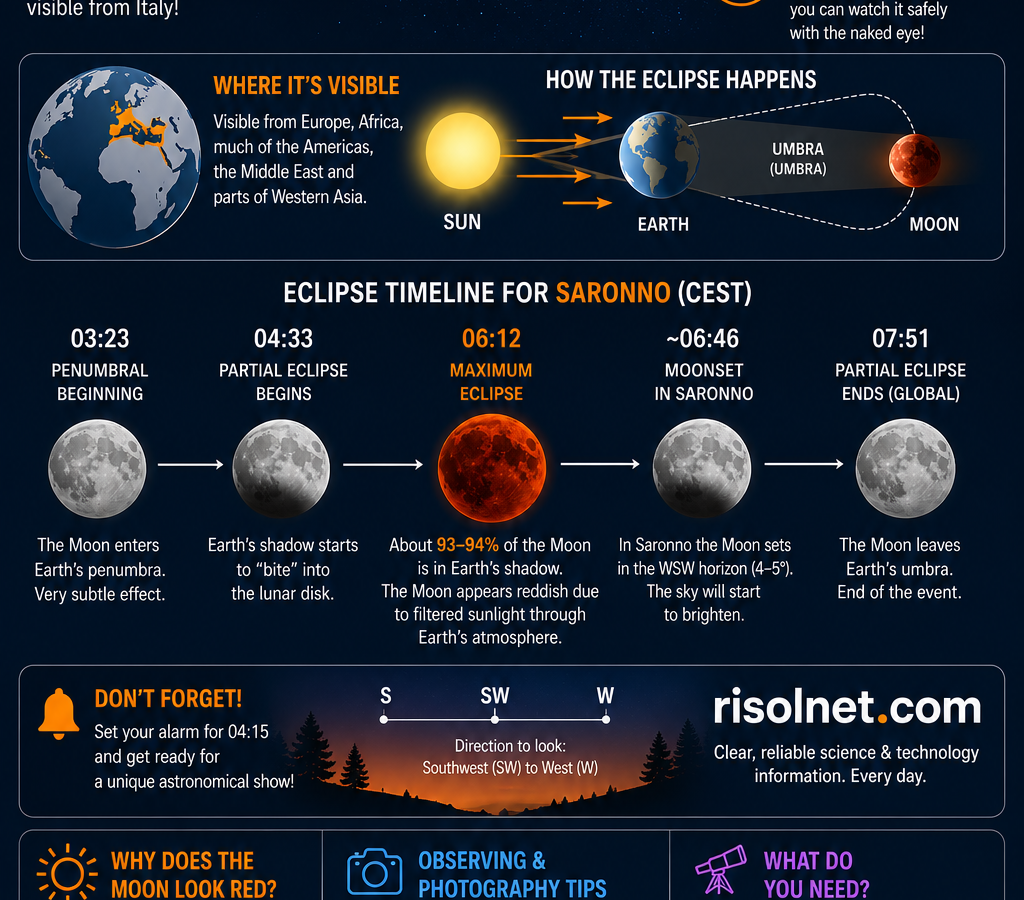
Set the alarm clock. Very early on Friday, August 28, 2026, the Moon will pass deeply into Earth’s shadow, producing one of the most impressive partial lunar eclipses of recent years.
The eclipse will be visible from large parts of Europe, Africa and the Americas. From Northern Italy, however, there is an additional challenge: the Moon will be approaching the western horizon while the eclipse reaches its maximum.
For observers around Saronno, Varese and Milan, the most spectacular part of the event will therefore take place between approximately 04:30 and 06:30 CEST.
Almost — but not quite — a total lunar eclipse
A lunar eclipse occurs when the Sun, Earth and Moon become sufficiently aligned for the Moon to pass through Earth’s shadow.
Earth’s shadow has two main regions: the outer penumbra, where only part of the Sun is obscured by Earth, and the much darker central umbra.
During the August 28 eclipse, the Moon will penetrate very deeply into the umbra without becoming completely immersed in it.
The eclipse will reach a magnitude of approximately 0.93, meaning that the event will look remarkably close to a total lunar eclipse.
Nature, apparently, decided to stop just short of 100%. Even celestial mechanics occasionally seems to enjoy teasing us.
When to watch from Saronno
For observers in the Saronno and Milan area, all times below are local Central European Summer Time (CEST, UTC+2).
- 03:23 — Penumbral eclipse begins
- 04:33 — Partial eclipse begins
- 06:12 — Maximum eclipse
- ~06:46 — Moonset in the Saronno/Milan area
- 07:51 — Partial eclipse ends globally, but the Moon will already be below our horizon
- 09:01 — Penumbral eclipse ends globally
The first penumbral phase at 03:23 will be extremely subtle. The event becomes much more obvious from 04:33, when Earth’s umbra begins to visibly cover the lunar surface.
By 06:12, the eclipse reaches maximum from our location. At that moment the Moon will be only about 4.7 degrees above the West-Southwest horizon.
This is the most important practical detail for local observers: you need a very clear western horizon.
Why can the eclipsed Moon turn red?
Even when the Moon enters Earth’s dark umbral shadow, it does not necessarily disappear.
Some sunlight passes through Earth’s atmosphere before reaching the lunar surface. Shorter blue wavelengths are scattered more efficiently by our atmosphere, while red and orange wavelengths are preferentially transmitted and refracted into Earth’s shadow.
In effect, the light reaching the eclipsed Moon has passed through the combined sunsets and sunrises occurring around the edge of Earth.
This is why the eclipsed portion of the Moon can develop beautiful shades ranging from dark brown and copper to deep red.
The exact colour depends on atmospheric conditions, including clouds, dust and aerosols around our planet.
Where should you look?
At the beginning of the partial phase, the Moon will be toward the Southwest.
As the eclipse progresses, it will move progressively toward the West-Southwest.
At maximum eclipse around 06:12, the Moon will be at an azimuth of roughly 250° and only about 4–5° above the horizon.
A field, lake shore, hilltop or any location with an unobstructed view toward the western horizon will therefore be much better than an urban location surrounded by buildings.
Do I need eclipse glasses?
No.
Unlike a solar eclipse, a lunar eclipse is completely safe to observe with the naked eye.
No solar filters or protective glasses are required. You can safely use binoculars, telephoto lenses and telescopes throughout the entire event.
Photography tips
This eclipse presents an interesting photographic challenge because the Moon will become progressively darker while simultaneously approaching the horizon and the sky begins to brighten before sunrise.
A tripod is strongly recommended, especially during the deeper phases of the eclipse.
If possible, use a remote shutter release or the camera’s timer to avoid vibration.
Do not rely on a single exposure setting throughout the event. The brightness difference between the illuminated portion of the Moon and the deeply eclipsed region can become enormous.
Using exposure bracketing can therefore be particularly useful. Shooting several exposures also makes it possible to create an HDR composite capable of preserving details in both the bright crescent and the dark reddish surface.
And remember that the low altitude can actually become a creative advantage: trees, buildings or a distant landscape can provide scale and produce a much more dramatic composition than an isolated Moon against a black sky.
The best observing window
For observers around Saronno, I would recommend being ready by approximately 04:15.
The partial phase begins at 04:33, while the period between roughly 05:15 and 06:15 should provide the most visually impressive views.
After 06:12, things become increasingly difficult because the Moon will be extremely low and the morning twilight will rapidly brighten the sky.
The Moon will finally disappear below the local horizon at approximately 06:46, meaning that Northern Italy will not see the end of the partial phase.
A beautiful demonstration of celestial geometry
A lunar eclipse is one of the simplest astronomical phenomena to observe, but it is also one of the most elegant demonstrations of celestial mechanics available to us.
We are literally watching the shadow of our own planet travel across another world almost 384,000 kilometres away.
And unlike many astronomical events requiring dark skies, expensive instruments or considerable patience, this one requires little more than a clear western horizon and a willingness to wake up at an hour normally reserved for bakers, airport departures and questionable life decisions.
Alarm set for 04:15. Camera ready. See you under the Moon. 🌑🔭📷
Sources & Further Information
-
NASA Science — Future Eclipses
-
NASA Scientific Visualization Studio — August 27–28, 2026 Deep Partial Lunar Eclipse
-
NASA Goddard Space Flight Center — Eclipses During 2026
-
Timeanddate — August 28, 2026 Partial Lunar Eclipse in Milan
Risolnet Science & Technology — August 27, 2026