




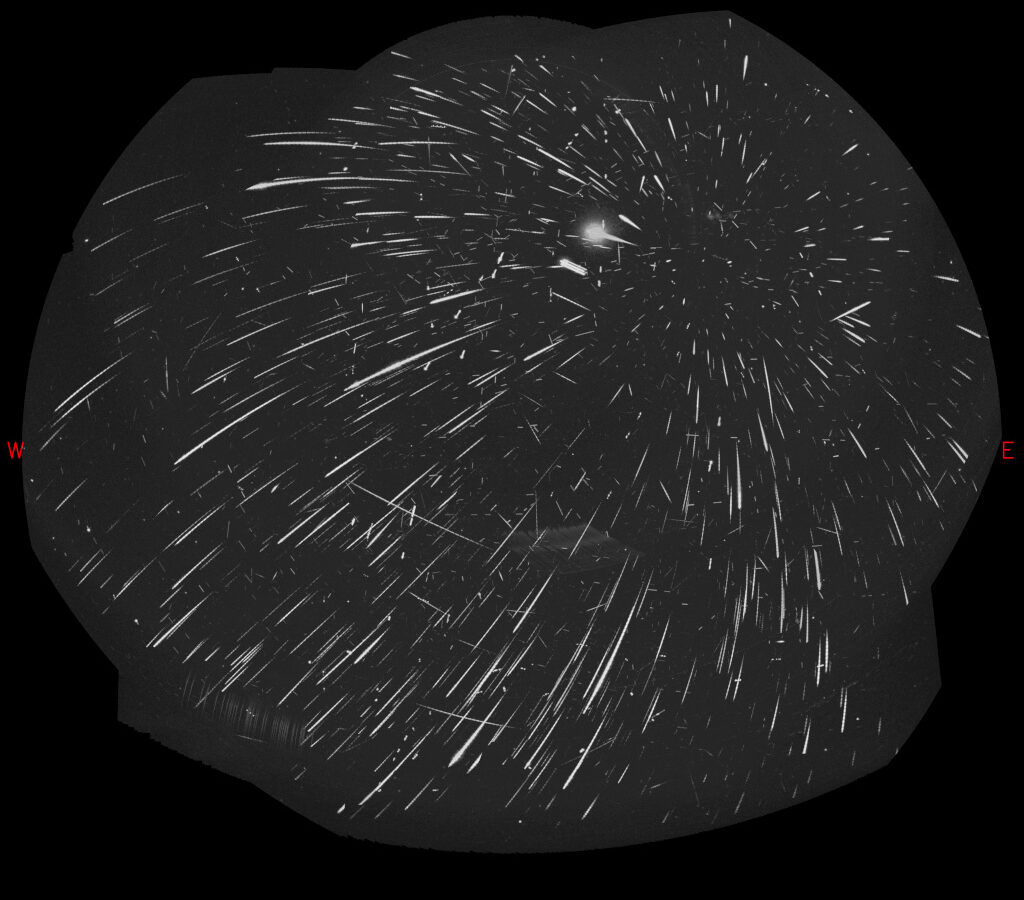
How many meteors can cross the sky in a single night? During the 2026 Perseid meteor shower, an observatory in the Czech Republic recorded a rather impressive answer: 1,706.
The image selected by NASA as the Astronomy Picture of the Day for August 22, 2026, is the result of observations collected by four dedicated meteor-monitoring cameras during the night of August 12–13, close to the peak of the Perseid meteor shower.
A Night of 1,706 Meteors
The images collected throughout the night were aligned and combined to create a spectacular all-sky view.
The result shows not only an extraordinary number of meteors, but also their apparent direction of origin in the sky.
The vast majority of the recorded trails belong to the Perseids. If their paths are extended backwards, they appear to converge toward a single point in the constellation Perseus: the so-called radiant.
Of course, the particles are not actually coming from the constellation Perseus. They travel along almost parallel trajectories, and their apparent convergence is simply a perspective effect, similar to railway tracks appearing to meet in the distance.
They Were Not All Perseids
The large amount of data collected also makes it possible to distinguish meteors belonging to much less active showers.
The image includes several Kappa Cygnids, whose radiant lies in the constellation Cygnus, as well as meteors associated with the broader antihelion source, a diffuse region of meteor activity located roughly opposite the Sun in the sky.
This is what makes the observation scientifically interesting: what we casually describe as a sky full of “shooting stars” becomes, through automated monitoring systems, a genuine astronomical dataset.
Where Do the Perseids Come From?
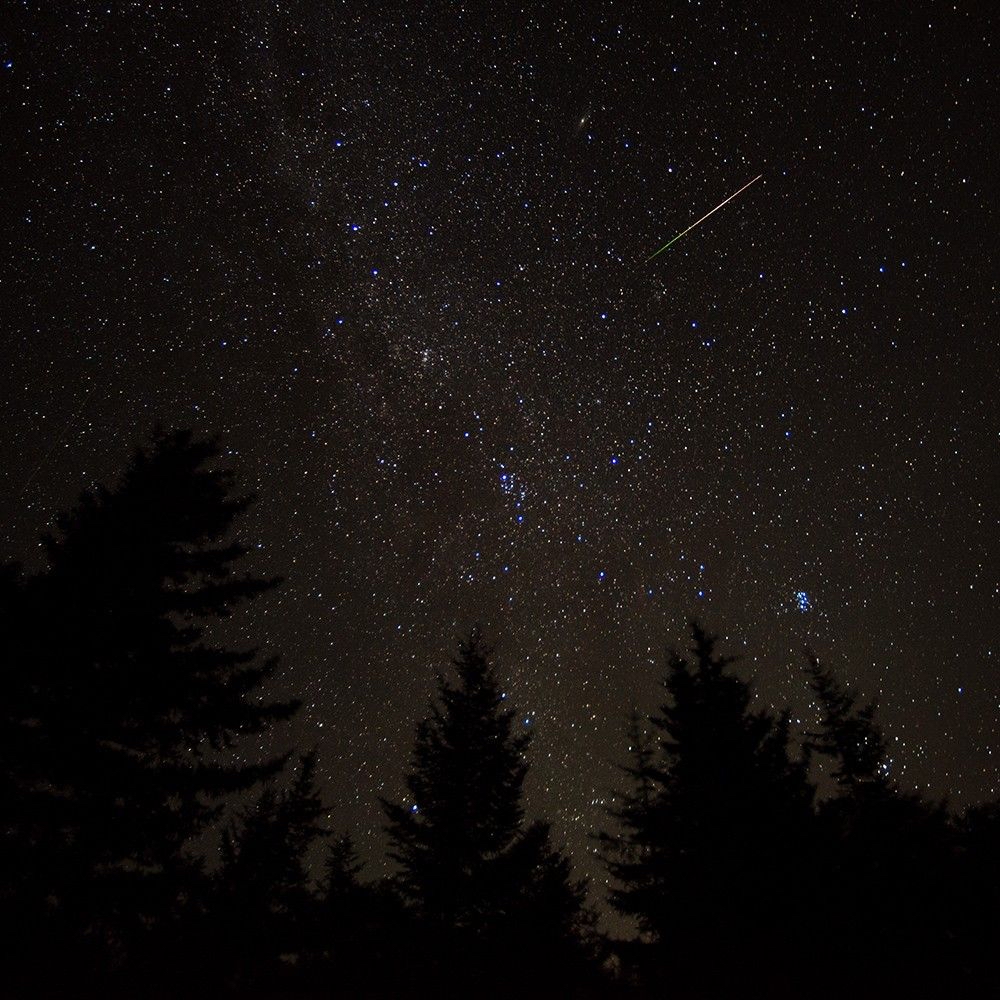
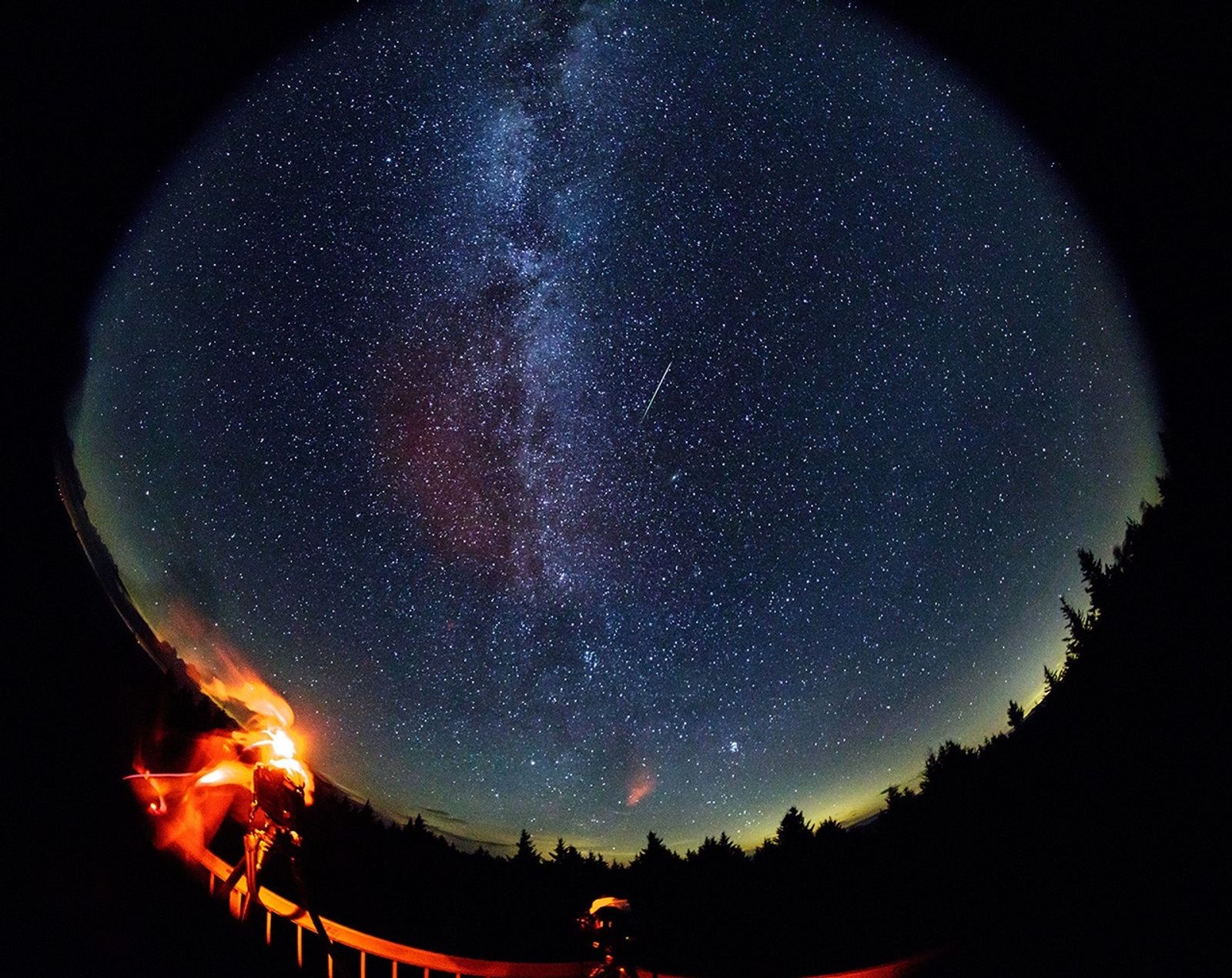
The Perseid meteor shower is produced by small fragments of material left along the orbit of the periodic comet 109P/Swift-Tuttle.
Every year, Earth passes through this stream of cometary debris, and the particles enter our atmosphere at speeds of approximately 59 kilometres per second.
The intense compression and heating of the atmosphere around these particles produces the brief luminous trails we observe from the ground.
Most of the particles are extremely small. In other words, one of the most popular astronomical spectacles of the year does not require giant asteroids: tiny grains of cometary material travelling through the atmosphere at roughly 212,000 kilometres per hour are more than enough.
The Universe can be surprisingly efficient when it wants to be.
Why the 2026 Perseids Were Particularly Interesting
The 2026 Perseid maximum occurred under exceptionally favourable observing conditions because the Moon produced almost no significant light pollution during the peak nights.
This allowed both observers and automated cameras to detect many relatively faint meteors that would otherwise have been washed out by moonlight.
The Perseids remain active until approximately August 24, 2026, although the meteor rate gradually decreases after the peak.
The figure of 1,706 meteors recorded during a single night remains a striking reminder of what is continuously happening above our heads: Earth moves through a cloud of microscopic debris left behind by a comet, and for a few hours our atmosphere transforms cosmic dust into light.
🔭 The Original 1,706-Meteor Image
The spectacular original composite was selected as NASA’s Astronomy Picture of the Day for August 22, 2026.
The image is copyrighted and credited to Jakub Koukal – Valašské Meziříčí Observatory, so it is better to link directly to the original NASA APOD page rather than reproduce it without permission.
👉
View “Mostly Perseids” on the official NASA APOD website
Sources
NASA Astronomy Picture of the Day – Mostly Perseids, August 22, 2026
NASA Science – Perseids Meteor Shower
NASA – Perseids Meteor Shower, August 13, 2026
NASA Science – Prepare for Perseids
Risolnet Science & Technology – August 22, 2026