Falcon 9 Hits the Moon: SpaceX Has Just Added Another Crater to the Solar System
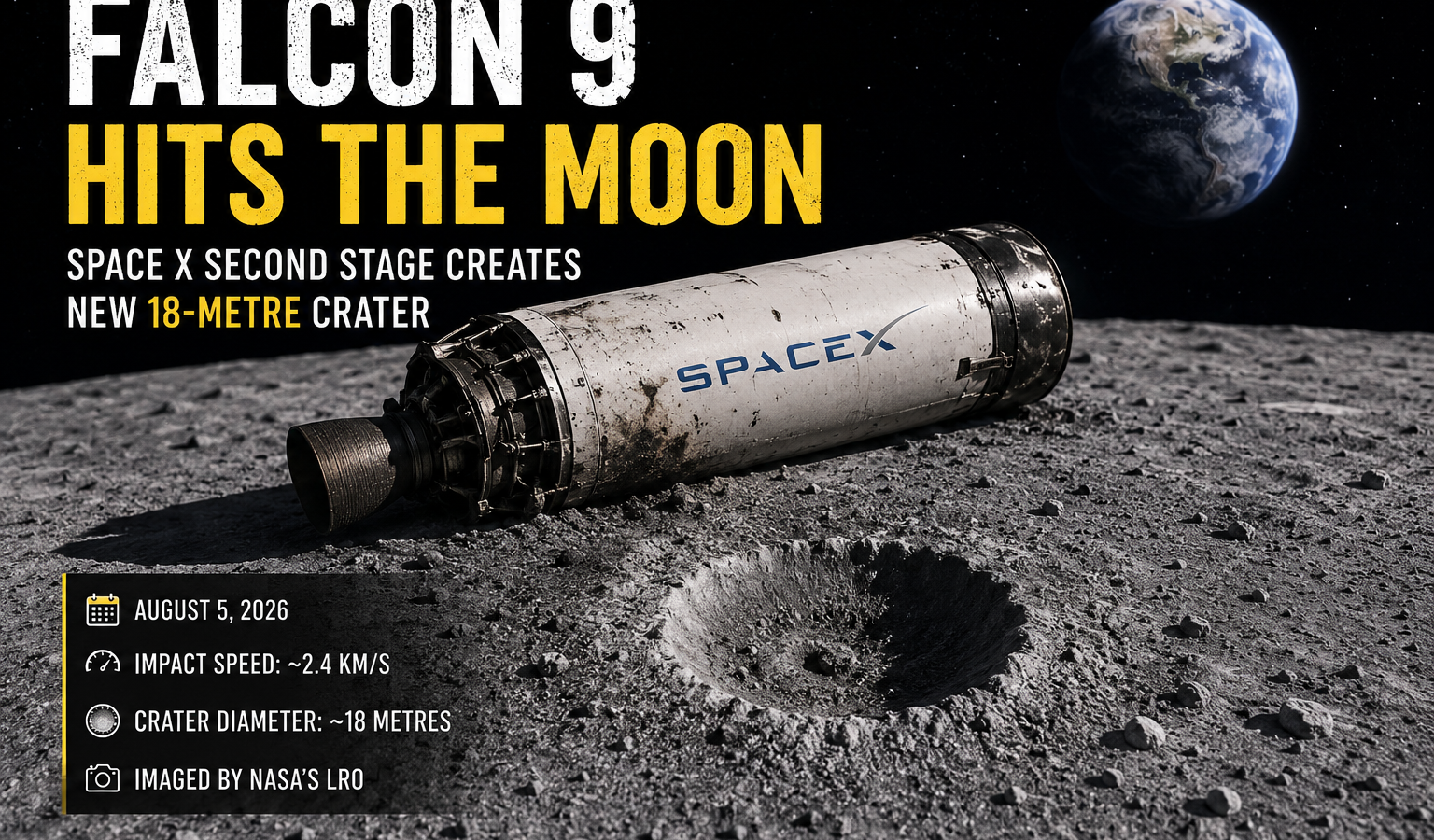
A SpaceX Falcon 9 upper stage slammed into the lunar surface at roughly 2.4 km/s. NASA has now photographed the result: a new crater about 18 metres wide. No lunar residents have reportedly filed a complaint.
On August 5, 2026, the Moon received a visitor that was not exactly part of the official tourism programme: the spent upper stage of a SpaceX Falcon 9.
The object, identified as 2025-010D, had a mass of roughly four tonnes and was travelling at around 2.4 km/s, equivalent to more than 8,600 km/h.
The outcome of this encounter between aerospace engineering and lunar geology was fairly predictable.
The Moon won.
Where did the Falcon 9 come from?
The upper stage belonged to the mission launched on January 15, 2025, nicknamed Ghost Riders in the Sky, which sent two commercial landers towards the Moon: Firefly Aerospace’s Blue Ghost Mission 1 and the Japanese ispace Hakuto-R Mission 2 / Resilience lander.
After completing its job, the Falcon 9 upper stage remained in a highly elliptical Earth orbit extending into the lunar region.
And this is where one of the fundamental lessons of orbital mechanics comes into play:
in space, there is no real equivalent of “just leave it there.”
For more than a year, the object continued travelling through space while being affected by the gravitational perturbations of the Earth, Moon and Sun, as well as solar radiation pressure.
Eventually, orbital dynamics presented the bill.
Final destination: the Moon.
The August 5 impact
Astronomers had predicted the collision with remarkable precision.
The Falcon 9 stage was expected to strike the lunar surface on August 5, 2026, at approximately 06:35 UTC, in a region between the Bell and Einstein craters.
Its predicted impact velocity was approximately 2.4 km/s, more than seven times the speed of sound in Earth’s atmosphere.
Naturally, there is no atmosphere on the Moon, so there was no sonic boom.
Just a Falcon 9 suddenly encountering something that, unlike space, had absolutely no intention of moving out of the way.
NASA found the crater
The scientifically interesting part came a few days later.
NASA’s Lunar Reconnaissance Orbiter (LRO) photographed the impact area using its high-resolution Narrow Angle Camera.
By comparing observations obtained before and after the event, scientists identified a newly formed crater approximately 18 metres, or 60 feet, across and less than 3 metres deep.
Characteristic rays of ejecta are visible around the impact site.
Some appear darker, while others are brighter.
The difference provides useful information about the lunar regolith. Surface material has been modified over millions of years through exposure to solar wind, cosmic radiation and micrometeorite impacts, while material excavated from deeper layers is relatively fresh.
The impact therefore acted, unintentionally, like an enormous geological shovel.
A somewhat aggressive sampling technique, admittedly, but an effective one.
Danuri helped locate the impact
Locating the crater also became a useful example of international scientific cooperation.
South Korea’s Danuri spacecraft, also known as the Korea Pathfinder Lunar Orbiter, provided observations that helped refine the position of the impact site.
These coordinates helped NASA’s Lunar Reconnaissance Orbiter team target subsequent high-resolution observations.
The result is something scientists particularly appreciate:
actual before-and-after images.
This was not a planned impact
One important detail: SpaceX did not deliberately send the Falcon 9 stage into the Moon.
This was therefore very different from a scientific experiment such as NASA’s LCROSS mission, which deliberately crashed a Centaur upper stage into Cabeus crater in 2009 to analyse the material thrown into space and search for evidence of water.
The Falcon 9 stage had simply become an uncontrolled object in cislunar space.
And that makes the episode scientifically interesting for another reason.
The emerging problem of cislunar debris
For decades, discussions about space debris have mainly focused on Earth orbit: dead satellites, discarded rocket stages and fragments travelling around our planet at enormous velocities.
But as lunar exploration increases, another category is becoming increasingly relevant:
Cislunar debris
Objects left in very high Earth orbits or on trajectories extending towards the Moon can remain in space for years, following surprisingly complex orbital evolutions.
Today, a Falcon 9 stage crashing into an uninhabited part of the Moon is primarily an interesting natural experiment in impact physics.
Tomorrow, things may be different.
With lunar exploration programmes, commercial landers, rovers, scientific infrastructure and eventually permanent surface installations, accurately tracking artificial objects travelling through the Earth-Moon system will become increasingly important.
Finding a new crater near Einstein is one thing.
Discovering that the next one has appeared next to a future lunar base would be rather less amusing.
An accidental scientific experiment
Paradoxically, the incident also provides scientists with a useful opportunity.
We know reasonably well the mass, structure and origin of the object responsible for the crater.
Researchers can therefore compare these properties with:
- impact velocity;
- crater dimensions;
- ejecta distribution;
- characteristics of the lunar terrain.
These observations can help refine models used to understand craters produced by natural impacts.
Before the collision, astronomers had also studied 2025-010D through photometric and spectroscopic observations, determining several of its physical and dynamical characteristics.
In other words, we observed an artificial object, reconstructed its trajectory, characterised it from Earth, predicted where it would crash and finally photographed the crater produced by the impact.
Not bad for something that was, technically speaking, space junk.
The cosmic moral of the story
The Moon has been bombarded by asteroids and meteoroids for roughly four and a half billion years.
One metal cylinder built in California is unlikely to ruin its day.
For us, however, the event offers a small preview of a problem that is likely to become increasingly important.
Humanity is beginning to establish a growing presence not only around Earth, but throughout the space between Earth and the Moon.
And, as often happens when humans arrive somewhere, traffic, abandoned hardware and parking problems soon follow.
This time, the Falcon 9 merely added another crater to the Moon, roughly 18 metres across.
Free of charge.
Because apparently our natural satellite did not have enough of them already.
Sources
-
NASA –
NASA Will Attempt to Observe Rocket Part’s Lunar Impact
, August 4, 2026. -
Benjamin Fernando et al. –
Observational planning for the 2026 August 5 Falcon 9 Upper Stage lunar impact
, arXiv, July 2026. -
Tanner Campbell et al. –
Physical Characterization of Moon Impactor 2025-010D
, arXiv, August 2026. -
William Jo et al. –
Predicted Ejecta Dynamics and Observability of the 2026 Falcon 9 Upper Stage Lunar Impact
, arXiv, July 2026. - NASA Lunar Reconnaissance Orbiter – observations of the newly formed Falcon 9 impact crater, August 2026.