




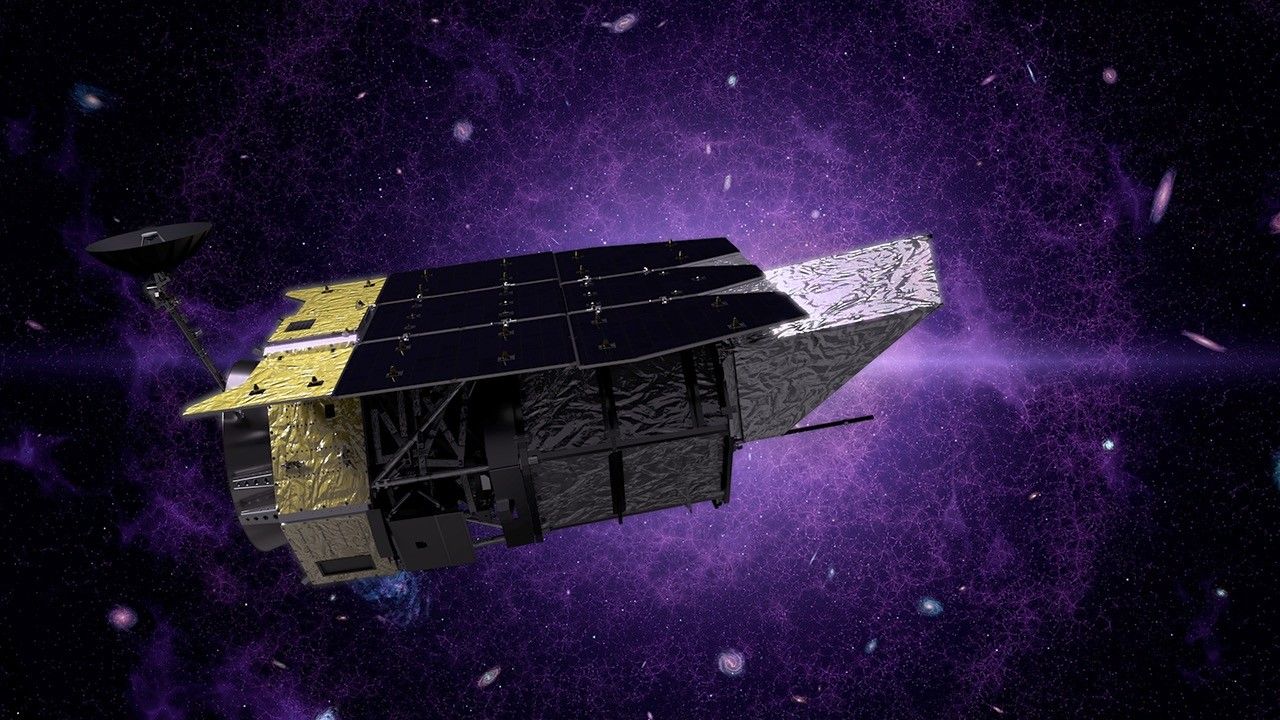
Roman Space Telescope: NASA’s new big eye on the Universe
The space telescope, designed to study dark energy, dark matter, and exoplanets with a field of view at least 100 times greater than that of Hubble, will launch on August 30th.
NASA’s next great space observatory is now ready to leave Earth. The Nancy Grace Roman Space Telescope, or more simply Roman Space Telescope, is one of the most ambitious astronomical missions of recent years and is scheduled for launch on August 30, 2026, aboard a SpaceX Falcon Heavy from Launch Complex 39A at Kennedy Space Center, Florida.
Roman was born with a far from modest goal: to help answer some of the fundamental questions of modern cosmology. Why is the expansion of the Universe accelerating? How is dark matter distributed? How common are planetary systems similar to our own?
A panoramic-view telescope
Roman has a primary mirror 2.4 meters in diameter, practically the same size as the Hubble Space Telescope.
The big difference, however, is in the way it will observe the sky.
Its main scientific instrument, the Wide Field Instrument (WFI), uses a sensor of about 300 megapixels and has a field of view of at least 100 times larger than Hubble’s.
Intuitively speaking, a single Roman observation will be able to capture an amount of sky that would require about a hundred Hubble images to cover with a comparable level of detail.
Roman will therefore be a sort of “panoramic Hubble”: instead of focusing primarily on extremely narrow portions of the sky, it will be able to perform enormous astronomical surveys while maintaining high resolution.
NASA estimates that Roman will be able to observe the sky up to 1,000 times faster than Hubble, while maintaining comparable sensitivity and infrared resolution.
A billion galaxies to understand dark energy
One of the mission’s main objectives will be the study ofdark energy, the mysterious phenomenon that appears to be responsible for the accelerating expansion of the Universe.
During his mission, Roman could measure the light coming from approximately a billion galaxies.
By analyzing their distribution, distance, and evolution over cosmic time, astronomers will be able to reconstruct the structure of the Universe on a very large scale with enormous precision.
These data will also allow us to indirectly study the distribution of dark matter, which neither emits nor absorbs light but manifests its presence through the gravitational effects it exerts on visible matter and the propagation of light.
The result will essentially be a gigantic three-dimensional map of the Universe.
A gigantic hunt for exoplanets
Roman will also play a fundamental role in the search for planets orbiting other stars.
One of the techniques used will be gravitational microlensing .
When a star passes almost perfectly in front of another much more distant star, the gravity of the foreground object can act like a lens, temporarily amplifying the light from the background source. The presence of a planet around the lensing star produces a small but measurable alteration of the phenomenon.
Thanks to a dedicated survey of the inner regions of the Milky Way, Roman is expected to discover over 1,000 exoplanets using this technique. over 1,000 exoplanets using this technique.
Scientific value will not be just the number of discoveries.
Roman will in fact allow you to create a real Statistical census of planetary systems in our Galaxy, helping us understand which types of planets are most common and whether the architecture of the Solar System is typical or exceptional.
Directly photographing other worlds
Roman will also carry the Coronagraph Instrument, a demonstration instrument designed to block the light from a star and make vastly fainter objects in its immediate vicinity observable.
In practice, the principle is conceptually simple: artificially dim the star to try to directly see the planets orbiting it.
Technically, of course, it’s anything but simple.
The difference in brightness between a star and a planet can be enormous, and even an infinitesimal amount of residual starlight is enough to completely hide the planet.
Roman’s coronagraph will then test high-contrast imaging and spectroscopy technologies. high-contrast imaging and spectroscopy which could become fundamental for future generations of telescopes designed to directly image Earth-like worlds.
NASA aims to obtain images of planets and circumstellar disks around nearby stars with levels of detail up to a thousand times better than currently available .
Destination L2
After launch, Roman will not enter Earth orbit.
Its destination will be the Sun-Earth Lagrangian point L2, located approximately , 1.5 million kilometers from Earth, in the opposite direction from the Sun.
This is the same region of space used by the James Webb Space Telescope.
From this position, Roman will be able to keep the Sun, Earth, and Moon essentially on the same side of the spacecraft, facilitating radiation shielding and allowing the instruments to operate at the low temperatures necessary for infrared observations.
Why is it called Nancy Grace Roman?
The telescope is named after the American astronomer Nancy Grace Roman, NASA’s first Chief of Astronomy and a key figure in the development of American space astronomy.
Her work was also instrumental in supporting the project that would later become the Hubble Space Telescope, so much so that she was nicknamed “Hubble’s mother.”
The choice of name is therefore particularly appropriate: the new telescope will ideally carry on part of Hubble’s scientific legacy, but will apply it on a vastly larger scale.
Roman, Hubble, and Webb: three different telescopes
Roman is not intended to replace either Hubble or James Webb.
The three observatories have complementary characteristics.
Hubble excels at very high-resolution observations of relatively small regions of the sky.
James Webb specializes primarily in extremely deep infrared observations, allowing the study of very faint and distant objects.
Roman, however, will add something that was missing: the ability to combine high sensitivity and resolution with an enormous field of view.
If Webb can observe a small fragment of the Universe in depth, Roman will be able to build a large map in which to identify the most interesting objects to study in detail.
A new era for astronomical surveys
Roman’s primary mission is scheduled for five years, with the possibility of an extension for another five years. five years
But the mission’s most important legacy will likely be the amount of data produced.
Observing huge portions of the sky with this combination of sensitivity, resolution, and speed means creating archives that could hide phenomena we don’t even know we need to look for today.
And this is perhaps the most scientifically fascinating aspect of the Roman Space Telescope.
Astronomers already know the big questions they want to address: dark energy, dark matter, galaxy formation, and exoplanets.
But the history of astronomy teaches us that when we build an instrument capable of observing the Universe in a completely new way, the most important discoveries are often precisely those that no one had predicted.
So, on August 30th, not just another space telescope will be launched.
One of the most powerful machines ever built will be launched to map the Universe on a cosmic scale.