




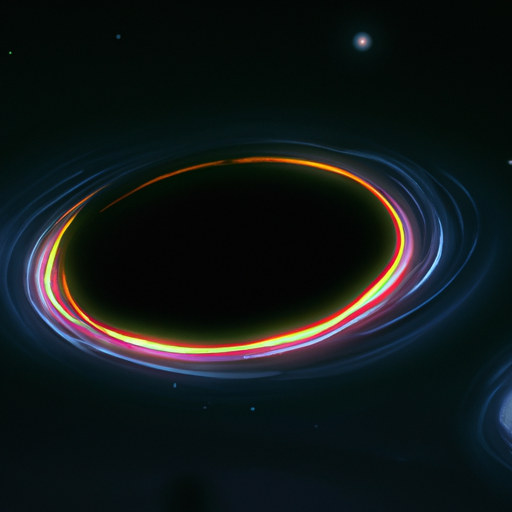
The Formation and Evolution of Black Holes
Scientists have long sought to understand the mysteries of black holes and their role in the universe. These cosmic entities have been the subject of study and speculation for decades, but only recently have we begun to make significant progress in understanding their formation and evolution.
Black holes form when a massive star exhausts its nuclear fuel and collapses. This collapse creates a region of space-time so dense that nothing, not even light, can escape its gravity. This region is what we call a black hole. A black hole can form in several ways. One of the most common processes is a supernova, in which a massive star explodes at the end of its life. During this explosion, the star’s core collapses, forming a black hole. This type of black hole is called a stellar black hole.
Another way black holes can form is through the merger of two neutron stars. Neutron stars are the dense remnants left after a massive star explodes in a supernova. When two of these neutron stars get close enough, their gravity can cause them to merge, forming a black hole.
Once formed, black holes can grow by absorbing surrounding matter. This process is known as accretion. As matter approaches the black hole, it is accelerated to incredible speeds and heated to extreme temperatures. This releases a large amount of energy, which can be observed as electromagnetic radiation.
Black holes can also interact with other stars and objects in their environment. For example, a black hole can capture a nearby star and tear it apart with its gravity. This process is known as stellar disintegration. During stellar disintegration, the star’s matter is swallowed by the black hole, releasing a large amount of energy.
Black hole merging is another interesting phenomenon that can occur in the universe. When two black holes get close enough, their gravity can cause them to merge, forming an even larger black hole. This process was first observed in 2015, when researchers detected gravitational waves produced by the merger of two black holes.
The formation and evolution of black holes are important to our understanding of the universe. These cosmic entities can influence the evolution of galaxies and the fate of stars. Furthermore, black holes are also important to our understanding of gravity and Einstein’s general relativity. Despite the progress we’ve made in understanding black holes, there are still many mysteries to be solved. For example, we still don’t know what happens inside a black hole or what happens to everything that gets swallowed by its gravity. These are active research topics for scientists around the world.
In conclusion, the formation and evolution of black holes are fascinating topics that continue to challenge scientists. Despite the progress we’ve made, there are still many mysteries to be solved. However, through observation and research, we hope to unlock the secrets of these enigmatic cosmic objects and better understand the role they play in the universe.
Unraveling the Secrets of Black Hole Singularities
Scientists have long sought to unravel the mysteries of black holes and their role in the universe. One of the most fascinating aspects of these celestial objects is their singularity, a region of infinite density at the center of the black hole. In this section, we will explore the secrets of black hole singularities and how scientists are trying to understand them.
Black hole singularities were predicted by Einstein’s general theory of relativity. According to this theory, when a massive star collapses in on itself due to gravity, it can form a black hole. At the center of a black hole lies a singularity, a region where the density and curvature of space-time become infinite.
However, the theory of general relativity cannot explain exactly what happens inside a singularity. To better understand these phenomena, scientists have turned to string theory and quantum gravity. These theories attempt to unify general relativity with quantum mechanics, which describes the behavior of subatomic particles. According to string theory, fundamental particles are not points, but small vibrating strings. These strings can take on different shapes and configurations, determining the properties of the particles we observe. Quantum gravity, on the other hand, attempts to describe gravity in terms of particles called gravitons.
However, string theory and quantum gravity have not yet been fully developed and tested experimentally. Therefore, scientists rely on theoretical models and computer simulations to study black hole singularities.
One of the most accepted hypotheses is that within a singularity, the laws of physics break. The equations describing the behavior of particles and forces may no longer be valid under these extreme conditions. This could lead to new, as yet unknown, physics that could explain the phenomena within black hole singularities. Scientists are also trying to understand whether black hole singularities are stable or can evolve over time. Some theories suggest that singularities could be unstable and could collapse on themselves, forming a new universe. This idea is known as the “Big Bounce” and could explain the origin of our universe.
To study black hole singularities, scientists use complex mathematical models and computer simulations. These tools allow them to explore the properties of singularities and test theories of quantum gravity and string theory.
Despite the progress made so far, understanding black hole singularities remains a puzzle. Scientists continue to search for new ways to study these mysterious objects and hope that in the future they will be able to unravel the secrets of singularities and their role in the universe.
In conclusion, black hole singularities are one of the most fascinating and complex questions in modern physics. Scientists are trying to understand these regions of infinite density using theories such as quantum gravity and string theory. Despite the progress made so far, many questions remain unanswered. However, with further research and theoretical development, scientists hope to unlock the secrets of black hole singularities and shed new light on the workings of the universe.
The influence of black holes on the formation and evolution of galaxies
Scientists have long sought to understand the mysteries of black holes and their role in the universe. One of the most fascinating aspects is the influence black holes have on the formation and evolution of galaxies.
Black holes are regions of space where gravity is so intense that nothing, including light, can escape their pull. This characteristic makes them extremely difficult to study directly, but scientists have managed to collect a vast amount of indirect data suggesting their impact on surrounding galaxies.
One way black holes influence galaxy formation is through their effect on surrounding gas and dust. When a galaxy approaches a supermassive black hole, its gas and dust can be attracted and swallowed by the black hole. This process, known as black hole accretion, can generate a large amount of energy in the form of electromagnetic radiation.
This radiation can affect the surrounding gas and dust, heating them and causing the formation of new stars. Furthermore, the energy released by the black hole can also push gas and dust away from the galaxy, influencing its structure and evolution over time.
Another way black holes can influence galaxies is through their jets of matter. Some supermassive black holes are surrounded by disks of material rotating around them. This material can be accelerated to near the speed of light and blasted into space in the form of jets of high-energy particles.
These jets can interact with the surrounding gas and dust, compressing them and causing the formation of new stars. Furthermore, the jets can also influence the formation of nearby galaxies, providing them with energy and matter to fuel star formation. In addition to directly influencing star formation processes, black holes can also influence the evolution of galaxies through their gravity. The presence of a supermassive black hole at the center of a galaxy can influence the motion of stars and other masses within the galaxy.
This can lead to the formation of structures such as spiral arms in spiral galaxies or stellar nuclei in elliptical galaxies. Furthermore, black hole gravity can also influence the interaction between galaxies, leading to the merging of two or more galaxies into a single larger one.
In conclusion, black holes play a fundamental role in the formation and evolution of galaxies. Through their accretion, jets of matter, and their gravity, black holes can influence the gas, dust, and stars within galaxies, shaping their structure and evolution over time. Despite their mysterious nature, scientists continue to investigate black holes and seek to fully understand their role in the universe. Through observations and computer simulations, they hope to uncover further details about these fascinating objects and their influence on the galaxies around them.